Styles
Blackout roman shades: how to choose, measure and fit them for a truly dark room

Blackout roman shades are one of the best ways to darken a room while keeping a soft, tailored look. They're made from fabric, like curtains, but they raise and lower in neat horizontal folds, like a blind. Add a blackout lining and you get a window covering that blocks light for sleep, cuts glare on screens, keeps heat out in summer and looks smart all day.
They are also one of the most misunderstood products. Many shades sold as "blackout" still let light in around the edges, through stitching holes or along the top, so a room ends up dim rather than dark. This guide explains how blackout roman shades are made, which styles block the most light, how to choose fabric and lining, inside vs. outside mounting, how to measure, cord safety, layering with curtains, making your own, and how to look after them.
For a broader look at darkening a room, see our blackout curtains guide, and for how roman shades compare with other window coverings, read curtains vs. drapes vs. blinds vs. shades.
What is a blackout roman shade?
A roman shade (called a roman blind in the UK) is a flat panel of fabric that covers the window when lowered. When you raise it, cords running through rings on the back pull the fabric up into a stack of folds at the top. Thin rods or battens sewn into pockets on the back keep the folds straight and even.
A blackout roman shade has a lining (or a coating on the fabric) that stops light passing through. With the right style and fitting, it can make a room very dark even in bright sunshine.
Blackout vs. room-darkening
- Blackout shades use an opaque lining that blocks almost all light through the fabric.
- Room-darkening shades use a thicker lining or dense fabric that reduces light a lot but lets a soft glow through.
- Light-filtering shades soften and diffuse light but don't darken.
If you need to sleep in daylight, run a home cinema or settle a baby for naps, choose true blackout.
How blackout roman shades are made
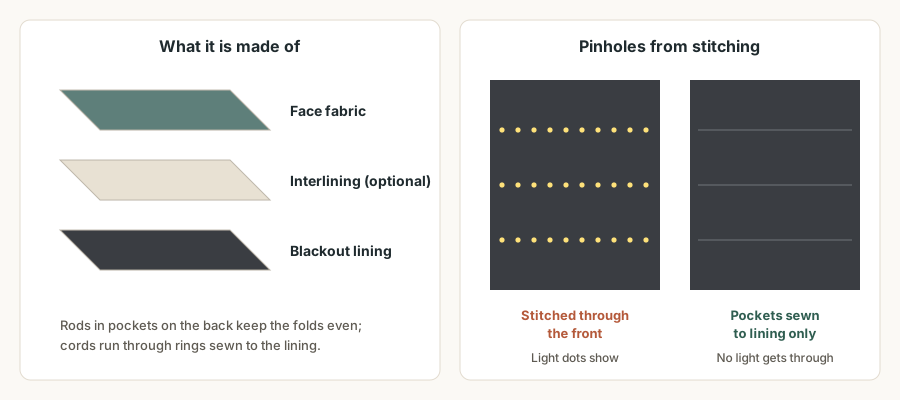
A good blackout roman shade usually has three parts:
- Face fabric: the decorative fabric you see from the room, such as linen, cotton, velvet or a print.
- Interlining (optional): a soft layer, like flannel or bump, sandwiched between face and lining. It adds body, gives plumper folds, improves insulation and makes the shade feel luxurious.
- Blackout lining: an opaque fabric, usually with a coated or multi-layer construction, on the back facing the window.
The stitching problem
The rods that make a roman shade fold neatly sit in pockets across the back. On cheaper shades, these pockets are stitched right through every layer, including the face fabric. Each stitch makes a tiny hole in the blackout lining, and in bright sun you see rows of light dots across the shade.
Better blackout roman shades avoid this by sewing the rod pockets only to the lining, or to a separate backing, so no stitches pass through the whole shade. Some use a second blackout layer behind the pockets to cover any holes. When you shop, look for descriptions like "no stitch-through", "pinhole-free" or "rod pockets on the lining only". The same applies to the rings that carry the cords: they should be sewn to the pocket tape or lining, not through the face.
Styles of roman shade
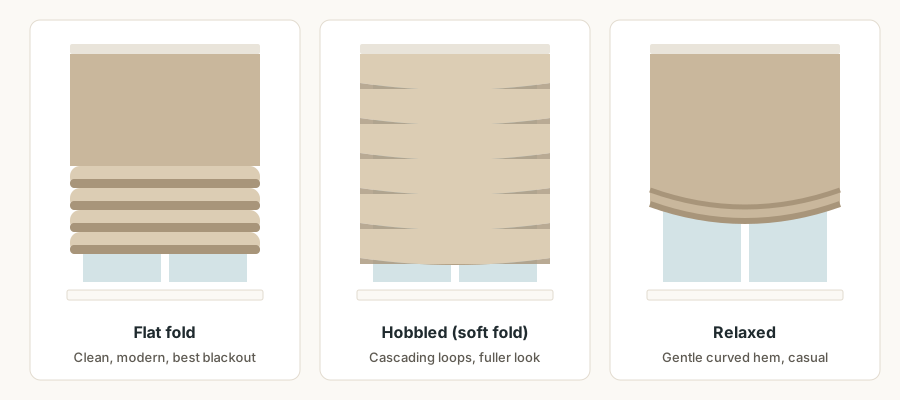
Flat fold (classic)
The fabric hangs perfectly flat when lowered and stacks into crisp folds when raised. It's clean and modern, shows off patterns well and gives the most even blackout because the fabric lies smoothly against the window. This is the best choice for most blackout uses.
Hobbled (soft fold or waterfall)
The fabric forms soft, overlapping loops down the full length, even when lowered. It looks full, traditional and luxurious. The loops add depth, but they also create a slightly uneven edge where light can slip past, so pair it with an outside mount for the darkest result.
Relaxed (European or London)
The bottom edge curves gently in a soft smile, rather than lying straight. It's casual and pretty, but the curve leaves gaps at the bottom corners and doesn't seal well, so it's better for rooms where some light is fine. Relaxed shades are usually decorative rather than true blackout.
Other details
- Banding or borders: a contrast strip of fabric down the sides or along the hem.
- Pleat-free "flat roman" (sometimes called a roll-up look): very minimal, almost like a fabric roller shade.
- Top-down/bottom-up: lowers from the top as well as raising from the bottom, for privacy with daylight at the top. It's great for daytime, though the extra rail can add a small light gap.
Choosing the fabric
Because the blackout lining does the light-blocking, the face fabric can be almost anything, but some work better than others:
- Cotton and cotton blends: crisp, easy to sew, fold well and come in endless colours and prints.
- Linen and linen-look: relaxed and natural, with lovely texture. Real linen creases, which can suit a relaxed shade; linen blends are crisper. See our linen curtains guide.
- Velvet: rich and insulating, but bulky; it suits larger windows where the stack won't look too heavy. See our velvet curtains guide.
- Polyester and faux silk: durable, fade-resistant and often easy to clean.
- Very thick fabrics like heavy wool or upholstery weaves make bulky folds and a deep stack, so they suit wide windows better than small ones.
Colour and pattern
With a good blackout lining, colour doesn't change how dark the room gets, but it changes how the shade looks by day. Light colours keep a room bright and fresh when the shade is open; deep colours like navy, forest green and charcoal feel cosy and dramatic. Bold patterns look best on flat fold shades, where they aren't broken up by loops. For more help, see how to choose curtain colours and patterned vs. plain curtains.
The window-facing side
Most blackout linings are white, ivory or grey on the side that faces the street. A light backing gives a neat, uniform look from outside and reflects summer heat back out of the window.
Inside mount or outside mount?
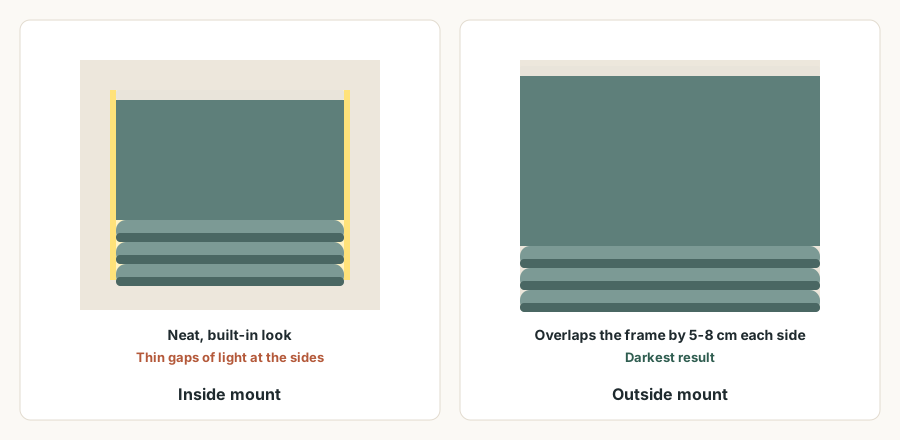
Inside mount
The shade fits within the window recess or frame. It looks clean and built-in, and shows off nice trim or a deep recess. The catch is that an inside-mounted shade must be a little narrower than the opening so it can move freely, which leaves thin slivers of light at the sides. You also need enough depth in the recess for the headrail and the folded stack, usually several centimetres, and the frame must be square.
Outside mount
The shade is fixed to the wall or frame above the window and overlaps the opening on each side. Because it covers the edges, it blocks far more light. It's the best choice for bedrooms, nurseries and media rooms, and for windows with shallow recesses, handles that stick out or frames that aren't square. Mounting the shade higher than the window also lets the folded stack sit above the glass, so it doesn't block the view when open, and makes the window look taller.
Ways to close the side gaps on an inside mount
- Light-blocking side channels: slim strips fixed to the sides of the recess that the shade's edges sit behind.
- Fit as tightly as the maker allows, using their recommended deduction.
- Add curtains over the top, closed at night (see layering below).
How to measure for blackout roman shades
Use a metal tape measure, measure each window separately, and write down every measurement. Check whether your supplier wants the exact recess size (they'll make the deduction) or the finished shade size.
Inside mount
- Width: measure inside the recess at the top, middle and bottom. Use the narrowest.
- Height: measure from the top of the recess to the sill at the left, centre and right. Use the shortest.
- Depth: check the recess is deep enough for the headrail and the stack, and note handles or locks that stick out.
- Squareness: measure the two diagonals. If they differ by more than about 1 cm, consider an outside mount.
Outside mount
- Width: measure the outside of the frame or recess and add 5–8 cm on each side for good blackout.
- Height: decide where the headrail goes, usually 5–15 cm above the opening (higher if you want the stack to clear the glass), and measure to 5–8 cm below the sill or to the top of the sill.
- Check clearance: make sure the headrail won't hit coving, a curtain pole or the ceiling.
Allow for the stack
When raised, a roman shade folds into a stack, typically 15–30 cm deep depending on the length and fabric thickness. Blackout lining and interlining make the stack bigger. On an inside mount, the stack covers the top of the glass. If you want a clear view, choose an outside mount high above the window.
For more measuring tips, see our guide on how to measure windows for curtains.
Lift systems and cord safety
Roman shades can be raised and lowered in several ways:
- Cord lock: pull the cords to raise, and they lock at the side. Simple, but loose cords can be a hazard.
- Continuous loop (chain or cord): a loop on one side turns a mechanism in the headrail. It's easy to use on large or heavy shades, and the loop should be fixed tight to the wall with a tensioner.
- Cordless: you raise and lower the shade by pushing or pulling the bottom rail or a handle. No cords at all, which makes them the safest choice for homes with children and pets.
- Motorised: battery or wired motors controlled by remote, app, wall switch or timer. Ideal for high or hard-to-reach windows, and very convenient for setting a schedule.
Child safety: loose or looped blind cords can strangle young children. Choose cordless or motorised shades in children's rooms and family homes. If you have corded shades, fit the safety devices supplied, keep cords out of reach and tensioned, and move cots, beds and furniture away from windows. In many countries, new shades must meet child-safety standards. See our guide to curtains for kids' rooms and nurseries for more.
How to fit a blackout roman shade
- Check the parts: headrail, brackets, screws, wall plugs, safety devices and any cleat or tensioner.
- Mark the brackets: place them near each end of the headrail, plus a central bracket on wider shades. Use a spirit level so they line up.
- Drill and fix: use the right fixings for your wall or frame. Blackout shades with interlining are heavier than they look.
- Clip or screw in the headrail.
- Fit safety devices and tension any continuous loop.
- Test: raise and lower the shade a few times, checking that the folds form evenly and the shade hangs level.
- Train the folds: new shades often fold better after being left fully raised for a day or two.
Our guide on how to hang curtains explains wall plugs, studs and levelling in more detail.
Getting a truly dark room
Even the best blackout roman shade can't stop light that goes around it. To get as dark as possible:
- Choose a flat fold style with stitch-free rod pockets.
- Outside mount with a generous overlap on all sides.
- Mount close to the wall and, if there's a gap above, add a pelmet or box valance over the headrail.
- Make the bottom rail meet the sill or extend below it.
- Use side channels on inside mounts.
- Layer with blackout curtains for the darkest result.
Layering roman shades with curtains
A blackout roman shade under a pair of curtains is a classic combination. The shade handles everyday light and privacy and blocks most light at night; the curtains seal the edges, add colour and softness and improve insulation.
- Inside-mounted shade + curtains on a pole above: neat and practical, and the curtains cover the shade's side gaps.
- Shade + stationary side panels: decorative curtains that frame the window but don't close.
- Coordinating fabrics: a patterned shade with plain curtains, or a plain shade with patterned curtains.
Mount the curtain pole far enough from the wall to clear the shade and its stack, and hang it higher and wider than the window. Our guides on how high to hang curtain rods and curtain rods and tracks explain the details.
Best rooms for blackout roman shades
Bedrooms
The most popular place. Combine an outside-mounted blackout roman shade with curtains for deep darkness and a hotel-like feel. See best curtains for bedrooms.
Nurseries and children's rooms
Blackout helps with daytime naps and light summer evenings. Choose cordless or motorised, and pick wipeable or washable fabrics.
Home cinemas and media rooms
Deep colours like charcoal or navy absorb stray light. Outside mounts and curtains on top give the best picture.
Home offices
Blackout isn't always needed here, but it's useful for video calls and for cutting glare. A top-down/bottom-up shade lets light in above the screen while blocking glare below.
Bay windows
A roman shade in each window of a bay keeps the space neat and works well with a window seat. See our bay window curtain ideas.
Small windows
Roman shades use no wall space and suit small windows where curtains would overwhelm. See curtains for small windows and small rooms.
Kitchens and bathrooms
Choose moisture-resistant polyester fabrics, avoid placing shades where they'll get splashed, and keep them raised away from cooking. In steamy bathrooms, a blackout roller or aluminium blind may last longer; see our aluminium venetian blinds guide.
Blackout roman shades vs. other blackout options
| Option | Darkness | Look | Insulation | Best for |
|---|---|---|---|---|
| Blackout roman shade | Very good (outside mount) | Soft, tailored | Good, very good with interlining | Bedrooms, living rooms, nurseries |
| Blackout roller shade | Very good | Plain, minimal | Fair | Budget, layering under curtains |
| Blackout cellular shade | Very good | Neat, modern | Excellent | Cold or hot rooms, energy saving |
| Blackout curtains | Excellent (with overlap) | Soft, full | Very good | Bedrooms, large windows |
| Shade + curtains | Best | Layered, luxurious | Excellent | Anyone needing total darkness |
Making your own blackout roman shade
If you can sew straight lines, a flat fold roman shade is a satisfying project. You'll need face fabric, blackout lining, rod pocket tape (or lining strips to make pockets), thin rods or dowels, rings, cord, a bottom weight bar, a headrail or a timber batten with screw eyes, and a cleat or cord safety device.
- Cut the fabric and lining to the finished size plus hem and side allowances.
- Sew the face fabric and lining together at the sides and turn, or lock-stitch the lining to the face for larger shades.
- Mark the fold positions evenly up the back, usually every 20–30 cm.
- Make the rod pockets on the lining side only, by sewing pocket tape or lining strips to the lining without stitching through the face fabric.
- Insert the rods and the bottom weight bar.
- Sew rings to the pockets in vertical lines, about 20–30 cm in from each side and spaced evenly across.
- Attach the top to the batten or headrail with hook-and-loop tape or staples.
- Thread the cords through the rings and screw eyes, and tie them to the bottom ring.
- Fit the cord safety device and hang the shade.
If you're new to sewing window treatments, our guides on how to sew unlined curtains and how to hem curtains will help with the basics.
Cleaning and care
- Dust regularly with a soft brush attachment on low suction, working from top to bottom. Pay attention to the top of the stack, where dust settles.
- Spot clean marks with a damp cloth and mild soap, testing an out-of-sight area first. Blot rather than rub.
- Don't machine wash unless the maker says it's safe. Most roman shades have rods, rings and cords, and blackout coatings can crack in hot washes. Some shades have removable covers that can be cleaned separately.
- Professional cleaning is the safest option for interlined or delicate shades.
- Avoid condensation: raise shades a little on cold mornings so damp doesn't sit against the window and cause mildew on the lining.
- Protect from fading: even with lining, the face fabric fades in strong sun; lowering shades during the brightest hours helps.
- Check the cords every so often for fraying, and keep safety devices in place.
For washing curtains you use alongside your shades, see how to wash curtains.
Common mistakes
- Choosing an inside mount for a bedroom and being surprised by light at the edges.
- Buying shades with stitch-through pockets, which leak light in rows of dots.
- Choosing a relaxed style and expecting full blackout.
- Forgetting the stack, so the raised shade blocks the top of the window.
- Measuring once instead of at three points.
- Leaving cords loose in a home with young children.
- Choosing a very bulky fabric for a small window.
- Washing a shade that isn't washable.
Frequently asked questions
Do blackout roman shades block all light?
The fabric and lining can block almost all light, but some always gets in around the edges, especially with an inside mount. Outside mounting, side channels or curtains on top give the darkest result.
Are roman shades or roller shades better for blackout?
Both block light well through the fabric. Roller shades are thinner and fit tighter in a recess, while roman shades are softer and more decorative. For the darkest room, either works best mounted outside the frame with curtains on top.
Can I add blackout lining to an existing roman shade?
Yes. You can sew a blackout lining onto the back, ideally attaching it at the top and sides only so you don't stitch through the face. Some makers also sell clip-on or hook-and-loop blackout liners.
Do blackout roman shades help with heat?
Yes. They reduce heat coming in through sunny windows in summer and help keep warmth in on cold nights, especially with interlining. Our thermal curtains guide explains how window coverings insulate.
Are cordless roman shades safe for nurseries?
Cordless and motorised shades are the safest choices for children's rooms because they have no cords to reach.
How long do blackout roman shades last?
With gentle use and care, a good-quality shade can last many years. Cords and rings can often be replaced if they wear out.
The bottom line
Blackout roman shades combine the softness of fabric with the neatness of a blind and real light-blocking power. For the darkest room, choose a flat fold style with rod pockets sewn to the lining only, mount it outside the frame with a generous overlap, make sure it reaches the sill, and add curtains if you need total darkness. Choose cordless or motorised control where children live, measure carefully at three points, allow for the stack, and dust gently rather than washing. Done well, a blackout roman shade gives you a beautiful window by day and a properly dark room by night.
Keep reading
 Styles
Oak wooden blinds: shades, slat sizes, real oak vs oak-effect, and care
Oak wooden blinds bring light, natural warmth to any room. Compare oak shades, real wood and oak-effect options, slat sizes and tapes, and learn how to style and care for them.
 Styles
Fitted horizontal blinds: a complete guide to made-to-measure blinds that fit perfectly
Fitted horizontal blinds are made to the exact size of your window, so they look neat and control light properly. Compare types, fitting methods, measuring and care.
 Styles
Walnut venetian blinds: real wood vs faux wood, styling and care
Rich, warm and timeless, walnut venetian blinds bring the look of dark wood to any window. Compare real and faux wood, slat sizes and tapes, and learn how to style and care for them.