Room Ideas
Curtains for kids' rooms and nurseries: safety and style

Curtains in a nursery or child's bedroom have a bigger job than almost anywhere else in the home. They need to darken the room for naps and early summer mornings, keep the room comfortable, stand up to sticky hands and regular washing, and, most importantly, be completely safe. They should also look lovely and, ideally, last as your child grows from a baby to a toddler to a school-age child.
Whether you are preparing a nursery for a new baby or updating an older child's room, this guide covers everything you need to know: safety first, then blackout options, fabrics, colours and patterns, hardware, and practical ideas for every age.
Safety first
Window coverings can pose real hazards to babies and young children. Safety organisations around the world warn about these risks, and they should guide every decision you make about curtains and blinds in a child's room.
Cords and chains
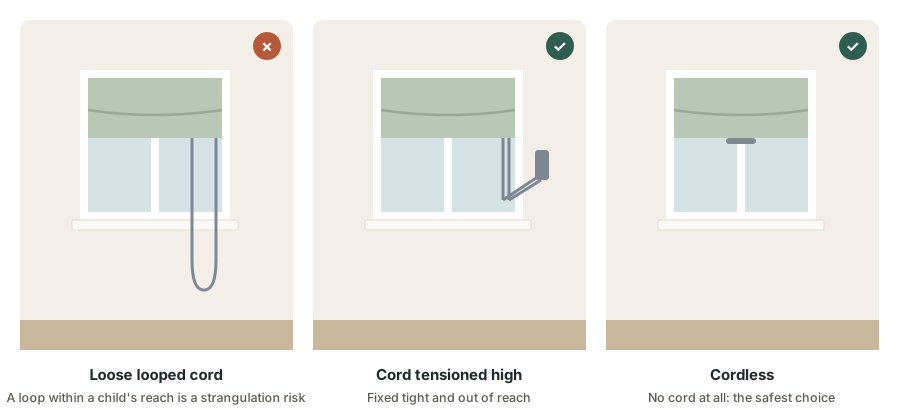
Looped cords and chains on blinds, corded curtain tracks and traverse rods are a strangulation risk for young children. A child can become entangled in a loop in seconds, silently. To keep children safe:
- Choose cordless window coverings wherever possible: cordless blinds, wand-operated tracks, motorised options or simple hand-drawn curtains.
- If cords are present, fix them tightly to the wall with a cord tensioner or cleat, high enough that a child can't reach them, even by climbing on furniture.
- Never leave loose loops or tie cords together, which can create a loop.
- Check existing blinds in older homes. Older designs may not meet current safety standards. Retrofit safety devices or replace them.
- Look for products that meet your country's child safety standards for window coverings, and follow the manufacturer's safety instructions.
Cot and bed placement
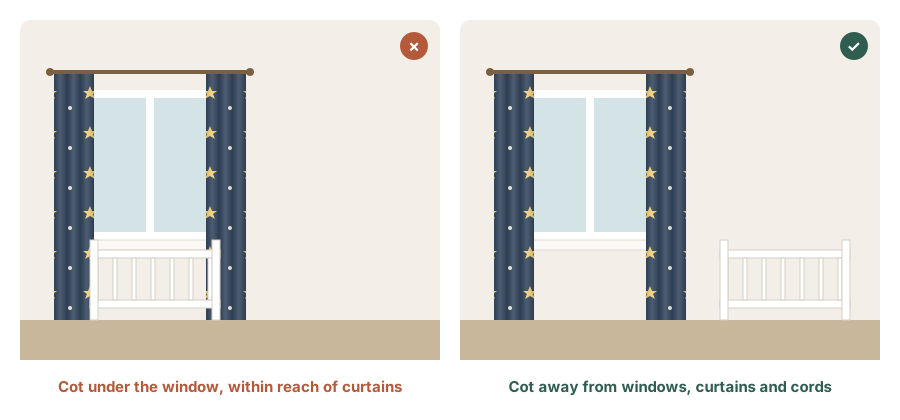
- Place the cot or bed away from windows, curtains and any cords, so a child can't reach or pull them from the cot.
- Keep climbable furniture away from windows: chests of drawers, toy boxes, chairs and bookcases can all be used as steps.
- Fit window restrictors or safety catches so windows can't open wide enough for a child to fall through.
Secure hardware
- Fix rods and brackets firmly into studs or masonry with proper fixings. Children love to pull and swing on curtains.
- Avoid tension rods for curtains that children can reach and pull, as they can pop out and fall.
- Check for loose parts regularly: finials, rings and screws.
Small parts and trims
Pom-poms, buttons, beads, tassels and decorative trims can come loose and become choking hazards. For babies and toddlers, choose curtains without small attached decorations, or keep trimmed parts high out of reach.
Tiebacks
Fabric or rope tiebacks with long, loose ends can be a hazard. Use short tiebacks fixed with a hook or rigid holdbacks, mounted high, or skip tiebacks altogether.
Fire safety
Choose fabrics that meet your country's fire safety standards for home furnishings, and look for inherently flame-resistant or flame-retardant fabrics if you want extra peace of mind. Keep curtains well away from heaters, lamps and night lights.
Blackout curtains for better sleep
Babies and young children often nap during the day and go to bed while it's still light in summer. Light also wakes many children early in the morning. Darkening the room can help them fall asleep and stay asleep.
Blackout options
- Blackout curtains: curtains with a blackout lining or blackout-coated fabric that blocks almost all light.
- Blackout liners: hang behind decorative curtains, so you can choose any fabric you love.
- Cordless blackout blinds: fitted inside the window recess, they block light at the glass. Combined with curtains, they give the darkest result.
- Portable blackout blinds: useful for travel and for rentals; they attach to the glass with suction cups.
Read our blackout curtains guide for a full explanation of blackout fabrics and linings.
Stopping light leaks
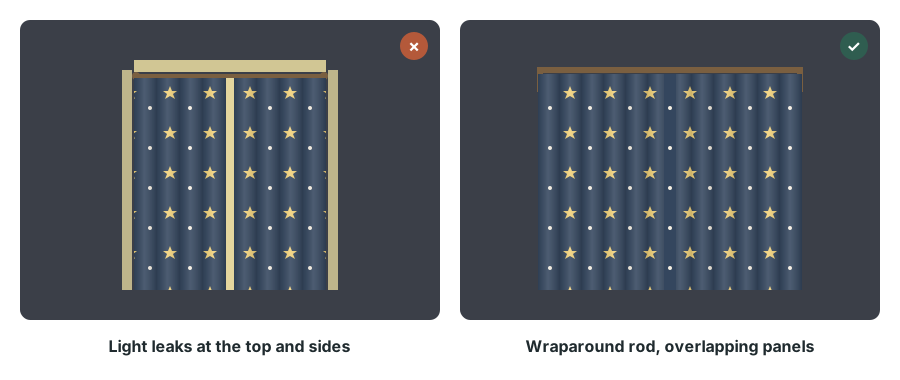
Even blackout curtains let light in around the edges. To get the room really dark:
- Hang the rod high, 10–15 cm or more above the frame, or use a ceiling track or a pelmet to block light from the top.
- Extend the rod wide, 15–25 cm beyond each side, so the curtains overlap the wall.
- Use a wraparound (return) rod so the curtains curve back to the wall at the sides.
- Overlap the panels in the centre, or use a track with overlap arms.
- Choose floor-length curtains to block light from below the window.
- Add a blackout blind behind the curtains for maximum darkness.
A worked example: darkening a nursery window
Imagine a nursery window 100 cm wide and 120 cm tall, with the top of the frame 210 cm from the floor and the ceiling at 250 cm.
- Blind: a cordless blackout roller blind fitted inside the window recess, sized to the recess width.
- Rod height: about 20 cm above the frame, at 230 cm, to stop light escaping over the top.
- Rod width: 100 cm + 25 cm each side = 150 cm. A wraparound rod with returns of about 10 cm brings the curtain edges back to the wall.
- Curtain width: for about 2 times fullness, plus the returns and a centre overlap, you need roughly 2 × (150 + 20 + 10) = 360 cm of curtain, for example two panels of about 180 cm.
- Curtain length: from the rod to just above the floor, about 229 cm, adjusted for the heading.
With the blind down and the curtains closed, very little light reaches the room, even on bright summer mornings. For step-by-step measuring, see how to measure windows for curtains, and for fullness, curtain fullness explained.
Darkness, routines and light in the morning
Many families find that a dark, quiet room supports a calm bedtime routine. A dark room also means you control when the day starts: open the curtains in the morning to let daylight in, which signals that it's time to get up. Some parents like curtains that are easy to open fully, so the room fills with natural light during the day and play time. If you have questions about your child's sleep, your health visitor, paediatrician or family doctor is the best person to ask.
Choosing fabrics
Children's rooms are busy, messy places, so practical fabrics matter:
- Machine washable: the most important feature. Sticky fingers, spills and dust mean you'll wash them often.
- Durable: cotton, cotton-polyester blends and polyester stand up well to pulling and washing.
- Low-dust: smooth, tightly woven fabrics collect less dust than velvet or heavy textured weaves, which helps children with dust allergies.
- Fade-resistant: polyester and lined curtains hold their colour better in sunny rooms.
- Easy to iron, or crease-resistant, so you're not ironing every week.
Avoid delicate fabrics such as silk, and dry-clean-only fabrics. Our guides on curtain fabrics compared and how to wash curtains have more detail.
Colours for children's rooms
Calm colours for sleep
Soft, muted colours such as sage, dusty blue, soft grey, warm white, oatmeal and pale terracotta create a restful atmosphere for sleep. They're also easy to live with as children grow.
Dark colours for darkness
Navy, charcoal, forest green and deep plum block more light and create a cosy feel, especially paired with lighter walls and bedding.
Bright accents
If your child loves bright colours, use them in smaller doses: a border, tiebacks or a pattern on a neutral background. Very bright, saturated curtains covering a whole wall can feel stimulating at bedtime.
See how to choose curtain colours for more advice.
Patterns that grow with your child
Character-themed curtains are fun, but children's tastes change quickly. A pattern that delights a three-year-old may embarrass an eight-year-old. To get more years from your curtains:
- Choose timeless patterns: stars, moons, clouds, spots, stripes, checks, small animals, leaves and simple geometric shapes.
- Choose plain curtains and change the theme with bedding, cushions, rugs and art, which are cheaper to update.
- Use playful details such as a patterned border, pom-pom trim (high up and well attached) or fun tiebacks, which can be changed later.
- Keep the scale right: small and medium patterns suit most children's rooms. See patterned vs. plain curtains.
Curtain ideas by age
Nurseries (babies)
- Cordless blackout blind plus soft floor-length blackout-lined curtains.
- Calm, soft colours that suit night-time feeds.
- No small trims or loose decorations within reach.
- Cot well away from the window.
Toddlers
- Sturdy, washable fabrics that can handle pulling.
- Securely fixed rods; no tension rods within reach.
- Blackout for naps and early summer mornings.
- Fun but simple patterns.
School-age children
- Let them help choose colours or patterns.
- Blackout still helps with summer bedtimes.
- Durable fabrics that can handle forts, games and hide-and-seek.
Teenagers
- More grown-up colours and textures, such as linen, velvet or plain cotton.
- Layered sheers and blackout curtains for privacy and late sleeping.
- Let them choose: it's their space.
Shared bedrooms
When siblings share a room, curtains can help keep the peace:
- Choose a neutral base that suits both children, and let each child personalise their own bedding and wall space.
- Darken the room fully if children have different bedtimes or nap schedules, so one child's early bedtime isn't disturbed by summer daylight.
- Room-dividing curtains: for older children, a ceiling-mounted track with a curtain between the beds can create a sense of private space. Fix the track securely, keep the curtain clear of the floor, and avoid this for babies and toddlers.
Allergies and air quality
Curtains collect dust, which can bother children with allergies or asthma. To keep the air cleaner:
- Wash new curtains before hanging (if the care label allows) to remove finishing chemicals, dust and any smell from packaging.
- Choose smooth, tightly woven fabrics that shed dust more easily than velvet, chenille or heavy textured fabrics.
- Wash regularly on a hot cycle if the fabric allows, and vacuum in between with a brush attachment.
- Consider blinds that can be wiped clean, combined with lighter curtains that are easy to wash.
- Keep the room ventilated to reduce damp and mould around windows.
Fun extras, done safely
- Reading nooks: a curtain across an alcove or under a high bed creates a cosy hideaway for older children. Use a securely fixed rod and keep the curtain short.
- Glow-in-the-dark or star patterns make bedtime magical without needing extra lights.
- Play curtains: a simple curtain across a doorway or shelf can become a puppet theatre or shop counter.
- Bed canopies: popular in older children's rooms, but don't hang canopies, netting or fabric over or into a baby's cot.
Choosing curtains with your child
From about four or five years old, many children love to help choose things for their room. Giving them a say can make them more excited about their bedroom and bedtime:
- Offer two or three options you're happy with, rather than an open choice.
- Let them choose the fun details, such as tiebacks, a border colour or the bedding, while you choose a practical, long-lasting curtain.
- Show them how the curtains help them sleep: closing them together can become part of the bedtime routine.
Long-lasting choices
Curtains that last from the nursery to the teenage years save money and waste. Good-quality, plain or simply patterned curtains in natural or durable fabrics, with a separate blackout liner, can be restyled again and again with new accessories. When your child outgrows them, they can move to another room, be shortened for a smaller window, or be passed on.
Lengths and styles
- Floor-length curtains block the most light and look polished. Keep them just above the floor (about 1 cm), not puddled, so they don't get trodden on, tripped over or used for hiding and climbing.
- Sill-length or short curtains suit windows above radiators, desks or window seats, and are out of reach of crawling babies.
- Roman shades are neat and stylish; choose a cordless version. Our blackout roman shades guide explains how to get them really dark.
- Eyelet and ring top headings slide easily, so children can open and close curtains themselves when they're older.
See the curtain length guide and curtain headings compared.
Temperature and comfort
Babies and young children are sensitive to temperature. Thermal and blackout curtains help keep rooms cooler in summer by blocking the sun, and warmer in winter by reducing heat loss through the glass. Close them during the hottest part of summer days and at dusk in winter. Learn more in our thermal curtains guide.
Make sure curtains don't cover radiators or heaters, which wastes heat and can be a fire risk, and that the room stays well ventilated.
Caring for children's curtains
- Spot clean quickly: blot spills and sticky marks straight away with a damp cloth and a little mild soap.
- Wash on the right cycle: follow the care label, and wash blackout-lined curtains gently, because hot water and harsh spinning can crack some blackout coatings.
- Keep a spare set for nurseries, so the room stays dark while one set is being washed and dried.
- Check seams and hooks after washing, and repair anything loose before rehanging.
Installation tips
- Plan the rod position: high and wide for darkness, as above.
- Use a stud finder or detector to avoid cables and pipes and find solid fixings.
- Use strong brackets and fixings suited to your wall type, plus a centre bracket on longer rods.
- Choose a wraparound rod or add a pelmet for maximum darkness.
- Install any blinds with all safety devices fitted, following the manufacturer's instructions.
- Check everything by pulling firmly on the curtains, as a child would.
Our guides on how to hang curtains and the curtain rods and tracks guide explain the details.
Budget-friendly ideas
- Buy plain, good-quality curtains that will last for years, and change the room's theme with cheaper accessories.
- Add a blackout liner behind existing curtains rather than buying new blackout curtains.
- Use a cordless blackout blind with simple, inexpensive curtains for both darkness and style.
- Add a fun border or tiebacks to plain curtains; when your child outgrows the look, remove them.
- Look for second-hand curtains in good condition, and wash them before use.
For more ideas, see how to make curtains look expensive on a budget.
Safety checklist
Before your child sleeps in the room, check that:
- There are no loose or looped cords or chains within reach of the cot, bed or any climbable furniture.
- Any cords are fixed tightly to the wall with a tensioner or cleat, out of reach.
- The cot or bed is away from the window, curtains and cords.
- Rods and brackets are firmly fixed and don't move when pulled.
- There are no small trims, buttons or beads within reach.
- Windows have restrictors or safety catches fitted.
- Curtains are clear of heaters, lamps and night lights.
- Curtains don't puddle on the floor.
Check again every few months, and whenever your child learns a new skill like standing, climbing or opening drawers, because their reach changes quickly.
Common mistakes
- Blinds with loose looped cords within reach of children.
- Cots and beds placed under windows.
- Tension rods or weak fixings that children can pull down.
- Small trims that can be pulled off and swallowed.
- Dry-clean-only fabrics in a room that needs frequent washing.
- Character curtains that are outgrown within a year or two.
- Blackout curtains on a narrow rod, letting light leak around the sides.
- Puddled curtains that become a trip or climbing hazard.
Frequently asked questions
Do babies need blackout curtains?
They're not essential, but many parents find a dark room helps babies nap during the day and sleep longer on light summer mornings. Combine blackout curtains with a cordless blackout blind for the darkest room.
Are corded blinds safe in a child's room?
Loose looped cords are a strangulation hazard. Choose cordless blinds, or make sure every cord is fixed tightly with a tensioner well out of reach, and keep cots and furniture away from windows.
What colour curtains are best for a nursery?
Soft, calming colours such as sage, dusty blue, warm grey and oatmeal, or darker colours like navy for extra darkness.
How often should I wash children's curtains?
Every two to three months, or more often if they get dirty or your child has allergies. Vacuum them every few weeks in between.
Should nursery curtains be floor-length?
Floor-length curtains block the most light, but keep them just above the floor rather than puddled, and make sure the rod is securely fixed. Sill-length curtains or blinds are a good choice when a window is above a radiator or furniture.
When should I replace the window coverings in an older home?
If blinds have loose looped cords or chains and can't be fitted with tensioners or other safety devices, replace them with cordless designs before your baby arrives or starts to move around. It's one of the simplest and most important safety upgrades in a child's room, and it usually costs very little.
Can I use tiebacks in a child's room?
Use short, rigid holdbacks or tiebacks with no long loose ends, mounted high. For babies and toddlers, it's simplest to avoid tiebacks altogether.
What's the best way to darken a nursery for daytime naps?
A cordless blackout blind fitted in the window recess, plus blackout-lined curtains hung high and wide on a wraparound rod, with the panels overlapping in the centre.
Are sheer curtains suitable for kids' rooms?
Yes, as a daytime layer behind or in front of blackout curtains on a double rod. On their own, they don't darken the room enough for good sleep. See our sheer curtains guide.
The bottom line
For children's rooms, safety comes first: choose cordless window coverings, fix any cords firmly out of reach, keep cots and furniture away from windows, use secure hardware and avoid small trims. Then focus on sleep, with blackout curtains hung high and wide on a wraparound rod, ideally with a cordless blackout blind. Choose washable, durable fabrics in calming colours and timeless patterns that will grow with your child. Done well, the curtains will keep your child safe, help them sleep and look lovely for years.
Keep reading
 Room Ideas
Bay window curtain ideas: how to measure, hang and style them
Bay windows are beautiful but tricky to dress. Here's how to choose between bent tracks, bay poles, separate rods and shades, how to measure every angle, and how to style a bay in any room.
 Room Ideas
Curtains for large windows and sliding glass doors: a complete guide
Big windows and sliding doors need curtains that are wide enough, strong enough and easy to use. Here's how to measure, choose the hardware, fabric, fullness and style for large openings.
 Room Ideas
Curtains for small windows and small rooms: how to make them look bigger
The right curtains can make a small window look larger and a small room feel brighter and more spacious. Here's how to choose the style, colour, length and hardware for small spaces.