Room Ideas
Bay window curtain ideas: how to measure, hang and style them

A bay window is often the best feature in a room. It pushes out from the wall, pulls in light from several directions and creates a little nook that can hold a window seat, a desk, a dining table or a favourite chair. It is also the window people find hardest to dress. Ordinary straight rods don't fit, standard curtains seem to be the wrong size, and it isn't obvious where the curtains should go when they're open.
The good news is that there are only a handful of sensible ways to dress a bay, and once you know which one suits your bay and the way you use the room, the rest is careful measuring. This guide explains the different types of bay window, the main curtain options with their pros and cons, how to measure each section, how much fabric you need, which lengths work, and how to style a bay in the living room, bedroom, dining room and kitchen.
First, which kind of bay do you have?
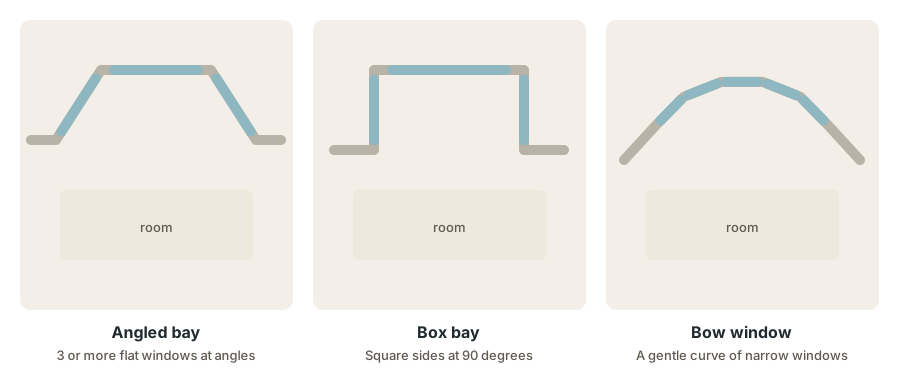
The shape of your bay decides which hardware will fit, so start by working out which of these you have:
- Angled bay (also called a canted bay): the most common type. It has a wide central window and two narrower side windows set at an angle, usually around 45 degrees, though 30 and 60 degrees are also found. Some have five sections instead of three.
- Box bay (square bay): the side windows meet the front window at right angles, so the bay forms a rectangle. Box bays are often shallower and common in older terraced houses.
- Bow window: four or more narrow windows arranged in a gentle curve. There are more joints and smaller angles, so the hardware has to bend more gradually.
Two other details matter just as much as the shape: how much wall there is above the windows (some bays have almost none, with the frames running right up to the ceiling) and how much wall there is at each end of the bay where open curtains could stack. Take a photo of your bay and note both before you start planning.
The four main ways to dress a bay window
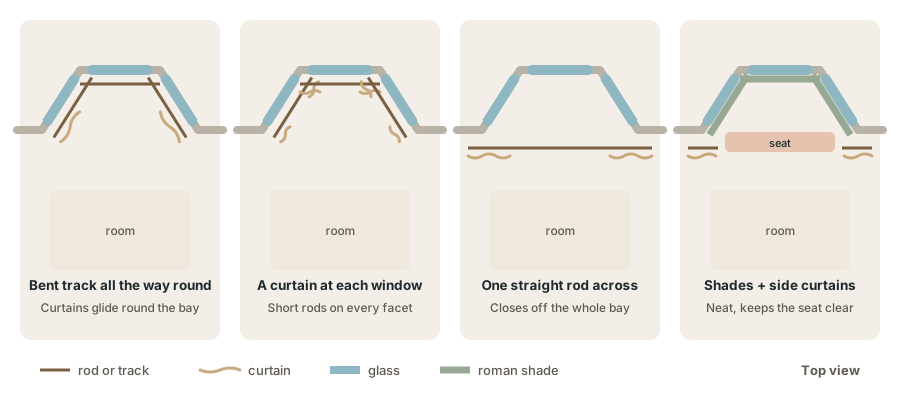
1. A bent track or bay pole all the way round
The most popular solution is a single track or pole that follows the shape of the bay. Curtains glide around the corners, so they can be drawn right round to close the whole bay, and opened back to the sides.
- Bendable tracks are aluminium or strong plastic tracks that are bent by hand or with a bending tool to match each angle. Because the gliders run inside or along the track and the brackets sit behind, the curtains pass the corners smoothly. Tracks are discreet, work with almost any heading that takes hooks, and can be fitted to the wall or the ceiling.
- Bay poles are decorative rods joined at each corner with angled connectors or flexible elbow joints. To let the curtains slide past the brackets, they use passing brackets or C-shaped rings that open on one side. Bay poles look more traditional and suit period homes, but they are heavier and usually more expensive than a track.
Best for: living rooms and bedrooms where you want to close the whole bay for privacy, warmth and darkness at night.
Watch out for: the stack. When open, all that fabric has to go somewhere. If there is little wall at each end of the bay, the open curtains will sit over the side windows and block light.
2. Separate curtains at each window
Each section of the bay gets its own short rod or track and its own pair of curtains (or a single panel). This keeps each window independent and avoids the need for corner joints.
Best for: box bays and bays with wide pillars between the windows, where each window already reads as a separate opening.
Watch out for: it uses more hardware and more curtains, and with several narrow windows it can look busy. Light gets in at the corners, so it is less effective for blocking light completely.
3. One straight rod across the opening
A single straight rod or track runs across the front of the bay, from one side wall to the other, as though the bay were one big window. When the curtains close, the whole bay is closed off from the room.
Best for: deep bays, bays with a window seat you don't want curtains to rest on, and situations where you want the bay to become a separate cosy nook, or to keep it cooler or warmer than the room.
Watch out for: when closed, the curtains hide the bay entirely, so the room loses the feeling of space. During the day, when they're open, it works well and is the simplest and cheapest option.
4. Shades or blinds in each window, with side curtains
Roman shades, roller blinds or wooden blinds are fitted inside or above each window to handle light and privacy, and a pair of decorative curtains frames the bay at the outer corners only. The curtains don't need to close; they are there to soften the look. Wooden slats such as walnut venetian blinds look especially smart in a bay.
Best for: bays with a window seat, desk or radiator in front of the glass, kitchens and dining rooms, and anyone who wants a neat, tailored look with easy daily use.
Watch out for: you need one shade per window, and they must be measured accurately. Choose cordless designs in homes with young children; our guide to curtains for kids' rooms and nurseries explains why.
Quick comparison
| Option | Closes the whole bay | Daytime light | Cost | Best room |
|---|---|---|---|---|
| Bent track or bay pole | Yes | Good if there's space to stack | Medium–high | Living room, bedroom |
| Curtains at each window | Mostly, gaps at corners | Good | Medium | Box bays, bays with pillars |
| Straight rod across the front | Yes, hides the bay | Excellent when open | Low | Deep bays, window seats |
| Shades + side curtains | Yes, with the shades | Excellent | Medium–high | Kitchens, dining rooms, seats, desks |
For more on the hardware itself, see our curtain rods and tracks guide, and for the difference between curtains, drapes and shades, read curtains vs. drapes vs. blinds vs. shades.
How to measure a bay window
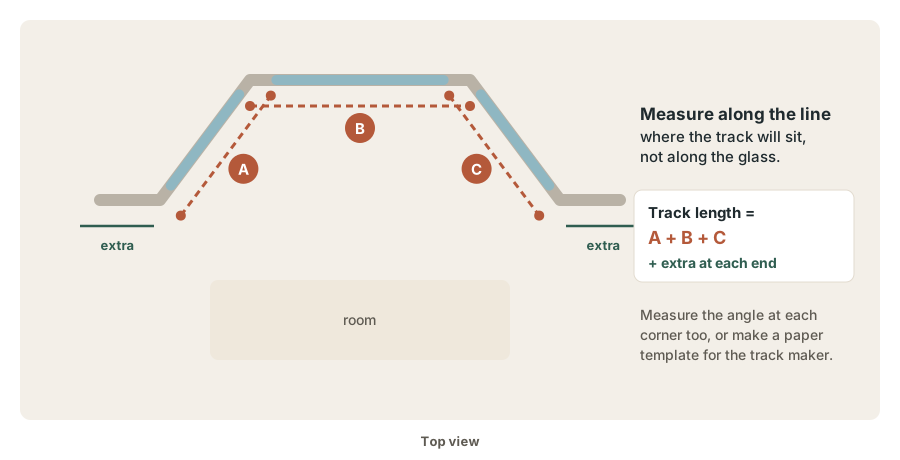
Bay windows are where measuring mistakes are most expensive, because a track that is bent to the wrong angle or cut too short can't be fixed easily. Use a metal tape measure, a pencil and a notepad, and take your time.
- Decide where the track or pole will go. On the wall above the windows (most common), on the ceiling (when there's little or no wall above) or inside the window recess (for shades). Mark the height with a pencil at each corner.
- Measure each section along that line. Not along the glass, and not along the windowsill. The track sits in front of the frame, so its sections are slightly different lengths from the windows themselves. Label them A, B, C and so on from left to right.
- Add the ends. If you want the curtains to stack on the side walls, add extra length at each end, usually 15–30 cm, depending on how much wall there is.
- Measure the angles. Hold a cheap angle finder or a bendable ruler in each corner, or use a protractor app. Many track companies prefer a template instead.
- Make a paper template if you can. Hold a long strip of lining paper or wallpaper against the wall at the track height, crease it into each corner and mark the ends. It records every length and angle exactly, and most made-to-measure track suppliers accept one.
- Measure the drop from the track height to where you want the curtains to finish, at each section. Floors and ceilings in bays are often uneven, so measure every section and use the shortest for floor-length curtains.
- Note obstacles: radiators, window seats, window handles that open inwards, shutters and light switches near the ends.
Our step-by-step guide on how to measure windows for curtains covers the basics in more detail, and how high to hang curtain rods explains how the height affects the look.
How much fabric do you need?
Work out the total track length first: A + B + C (+ D + E for a five-sided bay) + the extra at each end. Then multiply by the fullness you want, usually about 2 times for pencil pleat and pinch pleat curtains, or 1.5–2 for eyelet and lighter fabrics. Our guide to curtain fullness explains the ratios.
A worked example
An angled bay measures A = 60 cm, B = 150 cm and C = 60 cm along the track line, with 15 cm extra at each end.
- Track length: 60 + 150 + 60 + 15 + 15 = 300 cm.
- Curtain width for 2× fullness: 300 × 2 = 600 cm.
- Panels: with ready-made panels 140 cm wide, 600 ÷ 140 = 4.3. Four panels give about 1.9× fullness, which is plenty for most fabrics; five panels give a fuller, more luxurious look.
How should the curtains split?
There are two common arrangements on a track that goes all the way round:
- A pair that opens to the ends: one wide curtain on each side, drawing back to the side walls. It's simple and uses the fewest panels, but the stacks are large, so you need enough wall at each end or they will cover the side windows.
- Several panels that stack at the corners: for example, curtains that gather at each corner of the bay when open, like columns between the windows. This keeps every window clear and suits bays with little end wall. You'll need more panels, and the track needs stops or overlap arms at each split.
Choosing the right length
- Floor-length: the most elegant choice for living rooms and bedrooms when nothing sits under the windows. The curtains frame the bay like a stage. See our curtain length guide.
- Sill-length: the practical choice when there's a radiator under the windows (so warm air can rise into the room), a window seat, a desk or a sofa pushed into the bay.
- Shades only: for a window seat you'll use every day, shades keep the seat completely clear.
Whatever you choose, keep every curtain in the bay the same length, finishing at the same point in each section, so the bay looks orderly.
Bay windows with a window seat
A window seat is the dream for many people, and it changes how you should dress the bay:
- Roman shades in each window are the neatest option. They pull up out of the way and never drape onto the cushions.
- A straight rod across the front of the bay with floor-length curtains turns the seat into a cosy hideaway when closed, which is lovely in a child's room or reading corner.
- Sill-length curtains on a bent track work if the seat is set slightly below the sill, so the hems hang just above the cushion.
- Avoid floor-length curtains on a bent track that have to fall over the seat cushions. They crumple, get sat on and never hang neatly.
Bay windows with radiators
Many bays have a radiator under the central window. Long curtains closed over a radiator trap the heat behind them and send it up and out of the window. Choose sill-length curtains that finish just above the radiator, or shades fitted inside each window, so the warm air can rise freely into the room. Thermal or lined curtains help keep the bay warm; our thermal curtains guide explains how.
Hardware tips for bay windows
- Choose ceiling fixing when there's less than about 5 cm of wall above the frames. Most bendable tracks can be ceiling-mounted with special brackets.
- Use more brackets than you think. Fit a bracket close to each side of every corner and at regular intervals along each section, roughly every 30–40 cm for tracks.
- Check the projection. The track or pole must clear handles, window catches and any shutters.
- Choose passing brackets or C-rings for poles, so curtains can slide past the corner brackets.
- Consider a corded or motorised track for wide or awkward bays. It saves pulling heavy curtains round corners by hand and protects the fabric.
- Buy a made-to-measure track if your angles are unusual or you're not confident bending one yourself. Many suppliers bend it to your template.
When it's time to fit everything, our guide on how to hang curtains walks through drilling, levelling and fixing brackets.
Headings that work well in a bay
- Pencil pleat: flexible and forgiving, gathers neatly on a track and is easy to adjust if your measurements are slightly out.
- Pinch pleat: tailored and elegant, ideal for formal bays in living and dining rooms.
- Wave (S-fold): modern, even folds and slim stacks, very good in bays where stacking space is tight. Needs a compatible wave track that bends.
- Eyelet (grommet): fine on a straight rod across the front, but eyelets can't pass bay pole joints or brackets, so avoid them on a bent pole.
Read curtain headings compared for more on each.
Bay window ideas by room
Living room bays
A bent track or pole with floor-length lined curtains, plus sheers behind for daytime privacy, is the classic look. Choose a calm, plain fabric so the shape of the bay is the feature, and hang the track as high as the bay allows. Our living room curtain ideas include more styling tips.
Bedroom bays
Bedrooms need darkness, so choose blackout or lined curtains on a track that goes all the way round, with an overlap where the panels meet, or blackout blinds in each window with dress curtains at the ends. Our blackout curtains guide and best curtains for bedrooms explain how to stop light leaking in.
Dining room bays
A round table in the bay is a lovely arrangement. Roman shades keep the windows tidy around the table, with full-length side curtains at the ends of the bay for elegance.
Kitchen bays
Choose café curtains or simple roller or roman shades in each window, in washable fabrics, and keep fabric well away from any hob. See our kitchen curtain ideas for safe choices.
Upstairs and oriel bays
Small upstairs bays and oriel windows (bays that project from an upper floor without reaching the ground) often have very little wall space. Inside-mounted shades or café curtains on tension rods in each window are usually the simplest answer.
Privacy and light in a bay
Bay windows often face the street, and because they let you see out in three directions, they also let people see in. Layering is the answer:
- Sheers or voiles on the back of a double track give daytime privacy without losing light. See our sheer curtains guide.
- Café curtains on the lower half of each window give privacy at eye level while keeping the top clear.
- Top-down, bottom-up shades cover the lower part of the glass only.
- Lined curtains closed at night give complete privacy.
Common mistakes with bay window curtains
- Measuring along the glass instead of along the line where the track sits.
- Forgetting the stack, so open curtains cover the side windows.
- Eyelet curtains on a bay pole, where they can't pass the joints and brackets.
- Too few brackets, especially near the corners, causing the track to sag.
- Long curtains over a window seat or radiator.
- Different lengths in different sections, which looks untidy.
- Choosing a busy pattern that fights with the shape of the bay.
- Buying the track before checking the ceiling or wall can take the fixings.
Frequently asked questions
What is the best way to hang curtains in a bay window?
For most bays, a bendable track or bay pole that follows the shape of the bay is best, because the curtains can close all the way round. If you have a window seat or radiator, roman shades in each window with curtains at the ends are often better.
Can I use a normal curtain rod in a bay window?
Only in two ways: a single straight rod across the front of the bay, or a separate short rod in each window. A normal rod can't follow the angles.
How many curtain panels do I need for a bay window?
Add up the track length, multiply by your fullness (about 2), and divide by the panel width. A typical three-sided bay needs four to six panels.
Should bay window curtains be floor-length?
Floor-length looks most elegant in living rooms and bedrooms. Choose sill-length or shades if there's a radiator, window seat, desk or sofa in the bay.
Are tracks or poles better for bay windows?
Tracks are lighter, more discreet, cheaper and glide more smoothly round corners. Poles are more decorative and suit period homes, but need passing brackets or C-rings to work properly.
Where should bay window curtains stack when open?
Either on the side walls at each end of the bay, if there's room, or at the corners of the bay between the windows. Stacking at the corners keeps every pane of glass clear.
Can I fit a bay window track myself?
Yes, if you're comfortable drilling and levelling. Bendable tracks come with instructions for shaping the corners. For unusual angles, heavy curtains or ceiling fixing into plaster, a made-to-measure track or a professional fitter is worth the cost.
The bottom line
Start by identifying your bay's shape and checking how much wall you have above and beside it. Then choose the set-up that matches how you use the space: a bent track or bay pole to close the whole bay, curtains at each window for box bays, a straight rod across the front for deep bays and window seats, or shades with side curtains for a neat, practical finish. Measure each section along the track line, make a paper template if you can, allow about twice the track length in fabric, keep every curtain the same length, and fit plenty of brackets. Do that, and your bay window will look like the beautiful feature it was always meant to be.
Keep reading
 Room Ideas
Curtains for kids' rooms and nurseries: safety and style
Children's rooms need curtains that are safe, darken the room for sleep, wash easily and grow with your child. Here's how to choose curtains for nurseries and kids' bedrooms.
 Room Ideas
Curtains for large windows and sliding glass doors: a complete guide
Big windows and sliding doors need curtains that are wide enough, strong enough and easy to use. Here's how to measure, choose the hardware, fabric, fullness and style for large openings.
 Room Ideas
Curtains for small windows and small rooms: how to make them look bigger
The right curtains can make a small window look larger and a small room feel brighter and more spacious. Here's how to choose the style, colour, length and hardware for small spaces.