Room Ideas
Best curtains for bedrooms: blackout, style and sizing

Of all the rooms in a home, the bedroom asks the most of its curtains. In a living room, curtains mainly need to look good and soften the light. In a bedroom, they also need to help you sleep: blocking early sunrise and streetlights, giving complete privacy, keeping the room cool on hot days and cosy at night, and creating a calm atmosphere you look forward to.
The good news is that getting bedroom curtains right isn't complicated. It comes down to a few key decisions: how dark you need the room, which fabric and colour suit the space, and how to size and hang the curtains so light can't sneak around the edges. This guide walks you through each decision, with specific advice for different bedroom layouts, children's rooms, small bedrooms and guest rooms.
What bedroom curtains need to do
- Control light. Most people sleep better in a dark room, and many need to block early morning sun, streetlights or car headlights.
- Give complete privacy, day and night.
- Help with temperature, keeping heat out on sunny afternoons and warmth in on cool nights.
- Soften sound a little, reducing echo and some outside noise.
- Create a calm, restful atmosphere through colour, texture and softness.
- Be easy to use every morning and evening.
Step 1: Decide how dark you need the room
This is the most important bedroom decision. Be honest about your sleep needs:
| Your situation | Recommended light control |
|---|---|
| Light sleeper, early sunrise, streetlights outside | Blackout curtains, hung high and wide, possibly with a blackout shade |
| Night-shift worker or daytime sleeper | Blackout curtains plus a blackout shade for the darkest possible room |
| Baby or young child who naps | Blackout curtains or a cordless blackout shade, or both |
| Sleeps easily, likes to wake with daylight | Room-darkening or lined curtains |
| Loves a bright, airy bedroom and has no light issues | Lined linen or cotton, perhaps with sheers |
If you're unsure, choose blackout. You can always leave blackout curtains slightly open, but you can't make light-filtering curtains darker. Our blackout curtains guide explains the different types and how to test them.
Step 2: Hang them to stop light leaks
Even the best blackout fabric leaks light if it's hung badly. Light escapes over the top, around the sides, down the middle where the panels meet, and under the hem. These four fixes solve most problems:
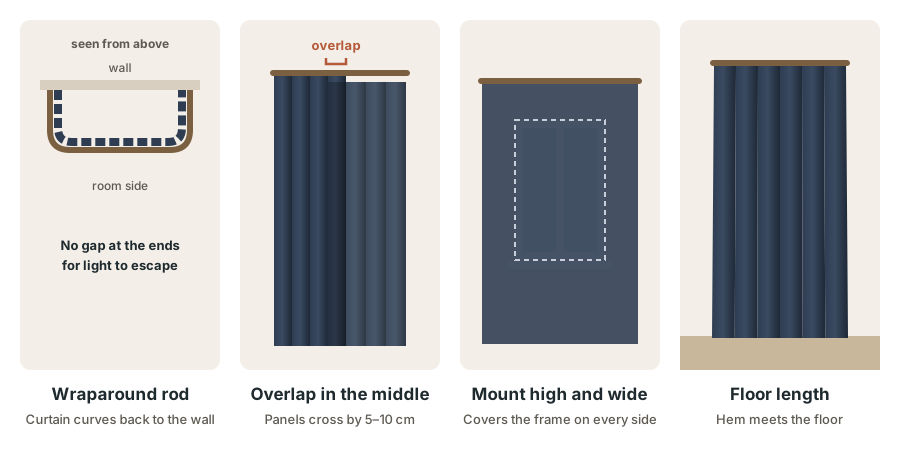
- Mount the rod high and wide: at least 10–15 cm above the frame (or close to the ceiling) and 15–25 cm or more beyond each side. See our guide on how high and wide to hang curtain rods.
- Choose enough width for the panels to overlap in the middle. Aim for 1.5–2 times the rod width in total. Our fullness guide shows how to calculate it.
- Go floor length, or add a slight break so the hem rests on the floor. See our curtain length guide.
- Use a wraparound rod, magnets or hook-and-loop strips to close the gaps at the sides.
Step 3: Choose the right fabric
Velvet
Thick, soft and luxurious, velvet naturally blocks a lot of light, insulates well and absorbs sound. It creates a cosy, enveloping feel that's perfect for bedrooms. Polyester velvet is durable and resists fading. It's heavy, so it needs a sturdy rod.
Blackout polyester
The most practical and affordable choice for darkness. Coated or triple-weave blackout polyester comes in every colour and many textures, including linen-look. Easy to wash and fade-resistant.
Lined cotton
Crisp, natural and versatile. With a blackout lining, cotton curtains give darkness with a soft, natural look.
Linen
Beautiful, relaxed and breathable, but unlined linen doesn't block light. In bedrooms, choose blackout-lined linen or layer linen curtains in front of a blackout shade. Our linen curtains guide covers the pros and cons.
Sheers
Lovely for softening daytime light, but never enough on their own in a bedroom. Use them as an inner layer behind heavier curtains.
For a full comparison of fabrics, see our guide to curtain fabrics.
Step 4: Choose a calming colour
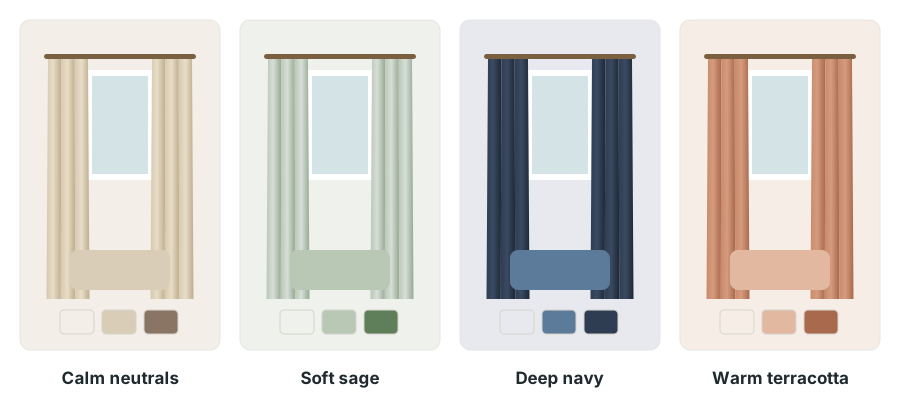
Bedroom colours set the mood. Many people find softer, muted colours more restful than bright, saturated ones. Here are four reliable directions:
- Calm neutrals: oatmeal, sand, stone and warm white. Timeless, relaxing and easy to match with any bedding.
- Soft sage and green: gentle and natural, lovely with wood furniture and plants.
- Deep navy and blue-grey: cocooning and cosy. Dark curtains make the room feel darker at night, even though true blackout fabric blocks light in any colour.
- Warm terracotta and blush: warm and inviting, especially in rooms with cooler light.
Light or dark curtains?
- Light colours keep a small bedroom feeling bright and spacious during the day, and fade less visibly in sun.
- Dark colours feel cosy and enveloping, and make the room feel darker at night.
- Matching the wall colour creates a calm, seamless look and makes the room feel larger.
- Contrasting with the wall makes the window a feature.
Patterns
Small, soft patterns and textures work well in bedrooms. Large, busy or high-contrast patterns can feel stimulating; if you love them, balance them with plain bedding and walls.
Step 5: Consider layering
Layering gives a bedroom the most flexibility:
- Sheers + blackout curtains on a double rod: sheers alone during the day for soft light and privacy; blackout curtains closed at night.
- Blackout shade + decorative curtains: the shade does the work of blocking light; the curtains add softness, colour and extra coverage. This lets you use any fabric you love, including unlined linen.
- Blackout shade + blackout curtains: the darkest possible setup, ideal for night-shift workers and nurseries.
Our guide to curtains, drapes, blinds and shades explains which shades pair best with curtains.
Step 6: Plan around the window position
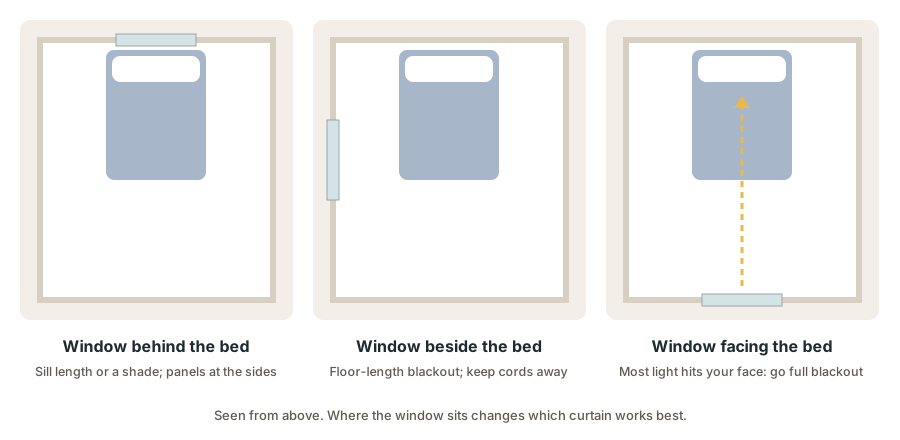
Window behind the bed
Floor-length curtains can be awkward behind a headboard. Good options are sill-length curtains, a blackout roller or blackout roman shade, or stationary floor-length side panels with a shade doing the work. Make sure curtains don't get trapped behind the headboard.
Window beside the bed
Floor-length blackout curtains work well here. Keep the bedside table clear of the curtain's path, and keep any cords well away from the bed, especially in children's rooms.
Window facing the bed
Light from this window shines directly onto your face, so it's the most disruptive position for sleep. Choose full blackout, hung high, wide and long, and consider adding a blackout shade.
Several windows
Use matching curtains at the same height on every window for a calm, unified look. Prioritise blackout on the window that lets in the most early light.
Step 7: Get the size right
- Width: total panel width of 1.5–2 times the rod width, so the curtains overlap in the middle and cover the wall at the sides.
- Length: floor length (floating about 1 cm or touching), or a slight break for maximum light blocking.
- Rod: a sturdy rod around 25 mm or thicker for heavy blackout or velvet curtains, with a centre bracket on longer rods.
Follow our step-by-step guide on how to measure windows for curtains before you buy.
Step 8: Choose an easy heading
Bedroom curtains are opened and closed every day, so choose a heading that slides easily:
- Grommet: easy to use and affordable; mount the rod high to reduce light over the top.
- Pinch pleat on rings or a track: tailored, slides smoothly and can block light well at the top.
- Avoid rod pockets for curtains you open daily.
Our curtain headings guide compares every option in detail.
Temperature: keeping bedrooms comfortable
- Hot rooms: close blackout or thermal curtains during the hottest part of the day. A light-coloured or white backing reflects sunlight back out of the window.
- Cool nights: heavy, lined curtains that reach the floor and cover the frame trap a layer of air and reduce draughts.
- Air conditioning: closing curtains on sunny windows reduces the heat the air conditioner has to remove. Keep curtains clear of the unit's airflow.
- Ventilation: in humid climates, open curtains and windows regularly to let air circulate and prevent musty smells.
Noise: what curtains can and can't do
Heavy, dense curtains, especially velvet and thick lined fabrics, absorb sound inside the room, reducing echo and making the bedroom feel quieter and cosier. They can also soften some higher-pitched outside noise. However, curtains won't soundproof a room: low-pitched sounds like traffic rumble pass through easily. If noise is a serious problem, thicker curtains help a little, but sealing gaps around windows makes a bigger difference.
Bedroom curtain ideas by room type
Main bedroom
Floor-length blackout or lined curtains in a soft, calming fabric such as velvet or linen-look polyester, hung high and wide. Add sheers on a double rod for daytime softness.
Small bedroom
- Choose light colours or curtains that match the walls, so they don't close in the room.
- Mount the rod close to the ceiling with floor-length curtains to add height.
- Extend the rod beyond the window so the open curtains don't cover the glass.
- If space beside the window is tight, a blackout roller shade with slim side panels saves room.
Children's bedroom
- Blackout curtains or a cordless blackout shade for naps and early summer mornings.
- Choose cordless products and keep any cords and tiebacks well out of reach. Window covering cords can be a strangulation hazard for young children.
- Washable fabrics, because children's rooms get messy.
- Playful colours or patterns are fine; choose ones that will still suit the child in a few years.
- Avoid long trailing curtains that small children can pull on.
Nursery
Combine a cordless blackout shade with blackout curtains for the darkest room. Choose soft, calming colours and washable fabrics, and keep the cot away from the window and any cords.
Teenager's bedroom
Blackout curtains help with late nights and late mornings. Let them choose the colour; easy-care fabrics and simple grommet headings stand up to daily use.
Guest bedroom
Guests may be sensitive to light in an unfamiliar room, so blackout curtains are a thoughtful choice. Neutral colours suit any guest and coordinate with changing bedding.
Studio or bedroom with a desk
Layer sheers with blackout curtains so you have soft, glare-free light for working during the day and darkness at night.
Box rooms and compact bedrooms benefit from the tricks in curtains for small windows and small rooms. For a baby's or child's bedroom, safety comes first: read curtains for kids' rooms and nurseries.
Why light matters for sleep
Our bodies use light as a signal for when to be awake and when to sleep. Bright light in the evening and at night can make it harder to fall asleep, while light early in the morning can wake us before we're ready. That's why a dark bedroom is widely recommended as part of good sleep habits.
Curtains help in two ways. At night, they block streetlights, car headlights, neighbours' lights and early sunrise. In the morning, opening them lets in natural daylight, which many people find helps them feel awake and alert. The ideal bedroom curtain is therefore not just dark, but easy to open fully when you get up.
How to test how dark your bedroom really is
- At night, close the curtains, switch off every light and let your eyes adjust for a few minutes. Look for light over the top of the rod, around the sides, down the middle and under the hem.
- In the morning, repeat the test just after sunrise, when outside light is strongest at a low angle.
- Note where light comes in and fix those gaps first: raise or widen the rod, add an overlap, add a valance or a wraparound rod, or layer a blackout shade.
- Check the fabric by holding a phone torch behind it. If you see a glow, it isn't true blackout.
Coordinating curtains with bedding and furniture
- Pick one colour from the bedding for the curtains, such as the colour of a stripe, a cushion or a throw. The room will look planned without being matchy.
- Mix textures, not just colours. Velvet curtains with cotton bedding, or linen curtains with a chunky knit throw, add depth.
- Keep patterns to one or two places. If the bedding is patterned, plain curtains usually look calmer, and vice versa.
- Match the rod finish to other metals in the room, such as lamp bases, handles or picture frames.
- Consider the headboard. An upholstered headboard and curtains in the same or a related fabric look elegant and cohesive.
Changing curtains with the seasons
Some people like to adjust bedroom curtains through the year:
- Hot months: close blackout or thermal curtains during the day to keep heat out, and use sheers for soft light in the evening.
- Cooler months: heavier lined or velvet curtains add warmth and cosiness.
- Easy swaps: a double rod lets you change just the front layer for a seasonal refresh while keeping the blackout layer in place.
Motorised curtains and shades in the bedroom
Motorised tracks and shades can open at a set time each morning to let daylight wake you gently, and close automatically in the evening or during the hottest part of the day. They're especially handy for large or hard-to-reach windows, and because they have no cords, they're a safe choice for children's rooms. The trade-offs are higher cost and the need for charging or a power supply.
Keeping bedroom curtains clean and allergy-friendly
Curtains collect dust, which matters in a room where you spend a third of your life. Vacuum them every few weeks with a soft brush attachment, and wash or clean them every few months according to the care label. Washable fabrics such as polyester and many cottons make this easier. If anyone in your home has dust allergies, smooth, tightly woven fabrics that are easy to wash are a practical choice.
Bedroom curtains for hot and humid climates
In warm, humid places, bedroom curtains have extra work to do. They need to keep out strong sun, help the room stay cool, and resist dampness and mildew.
- Choose blackout or thermal curtains with a light-coloured backing for sun-facing windows. The pale back reflects heat out of the window.
- Close them during the hottest hours, usually late morning to late afternoon on west- and south-facing windows, to stop the room heating up before bedtime.
- Prefer synthetic or blended fabrics, such as polyester blackout, which resist mildew and dry quickly after washing.
- Leave a little space between curtains and walls so air can move, and open curtains and windows regularly to let the room breathe.
- Avoid very heavy fabrics like thick velvet in rooms without air conditioning; they can make the room feel stuffy.
- Wash curtains more often in humid seasons to prevent musty smells.
Bedroom curtains on a budget
- Spend on blackout performance first. Ready-made blackout polyester curtains are affordable and effective.
- Add a blackout liner to curtains you already own instead of replacing them.
- Prioritise width and length over fabric price. Generous, floor-length curtains look better and block more light.
- Use an inexpensive blackout roller shade behind existing curtains.
- Raise the rod before buying anything new; it costs nothing and makes a big difference.
Bedroom curtain checklist
- Blackout or room-darkening, depending on your sleep needs.
- Rod mounted high and wide.
- Panels that overlap in the middle (1.5–2× rod width).
- Floor length or a slight break.
- A heading that slides easily.
- A calming colour that suits the room.
- Cordless products in children's rooms.
- Washable or easy-care fabric.
- Sturdy rod and secure brackets.
Common bedroom curtain mistakes
- Choosing light-filtering curtains for a light sleeper. Go blackout.
- Hanging the rod right on the frame, so light pours over the top.
- Buying narrow panels that can't overlap in the middle.
- Curtains that stop short of the floor, letting light in underneath.
- Rod pocket curtains on a window you open daily.
- Long curtains trapped behind a headboard. Use a shade or side panels instead.
- Corded products in a child's room. Choose cordless.
Frequently asked questions
What type of curtains are best for a bedroom?
For most people, floor-length blackout curtains, hung high and wide, with panels that overlap in the middle. Light sleepers and day sleepers benefit from adding a blackout shade.
Should bedroom curtains be light or dark?
Either can work. With true blackout fabric, both block light. Dark colours feel cosier and make the room feel darker; light colours keep a small room feeling bright by day.
Are blackout curtains good for sleep?
A dark bedroom is widely recommended for good sleep, and blackout curtains are one of the easiest ways to achieve it, especially with early sunrise or streetlights.
Should bedroom curtains touch the floor?
Yes, ideally. Floor-length curtains, or a slight break, stop light leaking under the hem and make the room feel taller.
Can I use linen curtains in a bedroom?
Yes, if they're blackout-lined, or if you layer them in front of a blackout shade or curtain.
What curtains are safest for children's rooms?
Cordless designs, with any tiebacks or cords kept well out of reach, in washable fabrics.
Do I need both a blind and curtains in a bedroom?
Not always. Well-hung blackout curtains are enough for most people. Adding a blackout shade helps light sleepers, day sleepers and nurseries, and lets you use decorative fabrics in front.
How often should bedroom curtains be washed?
Vacuum them every few weeks and wash or clean them every few months, or more often in humid climates or if anyone has dust allergies. Always follow the care label.
The bottom line
The best bedroom curtains are dark enough for your sleep, sized and hung so light can't sneak around them, easy to open every morning, and in a fabric and colour that make the room feel calm. Start with blackout, mount the rod high and wide, choose generous width and floor length, and layer a shade or sheers if you need extra darkness or daytime softness. Get these basics right, and your bedroom will become the restful retreat it should be.
Keep reading
 Room Ideas
Bay window curtain ideas: how to measure, hang and style them
Bay windows are beautiful but tricky to dress. Here's how to choose between bent tracks, bay poles, separate rods and shades, how to measure every angle, and how to style a bay in any room.
 Room Ideas
Curtains for kids' rooms and nurseries: safety and style
Children's rooms need curtains that are safe, darken the room for sleep, wash easily and grow with your child. Here's how to choose curtains for nurseries and kids' bedrooms.
 Room Ideas
Curtains for large windows and sliding glass doors: a complete guide
Big windows and sliding doors need curtains that are wide enough, strong enough and easy to use. Here's how to measure, choose the hardware, fabric, fullness and style for large openings.