Styles
Fitted horizontal blinds: a complete guide to made-to-measure blinds that fit perfectly

Fitted horizontal blinds are blinds made to the exact size of a particular window, with slats or fabric that run from side to side and move up and down. Because they're measured and made for one window, they sit neatly in the frame or recess, leave the smallest possible gaps, and look far tidier than ready-made blinds cut down to a near-enough size.
The phrase covers a family of blinds rather than one product: venetian blinds with tilting slats, roller blinds, roman blinds, pleated and cellular blinds, and more. What they share is that they work horizontally and are fitted to measure. This guide explains the types, the three main ways to fit them, which suits each room, how to measure accurately, child safety, fitting, and how to keep them looking good for years. Whether you're dressing one small bathroom window or every window in a new home, the same principles apply.
What does "fitted" mean?
"Fitted" usually means one of two things, and it helps to know which a supplier means:
- Made to measure: the blind is made to the exact width and drop of your window, rather than chosen from a few standard sizes.
- Fitted to the window frame: the blind is mounted on the window itself, often in a slim frame that clips onto the sash of a uPVC window, so it moves with the window and sits close to the glass. These are often called "perfect fit" or frame blinds.
Both give a neater, more precise result than ready-made blinds. Some fitted blinds are installed by the supplier; many are designed for easy DIY fitting.
Fitted vs. ready-made blinds
| Fitted (made to measure) | Ready-made | |
|---|---|---|
| Size | Exact to your window | Standard widths and drops |
| Fit | Minimal gaps, neat look | Often too wide, narrow or long |
| Light control | Better, fewer gaps at the edges | More light leaks |
| Choice | Huge range of colours, fabrics and controls | Limited |
| Delivery | Usually made to order | Available straight away |
| Cost | Higher | Lower |
Ready-made blinds can be fine for a quick fix or a standard-sized window. For awkward sizes, bay windows, tilt-and-turn windows and anywhere you care about light and appearance, fitted blinds are worth it.
Types of fitted horizontal blinds
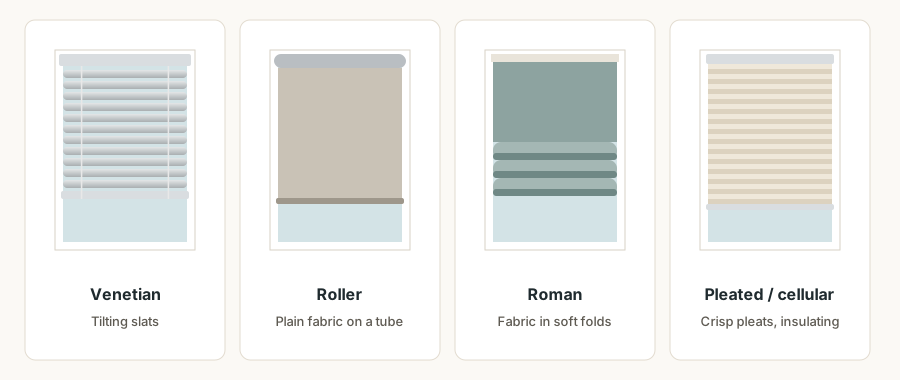
Venetian blinds
Horizontal slats held together by ladder strings or tapes. You can tilt the slats to control light and privacy precisely, and raise the whole blind to clear the window. Venetians come in:
- Aluminium: slim, light, moisture-proof and affordable; ideal for kitchens and bathrooms. See our aluminium venetian blinds guide.
- Real wood: warm and natural, with wider slats; best in living rooms, bedrooms and studies. See our guides to oak wooden blinds and walnut venetian blinds.
- Faux wood: a wood look in a moisture-resistant material, heavier than real wood.
Roller blinds
A single piece of fabric that rolls around a tube at the top. They're simple, slim and affordable, and come in light-filtering, dim-out and blackout fabrics. They don't tilt, so it's either up, down or somewhere in between.
Roman blinds
Fabric that folds into soft horizontal pleats as it rises. They add the softness and pattern of curtains in a neat, compact form, and can be lined for blackout. See our blackout roman shades guide.
Pleated and cellular (honeycomb) blinds
Crisp, concertina-like pleats of fabric. Cellular blinds have two layers forming air pockets that insulate well. Both are very slim when raised and come in top-down/bottom-up versions. They're popular in conservatories, roof windows and perfect fit frames.
Day and night (vision) blinds
Two layers of fabric with alternating sheer and solid horizontal bands. Sliding the layers lines the bands up for light or offsets them for privacy. They give some of the control of a venetian with the softness of fabric.
Which type suits what?
| Type | Light control | Damp rooms | Insulation | Look |
|---|---|---|---|---|
| Aluminium venetian | Excellent (tilting) | Excellent | Low | Crisp, modern |
| Wood venetian | Excellent (tilting) | Poor (real wood) | Fair | Warm, natural |
| Faux wood venetian | Excellent (tilting) | Very good | Fair | Wood look |
| Roller | Good (up or down) | Good with suitable fabric | Fair | Simple, minimal |
| Roman | Good | Poor to fair | Good (lined) | Soft, tailored |
| Pleated / cellular | Good, top-down options | Fair to good | Very good (cellular) | Neat, light |
Three ways to fit horizontal blinds
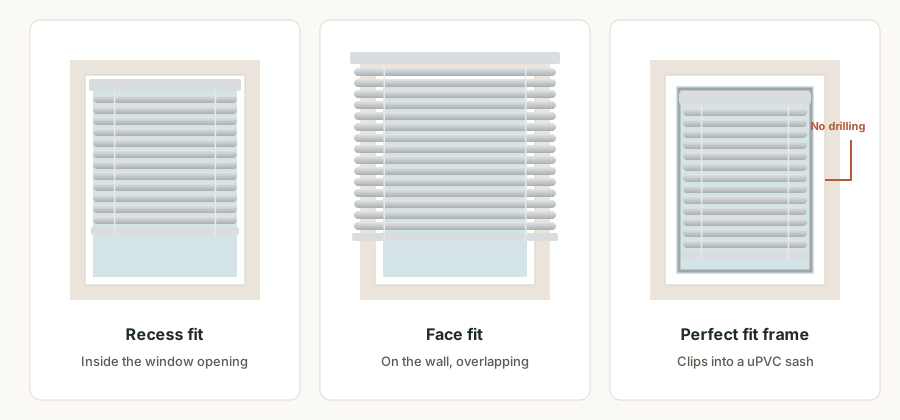
Recess fit (inside mount)
The blind sits inside the window opening. It's the neatest, most built-in look, and keeps the window sill and surrounding wall clear. The blind is made slightly narrower than the recess so it can move freely, which leaves thin gaps of light at the sides. You need enough recess depth for the headrail and, for venetians, for the slats to tilt without hitting handles.
Face fit (outside mount)
The blind is fixed to the wall or frame above the window and overlaps the opening on each side. It blocks more light, can make a window look bigger, and works where the recess is too shallow, uneven or blocked by handles. It's the best choice for bedrooms where darkness matters.
Perfect fit frame (fitted to the window)
The blind sits in a slim aluminium frame that clips onto the glazing beads of a uPVC window, usually with no drilling. Because it's fixed to the opening part of the window, it moves with the window when you open it, which makes it ideal for tilt-and-turn windows, doors and conservatories. The frame holds the blind close to the glass, so there are almost no light gaps at the sides and no loose cords or swinging slats.
Perfect fit frames need a suitable window: usually uPVC with glazing beads of the right depth and shape. Most suppliers publish a simple check, and some send a free gauge. Aluminium and timber windows often need different fixing.
Which fitting method should you choose?
- Neatest look, deep recess: recess fit.
- Darkest room or shallow recess: face fit.
- Tilt-and-turn, uPVC doors, conservatories, rentals where you can't drill the walls: perfect fit frame (check the tenancy and window first).
The benefits of fitted horizontal blinds
- A precise, tidy fit that looks built-in rather than added on.
- Better light and privacy control, with fewer gaps at the edges.
- Space-saving: they stack small at the top and leave sills and floors clear.
- Huge choice of materials, colours, fabrics and controls.
- Works with awkward windows, including bays, very narrow or very wide windows, and tilt-and-turn windows.
- Can be layered with curtains for warmth and softness.
Possible downsides
- Higher cost and a wait while they're made.
- Measuring mistakes are costly, because a blind made to the wrong size usually can't be returned.
- Recess-fit blinds leak a little light at the sides.
- Horizontal slats collect dust, especially in kitchens.
Choosing fitted horizontal blinds room by room
Living rooms
Wood or faux wood venetians give warmth and adjustable light; roman blinds add pattern and softness. Pair either with curtains for a layered look. See our living room curtain ideas.
Bedrooms
Blackout roller or roman blinds, face fitted for the darkest room, or a perfect fit blackout blind on uPVC windows. Wood venetians are lovely but always leak some light, so add lined curtains. See best curtains for bedrooms.
Kitchens
Aluminium or faux wood venetians, or wipe-clean roller blinds, keep things practical. Keep blinds clear of hobs. See kitchen curtain ideas.
Bathrooms
Aluminium venetians, faux wood or water-resistant roller fabrics. Avoid real wood and most fabric roman blinds.
Home offices
Venetians are excellent for cutting screen glare while keeping the room bright. Top-down/bottom-up pleated blinds let light in above the desk while shading your eyes.
Children's rooms
Cordless or perfect fit blinds with no loose cords, in blackout fabric for naps. See curtains for kids' rooms and nurseries.
Conservatories
Pleated or cellular blinds in perfect fit frames are the classic choice. Reflective or light backings help keep heat out in summer.
Bay windows
One blind per window gives a neat fit around the bay; check how the headrails meet at the corners. See bay window curtain ideas.
Small windows
Fitted blinds are perfect where curtains would swamp the window. See curtains for small windows and small rooms.
How to measure for fitted horizontal blinds
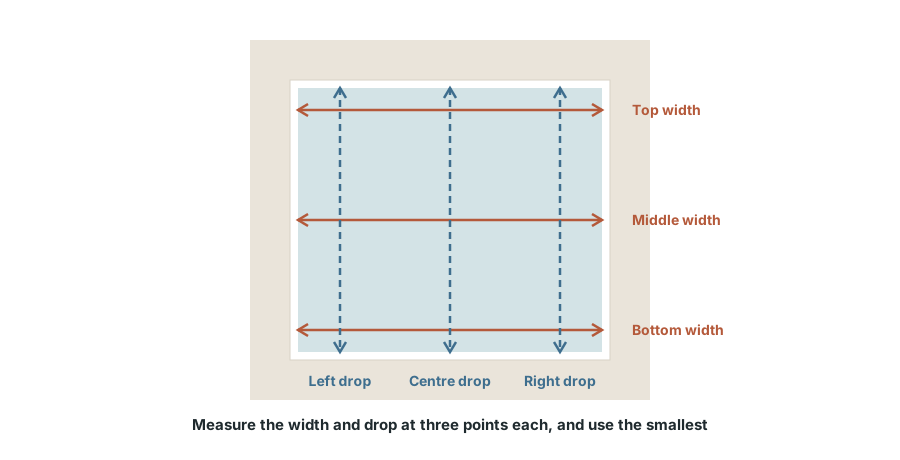
Accurate measuring is the most important step, because a fitted blind is made for one window only. Use a steel tape measure, work in millimetres, and measure every window separately, even if they look the same. Always check whether your supplier wants the exact recess size (they make the deduction) or the finished blind size.
Recess fit
- Width: measure inside the recess at the top, middle and bottom. Use the smallest.
- Drop: measure from the top of the recess to the sill at the left, centre and right. Use the smallest.
- Depth: check the recess depth against the maker's minimum for your blind type, and note handles, locks or tiles that stick out.
- Obstructions: look for curtain poles, alarm sensors or plaster bulges that could get in the way.
Face fit
- Width: measure the width of the opening and add an overlap, typically 5–10 cm on each side.
- Drop: measure from where the headrail will sit (usually 5–10 cm above the opening) to just below the sill, or to the sill if it sticks out.
- Check space above the window for the brackets.
Perfect fit frame
- Check your window is suitable using the supplier's guide or gauge for bead depth and angle.
- Measure the glass or the visible area between the glazing beads, as the supplier instructs; perfect fit blinds are usually measured very differently from recess blinds.
- Measure each opening sash separately.
Our guide on how to measure windows for curtains covers measuring tips that apply to blinds too.
Controls and child safety
Fitted horizontal blinds can be operated in several ways:
- Cord and cord lock: traditional and simple.
- Continuous chain or loop: easy for larger blinds; the loop must be held tight with a tensioner fixed to the wall.
- Tilt wand: for turning venetian slats.
- Cordless: push and pull the bottom rail; no cords at all.
- Motorised: battery or mains motors with a remote, app or timer.
Loose or looped cords on blinds can strangle young children. In homes with children, choose cordless, motorised or perfect fit blinds where possible. If a blind has cords or chains, fit the safety devices supplied, keep cords taut and out of reach, and move beds, cots and furniture away from windows.
How to fit horizontal blinds
Recess and face fit
- Unpack and check the blind, brackets, screws and safety parts.
- Mark the bracket positions near each end of the headrail, plus centre brackets on wide blinds. Use a spirit level.
- Drill and fix the brackets with fixings that suit the wall, ceiling or frame. Take care not to drill into the glass or drainage channels of uPVC frames.
- Clip in the headrail and lock the brackets.
- Attach the wand or chain and fit cord safety devices.
- Test by raising, lowering and tilting a few times.
Perfect fit frame
- Clean the glazing beads.
- Clip the brackets onto the top and bottom beads in the positions shown in the instructions.
- Push the frame into the brackets until it clicks into place.
- Test the blind, then open and close the window to check it moves freely.
For more on fixings and finding studs, see how to hang curtains.
Colours, materials and finishes
- White and soft white match most window frames and keep rooms bright.
- Greys look calm and modern and hide dust well.
- Natural wood tones add warmth.
- Bold colours and patterns work best on roller and roman blinds.
- Matching the frame (white blinds on white frames, for example) gives the most built-in look.
Many fabric blinds have a white or neutral backing that faces the street, giving a tidy look from outside and reflecting summer heat. For help choosing colours, see how to choose curtain colours.
Fitted horizontal blinds for awkward windows
Tilt-and-turn windows
These open inwards, so a blind in the recess would block them. A perfect fit frame or a blind fixed directly to the sash moves with the window and never gets in the way. Choose slim pleated, roller or 25 mm venetian blinds to keep the depth down.
French doors and patio doors
Blinds fixed to each door leaf move with the door. Hold-down brackets or perfect fit frames stop venetians from swinging and tapping on the glass. For very wide sliding doors, vertical blinds or curtains may work better; see curtains for large windows and sliding doors.
Very wide windows
Split a wide window into two or three blinds, ideally lining the joins up with the window's own frames. Each blind is lighter to lift, and you can raise one section at a time.
Corner windows
Where two windows meet at a corner, the headrails must clear each other. Most suppliers explain how much to deduct from one blind so they don't clash.
Roof and skylight windows
Ordinary blinds would sag on a sloping window. Roof windows need blinds held in side channels or tensioned, usually from the window maker or a specialist.
Arched and shaped windows
Horizontal blinds are rectangular, so on an arched window they're usually fitted below the arch, leaving the curve uncovered, or face fitted above it. Custom shaped blinds exist but are specialist and costly.
Ordering tips
- Order samples of slats or fabrics and look at them in your room at different times of day, against your frames, walls and floor.
- Check the deduction policy so you know whether to give recess or finished sizes.
- Label each window on your measurement list ("kitchen left", "bedroom bay centre") so blinds go to the right place.
- Choose the control side for each blind, keeping cords and wands away from beds, worktops and furniture.
- Ask about returns and remakes: some suppliers offer a remake guarantee if you mis-measure.
- What affects the price: size, material (real wood costs more than aluminium), fabric grade, blackout linings, cordless or motorised controls and fitting service.
Light, privacy and energy
- For privacy with daylight, tilt venetian slats upward, or use a top-down/bottom-up blind.
- For darkness, choose blackout roller, roman or pleated fabrics and face fit them, or use perfect fit frames.
- For warmth, cellular blinds trap air and insulate well; any blind closed at dusk reduces heat loss through the glass.
- For summer heat, light or reflective backings and closing blinds during the hottest hours help keep rooms cool.
For extra insulation, combine blinds with thermal curtains; see our thermal curtains guide.
Layering blinds with curtains
A fitted blind inside the recess, with curtains hung on a pole above and beyond the window, is one of the most practical and attractive window treatments. The blind handles everyday light and privacy; the curtains add softness, colour, warmth and darkness at night. Fit the pole far enough from the wall to clear the blind, and hang it higher and wider than the window. See how high to hang curtain rods.
Caring for fitted horizontal blinds
- Venetians: dust weekly with a microfibre cloth, a duster or a soft vacuum brush, closing the slats one way and then the other. Wipe aluminium and faux wood with a damp cloth; only dust real wood, or use a barely damp cloth and dry immediately.
- Roller and pleated blinds: vacuum gently and spot clean with a damp cloth and mild soap. Many fabrics are treated to resist dust and stains.
- Roman blinds: vacuum and spot clean; don't machine wash unless the maker says it's safe.
- All blinds: raise them a little on cold mornings to let condensation dry, and check cords and safety devices now and then.
Common mistakes
- Measuring only once instead of at three points.
- Making the deduction twice when the supplier already does it.
- Ignoring recess depth, so slats hit the handles.
- Choosing a recess fit for a bedroom that needs darkness.
- Choosing real wood for a steamy bathroom.
- Buying perfect fit frames without checking the window beads first.
- Leaving cords loose where children live or visit.
Frequently asked questions
What are fitted horizontal blinds?
They're blinds made to the exact size of your window, with slats or fabric that run horizontally and raise and lower. Venetian, roller, roman, pleated and cellular blinds are all horizontal blinds.
Are fitted blinds better than ready-made?
For most windows, yes: they fit precisely, leave fewer gaps, look neater and offer far more choice. Ready-made blinds are cheaper and faster for standard sizes.
Do perfect fit blinds need drilling?
Usually not. Most clip onto the glazing beads of uPVC windows. Some window types need small screws instead.
Which horizontal blind is best for a bathroom?
Aluminium or faux wood venetians, or a water-resistant roller fabric.
Can I fit horizontal blinds myself?
Yes. Most recess, face fit and perfect fit blinds are designed for DIY fitting with basic tools. Measuring carefully is the hardest part.
How long do fitted horizontal blinds last?
Good-quality fitted blinds often last many years with normal use. Cords, chains, wands and individual slats can usually be replaced, and choosing the right material for the room (aluminium or faux wood in damp areas, for example) makes the biggest difference to lifespan.
What's the difference between horizontal and vertical blinds?
Horizontal blinds have slats or fabric that run side to side and raise and lower. Vertical blinds have tall louvres that hang down and draw to the side, which suits very wide windows and patio doors.
The bottom line
Fitted horizontal blinds give you a neat, made-to-measure window covering with the light control you need. Choose venetians for adjustable light, roller or roman blinds for simplicity or softness, and pleated or cellular blinds for slim stacks and insulation. Pick a recess fit for the neatest look, a face fit for the darkest room, and a perfect fit frame for tilt-and-turn windows and conservatories. Measure carefully at three points, choose cordless or perfect fit options where children live, and keep your blinds dusted, and they'll look sharp and work smoothly for years.
Keep reading
 Styles
Oak wooden blinds: shades, slat sizes, real oak vs oak-effect, and care
Oak wooden blinds bring light, natural warmth to any room. Compare oak shades, real wood and oak-effect options, slat sizes and tapes, and learn how to style and care for them.
 Styles
Blackout roman shades: how to choose, measure and fit them for a truly dark room
Blackout roman shades combine soft fabric folds with real darkness. Learn the styles, linings, mounts, measuring, cord safety and tricks that stop light leaking around the edges.
 Styles
Walnut venetian blinds: real wood vs faux wood, styling and care
Rich, warm and timeless, walnut venetian blinds bring the look of dark wood to any window. Compare real and faux wood, slat sizes and tapes, and learn how to style and care for them.