Styles
Aluminium venetian blinds: a complete guide to choosing, fitting and caring for them

Aluminium venetian blinds are one of the most practical window coverings you can buy. They are slim, light, tough, inexpensive and easy to clean, and they let you control light and privacy with a simple twist of a wand. They have been around for decades, but modern versions come in far more colours, finishes and slat sizes than the office blinds many of us remember, and they look sharp in kitchens, bathrooms, home offices, bedrooms and modern living spaces.
This guide explains everything you need to know before buying an aluminium venetian blind: how they work, their pros and cons, which slat size and colour to choose, where they work best, how to measure for inside or outside the recess, child safety, fitting, everyday use and cleaning.
What is an aluminium venetian blind?
A venetian blind is made of horizontal slats held together by thin ladder strings (or wider fabric tapes). The slats can be tilted to let in more or less light, and the whole blind can be raised to clear the window. In an aluminium venetian blind, the slats are thin, slightly curved strips of aluminium, usually painted or coated in a baked-on finish.
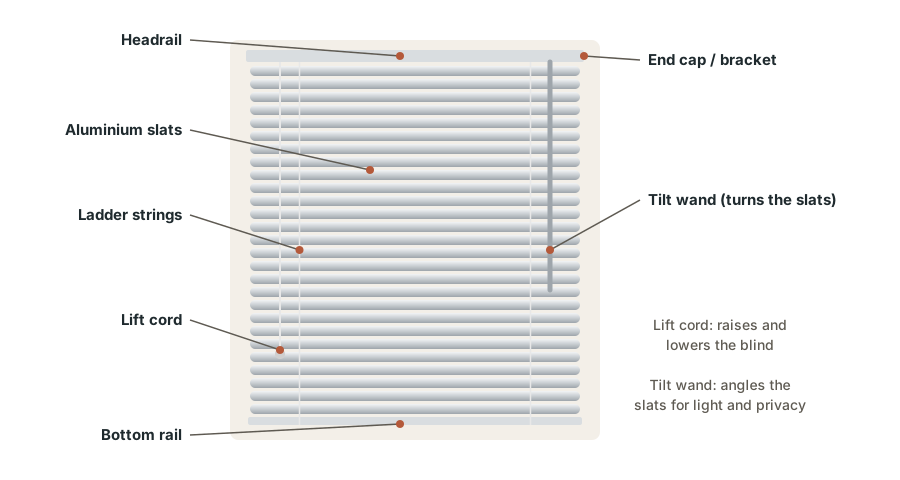
- Headrail: the metal box at the top that holds the mechanism and fixes to the brackets.
- Slats: the aluminium strips that tilt to control light.
- Ladder strings: the thin cords running down each side that hold the slats evenly spaced and tilt them.
- Lift cord: raises and lowers the blind, and locks it at the height you want. On cordless blinds, you simply push or pull the bottom rail instead.
- Tilt wand or tilt cord: turns the slats open or closed.
- Bottom rail: the weighted rail at the bottom that keeps the blind straight.
- Brackets: fix the headrail to the wall, ceiling or inside of the window frame.
Why choose aluminium venetian window blinds?
The advantages
- Moisture-resistant: aluminium doesn't swell, warp or go mouldy in steam, which makes it one of the best choices for bathrooms and kitchens.
- Precise light control: you can angle the slats to direct light up to the ceiling, block glare or close them fully.
- Privacy without darkness: slats tilted upwards stop people seeing in while still letting daylight through.
- Slim and space-saving: they sit neatly inside a window recess and stack small when raised.
- Easy to clean: a quick wipe removes dust and kitchen splashes.
- Affordable: they are among the least expensive made-to-measure blinds.
- Lightweight and durable: easy to operate and long-lasting with normal care.
- Huge choice of colours: from white and silver to bold colours, metallics and wood-look prints.
The disadvantages
- Can dent or bend: thin slats can kink if knocked, grabbed by children or chewed by pets.
- Some light gets through: even fully closed, small gaps between slats and around the edges let light in, so they are not a true blackout option.
- Can rattle: in a breeze from an open window, slats can tap against each other and the frame.
- Less warm and soft: they look crisp and clean but don't add the softness of fabric, and they insulate less than thick curtains.
- Dust shows: horizontal slats collect dust, especially in kitchens with cooking grease.
Choosing the slat size
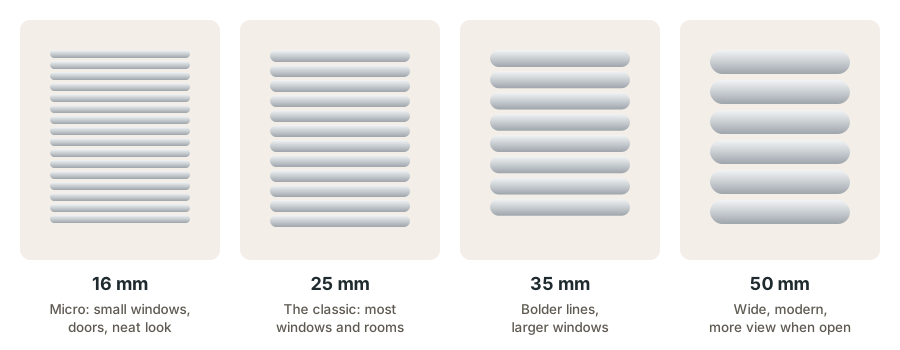
The width of the slats has the biggest effect on how an aluminium venetian blind looks and works. The most common sizes are:
| Slat width | Look | Best for |
|---|---|---|
| 16 mm (micro) | Very fine, almost like a texture | Small windows, glazed doors, tilt-and-turn windows, shallow recesses |
| 25 mm | The classic venetian look | Most windows in kitchens, bathrooms, bedrooms and offices |
| 35 mm | Bolder, more contemporary lines | Larger windows and modern rooms |
| 50 mm | Wide, statement slats | Big windows where you want more view between the slats when open |
As a rule, the bigger the window, the wider the slats can be. Wider slats also mean fewer of them, so there's a clearer view through the gaps when they're open and a deeper stack when the blind is raised. Narrow slats suit small windows and shallow recesses, because they need less depth to tilt without hitting the glass or handles.
Colours and finishes
Aluminium slats come in a wider range of finishes than almost any other blind:
- White and off-white: clean, bright and the most popular choice. They blend with white window frames and make rooms feel larger.
- Silver and brushed metal: modern and slightly industrial, lovely in kitchens with stainless steel appliances.
- Greys and charcoal: sophisticated and contemporary, ideal for home offices and modern bathrooms.
- Black: bold and graphic, especially effective against white walls or black window frames.
- Colours: soft pastels, sage, navy or brighter shades for kitchens and children's rooms.
- Metallic finishes: brass, copper and gold effects for a touch of glamour.
- Wood-effect prints: the look of wood with aluminium's practicality in a damp room. If you love the real wood look, see our guides to oak wooden blinds and walnut venetian blinds.
- Perforated slats: tiny holes let a soft glow of light through even when the slats are closed, while keeping privacy.
A matte finish hides fingerprints and water spots better than gloss, which matters in bathrooms and kitchens. For help matching colours to your room, see how to choose curtain colours; the same principles apply to blinds.
Where aluminium venetian blinds work best
Bathrooms
Aluminium is one of the best blind materials for bathrooms. It copes with steam, splashes and humidity, and tilting the slats upwards gives privacy while still letting in daylight. Choose a matte finish and wipe it down now and then to prevent water spots.
Kitchens
Kitchens need easy cleaning and good light. Aluminium blinds can be wiped free of grease, and they don't absorb cooking smells the way fabric does. Keep them raised when cooking near a hob, and choose a lighter colour that won't show every speck of dust. Our kitchen curtain ideas cover more options for kitchen windows.
Home offices
The ability to angle the slats makes aluminium blinds excellent for cutting glare on computer screens while keeping the room bright.
Bedrooms
Aluminium blinds give flexible privacy, but light leaks around the slats, so they are not enough on their own for a dark bedroom. Pair them with lined or blackout curtains; see our blackout curtains guide and best curtains for bedrooms.
Small windows and glazed doors
Slim 16 mm or 25 mm aluminium blinds fit neatly on small windows, door panels and tilt-and-turn windows where curtains would get in the way. For more ideas, see curtains for small windows and small rooms.
Conservatories and sunrooms
Aluminium blinds reflect some heat and control glare, though on large glass roofs and walls they can make the room look busy. Light colours reflect more heat than dark ones.
Aluminium vs. other venetian blinds
| Feature | Aluminium | Real wood | Faux wood |
|---|---|---|---|
| Damp rooms | Excellent | Poor | Very good |
| Weight | Very light | Light to medium | Heavy |
| Look | Crisp, modern | Warm, natural | Wood look, slightly uniform |
| Durability | Can dent | Can warp in damp | Very durable |
| Cost | Low | Medium to high | Medium |
| Typical slats | 16–50 mm | 35–63 mm | 50–63 mm |
To compare blinds with curtains, shades and drapes, read curtains vs. drapes vs. blinds vs. shades.
Inside or outside the recess?
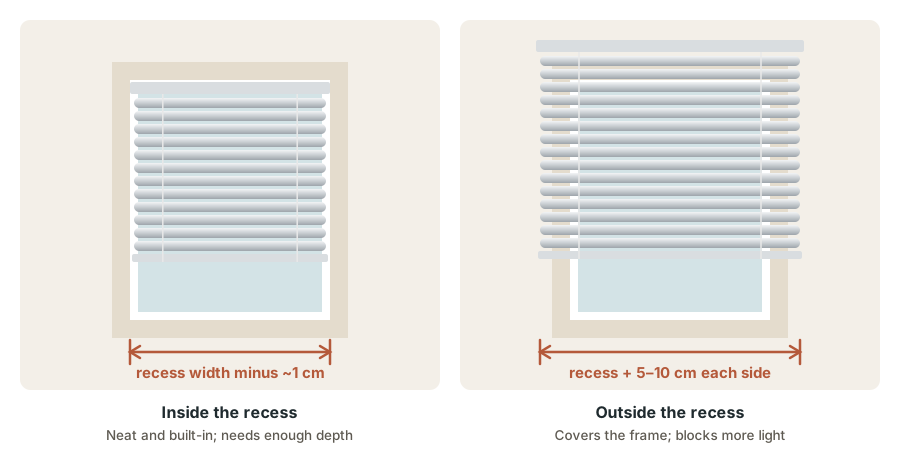
Inside the recess
The blind sits within the window opening, so the frame and surrounding wall stay visible. This is the neatest look and the most popular choice for aluminium blinds. You need enough depth in the recess for the headrail and for the slats to tilt without hitting handles, so check the minimum depth the maker gives for your slat size before you order.
Outside the recess (face fit)
The blind is fixed to the wall above the window and overlaps it on each side. It is the better choice when the recess is too shallow, when window handles stick out, or when you want to block more light at the edges. It can also make a small window look bigger.
How to measure for an aluminium venetian blind
Use a metal tape measure and record everything in millimetres, as most made-to-measure suppliers do. Always measure each window separately, even if they look identical.
Measuring inside the recess
- Width: measure the width of the recess at the top, middle and bottom. Use the smallest measurement.
- Drop: measure the height from the top of the recess to the sill on the left, middle and right. Use the smallest.
- Depth: measure how deep the recess is, and note any handles or locks that stick out.
- Give the exact recess size: most suppliers then make the blind slightly narrower (usually about 1 cm) so it fits without rubbing. Check whether the supplier makes this deduction for you or expects you to do it, so it isn't deducted twice.
Measuring outside the recess
- Width: measure the width of the window opening and add 5–10 cm on each side for good coverage and privacy.
- Drop: measure from where the headrail will sit (usually 5–10 cm above the opening) to 5–10 cm below the sill, or to the sill if it sticks out.
- Check the wall space above the window for the brackets, and that nothing (like a coving or curtain pole) is in the way.
Our guide on how to measure windows explains the basics, and the same care applies to blinds.
Cords and child safety
Looped cords on blinds can be a strangulation hazard for young children. Modern blinds sold in many countries must meet child-safety standards, but it's still important to choose and fit them carefully:
- Choose cordless or wand-operated blinds wherever children live or visit.
- If your blind has cords, fit the cord tidy or tensioner supplied, high on the wall and out of reach, and keep cords tight.
- Keep cots, beds and climbable furniture away from windows with blinds.
- Replace older blinds with loose looped cords that can't be made safe.
Read our guide to curtains for kids' rooms and nurseries for more on window safety in children's rooms.
How to fit an aluminium venetian blind
- Check the parts: headrail, brackets, screws, tilt wand, cord tidy (if corded) and any end caps.
- Mark the bracket positions: for inside-recess fitting, about 5–8 cm in from each end of the headrail; for outside fitting, on the wall above the window, level with each other. Wider blinds need a centre bracket too.
- Drill and fix the brackets: use the right wall plugs or screws for your wall or window frame. For uPVC frames, take care not to drill into the glazing or drainage channels.
- Clip in the headrail: most aluminium blinds simply snap into their brackets and lock with a small catch.
- Attach the tilt wand to its hook, and fit the cord tidy if supplied.
- Test it: raise, lower and tilt the blind a few times, checking it hangs straight.
Our guide on how to hang curtains explains how to find studs, use wall plugs and keep brackets level.
Using your blind for the best light and privacy
- Slats tilted upwards (the inside edge higher than the outside): bounces light onto the ceiling and blocks the view from outside and below. This is the best setting for privacy in daytime.
- Slats level: the most light and view.
- Slats tilted downwards: directs light onto the floor and lets people below see in more easily; better for upstairs windows that aren't overlooked.
- Fully closed: blocks most light, but some still gets through the edges and cord holes.
- At night: close the slats with the convex side facing out for the best privacy when lights are on inside.
Heat, glare and energy
Aluminium venetian window blinds are not an insulating layer in the way thick curtains are, but they still help with comfort. On sunny days, slats tilted to reflect light back towards the glass bounce away part of the sun's heat before it reaches the room. A white or silver finish reflects the most; dark colours absorb more heat and can make the slats warm to the touch. In a south- or west-facing room, closing the blind during the hottest hours keeps the space noticeably cooler and protects floors and furniture from fading.
In winter, the layer of air between the blind and the glass helps a little, but the gaps between slats let warm air escape. If a room feels cold, add thermal or lined curtains over the blind, close them at dusk, and leave the blind open during the day to let free solar warmth in.
Special windows and doors
Tilt-and-turn windows
These windows open inwards, so an inside-recess blind would block them. The usual answer is a blind fixed directly to the opening sash with special brackets, so it moves with the window. Slim 16 mm or 25 mm slats keep the weight and depth down.
Doors and French doors
Fix the blind to the door itself, above the glass, so it moves with the door. Hold-down brackets at the bottom stop the blind swinging and rattling every time the door opens and closes.
Wide windows
Very wide windows are usually better with two or three blinds side by side, either on one shared headrail or as separate blinds. Each blind is lighter to raise, and you can open one section at a time. Bay windows work the same way, with one blind per pane; see our bay window curtain ideas for more.
Hard-to-reach windows
For high windows, or windows behind a sink or worktop, choose a longer tilt wand or a motorised blind. Battery-powered motors can raise, lower and tilt the slats with a remote or an app, with no cords at all.
Cleaning and care
Regular dusting
- Close the slats one way and dust from top to bottom with a microfibre cloth, a lambswool duster or a vacuum with a soft brush attachment.
- Tilt the slats the other way and repeat on the reverse side.
- A slat-cleaning tool with fabric "fingers" lets you clean several slats at once.
Deeper cleaning
- Wipe each slat with a cloth dampened in warm water and a little washing-up liquid, then dry it with a clean cloth to avoid water spots.
- For kitchen grease, use warm soapy water and wipe slowly; avoid abrasive pads and strong solvents that can damage the coating.
- Very dirty blinds can be taken down and laid in a bath of warm soapy water, but keep the headrail mechanism out of the water and dry the blind thoroughly before rehanging. Always check the maker's care instructions first.
Fixing small problems
- A bent slat: gently flatten it between your fingers; badly bent slats can often be replaced by the supplier.
- A blind that won't lock: pull the lift cord slightly towards the centre of the window, then release.
- Uneven blind: lower it fully and tilt it open, then raise again; the cords usually rebalance.
For cleaning curtains you use alongside blinds, see how to wash curtains.
Combining blinds and curtains
Blinds and curtains work beautifully together. The blind handles daily light and privacy, while curtains add softness, colour, warmth and darkness at night.
- Inside-recess blind + floor-length curtains on a rod above the window: the classic combination for living rooms and bedrooms.
- Blind + side panels that don't close: a neat, decorative frame.
- Blind + thermal curtains: the curtains add the insulation the blind lacks; see our thermal curtains guide.
When combining them, fit the curtain rod far enough out from the wall to clear the blind's headrail and tilt wand.
Buying tips
When people search for blinds, venetian aluminium styles are often the first they see because they're so affordable. A few checks help you choose a good one:
- Slat thickness: thicker, better-quality slats resist bending.
- Finish: baked-on, scratch-resistant coatings last longer than thin paint.
- Mechanism: a smooth cord lock or quality cordless system makes daily use easier.
- Made to measure vs. ready-made: ready-made blinds are cheap but come in fixed widths; made-to-measure blinds fit inside the recess properly.
- Samples: order slat samples to check the colour against your walls and frames.
- Safety: choose cordless or wand control in family homes.
Common mistakes
- Measuring only once instead of at three points, so the blind doesn't fit an uneven recess.
- Deducting the clearance twice when the supplier already does it.
- Ignoring recess depth, so the slats hit handles when tilted.
- Choosing wide slats for a small window, which looks clumsy.
- Expecting blackout: aluminium blinds always leak some light.
- Leaving cords loose in homes with young children.
- Using harsh cleaners that strip the coating.
Frequently asked questions
Are aluminium venetian blinds good for bathrooms?
Yes. Aluminium is one of the best blind materials for bathrooms because it doesn't warp, swell or go mouldy in steam.
Do aluminium venetian blinds block all light?
No. Even when closed, some light gets through the gaps between slats, the cord holes and the edges. For a dark room, pair them with blackout curtains.
What size slats are best?
25 mm is the most popular all-round size. Choose 16 mm for small windows and doors, and 35–50 mm for larger windows or a bolder look.
How long do aluminium blinds last?
With normal care, a good-quality aluminium venetian blind can last many years. Bent slats and worn cords can often be repaired or replaced.
Can aluminium venetian blinds be cut to size?
Some ready-made blinds can be shortened in width with a hacksaw, following the maker's instructions, and their drop shortened by removing slats. Made-to-measure blinds are a better choice for a perfect fit.
Are aluminium venetian blinds out of date?
Not at all. Modern colours, matte finishes and wider slats give them a crisp, contemporary look, especially in kitchens, bathrooms and offices.
The bottom line
An aluminium venetian blind is a smart, affordable choice for any room that needs easy cleaning, moisture resistance and flexible control of light and privacy. Choose 25 mm slats for most windows, narrower for small ones and wider for large ones; pick a finish that suits your frames and walls; measure carefully at three points; fit it inside the recess if there's enough depth; and choose cordless or wand control in family homes. Dust it regularly, pair it with curtains where you want warmth or darkness, and it will serve you well for years.
Keep reading
 Styles
Oak wooden blinds: shades, slat sizes, real oak vs oak-effect, and care
Oak wooden blinds bring light, natural warmth to any room. Compare oak shades, real wood and oak-effect options, slat sizes and tapes, and learn how to style and care for them.
 Styles
Fitted horizontal blinds: a complete guide to made-to-measure blinds that fit perfectly
Fitted horizontal blinds are made to the exact size of your window, so they look neat and control light properly. Compare types, fitting methods, measuring and care.
 Styles
Blackout roman shades: how to choose, measure and fit them for a truly dark room
Blackout roman shades combine soft fabric folds with real darkness. Learn the styles, linings, mounts, measuring, cord safety and tricks that stop light leaking around the edges.