Room Ideas
Kitchen curtain ideas: practical, pretty and safe window treatments

The kitchen is one of the hardest-working rooms in the home, and its windows need curtains that work just as hard. A good kitchen window treatment lets in plenty of light, gives privacy where it's needed, copes with steam, splashes and cooking smells, washes easily, and stays well away from heat and flames. At the same time, it can bring colour, pattern and personality to a room that's often full of hard surfaces.
This guide covers the best curtain styles for kitchens, the right fabrics, colours and patterns, ideas for windows over the sink and near the stove, important safety rules, how to measure and hang kitchen curtains, and how to keep them clean.
What makes kitchen curtains different?
Kitchen curtains face challenges that living room and bedroom curtains don't:
- Heat and flames: fabric near a hob, oven or toaster can catch fire.
- Steam and humidity: boiling, washing up and dishwashers create moisture that can cause mildew.
- Grease and smells: cooking fumes leave a sticky film on fabric and soak into it.
- Splashes: windows over sinks get wet.
- Light: kitchens need good daylight for cooking and working safely.
- Limited space: windows often sit above counters, sinks and taps, so long curtains are impractical.
Because of this, the best kitchen curtains are usually short, light, washable and easy to move.
The best curtain styles for kitchens
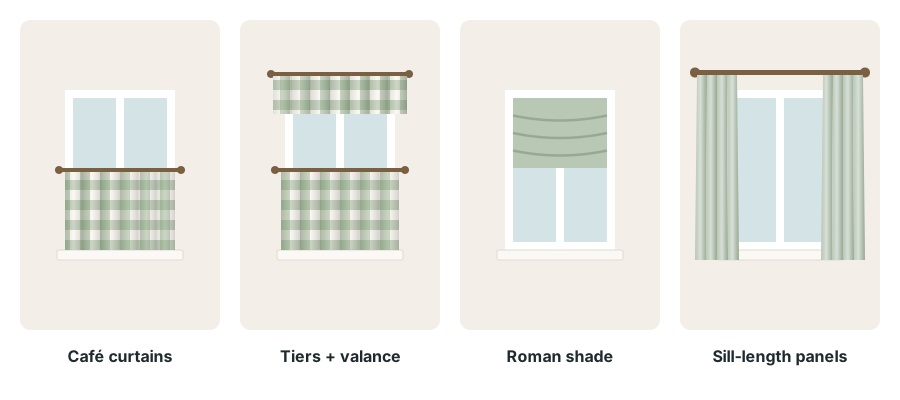
Café curtains
Café curtains cover only the lower half of the window, hung from a rod halfway up. They give privacy at eye level while letting light pour in through the top. They're named after the cafés of Paris, where they kept diners' faces hidden from passers-by. Café curtains are the classic kitchen choice: cheerful, practical and easy to wash.
Tier curtains and valances
Tiers are short curtains, often sold in pairs, similar to café curtains. Pairing them with a valance, a short decorative strip of fabric across the top of the window, frames the whole window with a cosy, cottage feel. The valance also hides the top of the frame or a blind.
Valance only
A valance on its own adds softness and colour without blocking any light or getting in the way. It's perfect for windows that don't need privacy, such as those overlooking a garden.
Roman shades
Roman shades are fabric blinds that fold up neatly into horizontal pleats. They're tidy, use little space, and can be raised fully above the sink or worktop, keeping fabric away from water and heat. They suit modern and traditional kitchens alike.
Sill-length panels
Short curtain panels that end at the windowsill frame the window with soft fabric. They work best on windows that aren't directly above a sink or hob, or on kitchen windows with a clear area in front, such as in a breakfast nook.
Floor-length curtains
Long curtains are only practical in kitchens on windows or patio doors with nothing in front of them, for example in a dining area or a large open-plan kitchen. Keep them well away from cooking areas.
Sheer curtains
Lightweight sheers soften the light and give daytime privacy while letting in plenty of brightness. They're light, quick to wash and dry fast. See our sheer curtains guide for more.
Swags and scarves
A fabric swag draped over a rod adds a soft, decorative top to a window without covering the glass. Keep it simple and light so it doesn't collect grease.
Curtains combined with blinds
A practical blind (roller, venetian or roman) handles privacy and light, while a valance or short side panels add softness and colour. It's a flexible combination that gives you the best of both.
How to hang café curtains
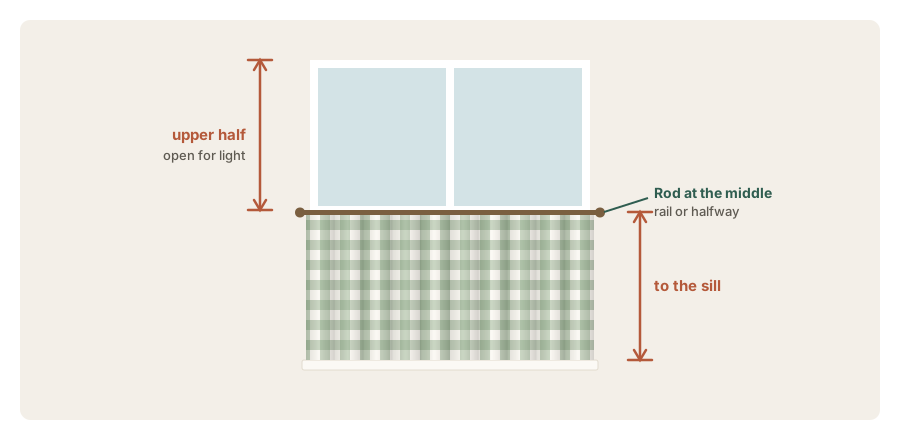
- Decide the rod height. The most common position is at the window's middle rail (where the two sashes meet) or halfway up the glass. For more privacy, mount it a little higher, for example two-thirds of the way up.
- Choose the rod. A slim café rod or tension rod, about 10–16 mm in diameter, mounted inside the window frame or on the face of the frame.
- Measure the length. Measure from the rod down to the sill. If the curtains will hang inside the frame, finish them about 1 cm above the sill so they don't drag. If they hang outside the frame, they can finish level with the bottom of the sill or apron.
- Measure the width. For a gathered look, the total width of the curtains should be about 1.5 to 2 times the width of the rod. See curtain fullness explained.
- Hang and adjust. Thread the curtains onto the rod or clip them on with clip rings, then spread the fullness evenly.
Safety: curtains near the hob and oven
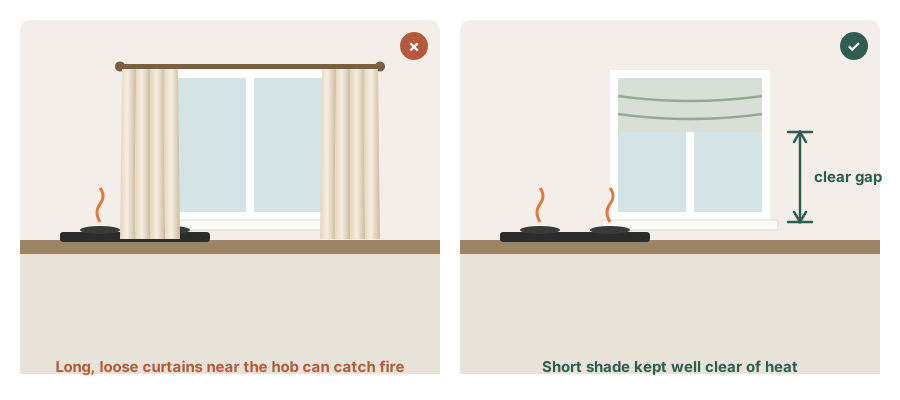
This is the most important rule of kitchen curtains. Fabric near a hob, oven, grill or toaster is a genuine fire risk, especially loose curtains that can blow in a breeze from an open window.
- Never hang long or loose curtains next to or above a hob or cooker.
- Choose roman shades, roller blinds or venetian blinds for windows near cooking areas, and keep them raised while cooking. Aluminium venetian blinds are especially easy to wipe clean.
- Keep a clear gap between any fabric and the heat source. Many safety organisations recommend keeping anything that can burn at least about a metre (3 feet) away from a cooking hob. Check your local fire safety guidance and your appliance instructions.
- Watch for breezes: an open window can blow even short curtains towards a flame.
- Consider flame-retardant fabrics for kitchen windows close to cooking areas.
- Keep tea towels, oven gloves and curtains away from toasters and other appliances that get hot.
If your hob is directly under a window, the safest choice is a wipeable blind or a window film for privacy, with no fabric at all near the heat.
Curtains for the window over the sink
The window over the sink is the most common kitchen window, and it has its own challenges: splashes, steam and a tap in the way.
- Keep the fabric above the splash zone. Café curtains ending at the sill, a roman shade or a valance all stay clear of water.
- Avoid curtains you need to reach over the sink to open and close. A valance, a fixed café curtain or a blind with a cord or wand is easier.
- Check the tap clearance. Tall taps can prevent a blind from coming down fully. Measure from the top of the tap to the window before choosing.
- Choose quick-drying fabrics such as polyester, cotton-polyester blends or lightweight cotton.
- Mount the hardware outside the frame if the window is deep, so the curtains don't get in the way of the window opening.
The best fabrics for kitchen curtains
| Fabric | Pros | Cons | Kitchen rating |
|---|---|---|---|
| Cotton | Crisp, fresh, washable, many prints | Can shrink and crease, fades in sun | Very good |
| Cotton-polyester blend | Easy care, less shrinking and creasing | Less natural look | Excellent |
| Polyester | Durable, quick-drying, resists fading and moisture | Can look shiny, can hold odours | Very good |
| Linen | Beautiful texture, relaxed look | Creases easily, can shrink | Good |
| Linen-look polyester | Linen style with easy care | Less breathable | Very good |
| Velvet, chenille, heavy fabrics | Rich and warm | Absorb grease and smells, hard to clean | Avoid |
| Silk | Luxurious | Damaged by sun, water and grease | Avoid |
The best kitchen fabrics are lightweight, machine washable and quick-drying. Look for "pre-shrunk" cotton, or wash the fabric before sewing if you make your own. Our guide to curtain fabrics compared covers each fabric in more detail.
Kitchen curtain colours
White and cream
Fresh, clean and bright. White curtains reflect light and suit every kitchen style. They do show marks, so choose washable fabrics.
Soft greens
Sage, olive and mint green feel fresh and natural, and work beautifully with wood, white cabinets and plants.
Blues
Navy, cornflower and duck-egg blue feel calm and classic, and look especially good with white kitchens and natural wood.
Yellow and warm tones
Butter yellow, terracotta and mustard bring warmth and cheerfulness, ideal for north-facing kitchens that get little sun.
Red
Red gingham and red checks are a traditional country kitchen classic, bright and welcoming.
Matching your kitchen
Pick a colour from your tiles, cabinet handles, crockery or accessories. If your kitchen has bold tiles or colourful cabinets, choose plain or subtle curtains so they don't compete. Our guide on how to choose curtain colours explains colour matching in more detail.
Patterns that suit kitchens
Kitchens are one of the best places for cheerful patterns. Small windows and short curtains mean a little pattern goes a long way.
- Gingham and checks: timeless, cheerful and great for cottage and farmhouse kitchens.
- Stripes: ticking stripes and classic stripes look crisp and tidy.
- Small florals: soft and pretty, especially in traditional kitchens.
- Fruit, herbs and botanicals: playful and fitting for a kitchen.
- Geometrics: modern and graphic, ideal with plain cabinets.
- Embroidery and lace: charming, light-filtering and traditional.
For more help, see patterned vs. plain curtains.
Kitchen curtain ideas by style
Farmhouse kitchen
Café curtains or tiers in gingham, buffalo check or ticking stripe on a simple black iron or wooden rod. Linen or cotton in white, cream, sage or red.
Modern kitchen
Plain roman shades or roller blinds in white, grey or a single bold colour. If you want curtains, use simple sill-length panels in plain cotton or linen-look fabric on a slim black or brushed metal rod.
Scandinavian kitchen
White or natural linen café curtains or a plain linen roman shade, with lots of light and a simple wooden or white rod.
Cottage kitchen
Floral or checked tiers with a matching valance, or a gathered skirt-style curtain. Soft colours and pretty details like ruffles or bobble trims.
Traditional kitchen
Roman shades in a classic pattern, or tiers with a shaped valance, in stripes, toile or small florals.
Industrial kitchen
Plain linen or cotton in grey, black or natural on a black pipe-style rod, or simple roller blinds.
Coastal kitchen
White sheers, blue-and-white stripes or simple linen in sand and soft blue tones.
Kitchen doors, patio doors and open-plan kitchens
Back doors with glass panels
A glass back door can be covered with a door curtain fixed at the top and bottom on slim door rods, so the fabric stays flat and doesn't swing when the door opens. Sheer or lightweight fabrics give privacy while letting light through. A door-mounted roller blind or a short café-style curtain on the lower half are other neat options.
Patio and sliding doors in kitchen-diners
In a kitchen-diner, the dining end is a great place for full-length curtains that soften the hard surfaces of the kitchen. Hang them on a rod that extends well beyond the door frame so the curtains stack clear of the glass and the doorway. Our guide to curtains for large windows and sliding doors explains how.
Coordinating an open-plan space
When the kitchen, dining and living areas share one space, the curtains should look connected. Use the same fabric or colour throughout, and vary the style for each area: café curtains or roman shades in the kitchen, full-length curtains in the dining and living areas. This keeps the space practical where you cook and soft where you relax.
Privacy at night
A lit kitchen at night is like a shop window: anyone outside can see in clearly. Café curtains hide the lower half, but if your kitchen window faces a street or neighbours, you may want full coverage after dark:
- Top-down, bottom-up shades can be lowered from the top or raised from the bottom, so you choose exactly which part of the window to cover.
- Roman shades or roller blinds lowered at night, combined with a decorative valance for style.
- Double café curtains: two tiers, one on the lower half and one on the upper half, which can be opened separately.
- Frosted or decorative window film on the lower panes for permanent privacy without fabric.
Measuring kitchen windows
Most kitchen curtains are short, so precise measuring is especially important. A curtain that's too long will drag on the sill or the worktop.
- Decide inside or outside mount. Inside-mounted curtains and blinds fit within the window frame; outside-mounted ones are fixed on or above the frame.
- Measure the width of the frame (inside or outside, as chosen) in three places and use the smallest for inside mounts.
- Measure the drop from the rod position to where the curtain should end: just above the sill for inside mounts, or the bottom of the sill or apron for outside mounts.
- Check obstructions: taps, handles, window locks and appliances.
See how to measure windows for curtains for step-by-step instructions, and the curtain length guide for help choosing lengths.
Make simple café curtains yourself
Café curtains are one of the easiest sewing projects, and a great first project if you've never made curtains before:
- Measure the rod width and the drop from the rod to the sill.
- Cut the fabric: width = rod width × 1.5 to 2, plus 5 cm for side hems; length = drop + 8 cm for the rod pocket + 8 cm for the hem.
- Hem the sides: fold 1.25 cm twice and stitch or use iron-on hemming tape.
- Make the rod pocket: fold the top down by 1.5 cm, then by about 6 cm, press and stitch along the lower fold. Check the rod slides through easily.
- Hem the bottom: hang the curtain first, mark the length so it finishes just above the sill, then double-fold and stitch.
Instead of a rod pocket, you can skip the top casing and use clip rings, which is even quicker. For more sewing tips, see our guide on how to hem curtains.
Caring for kitchen curtains
- Wash regularly: every one to three months, more often for curtains near cooking areas, since grease builds up quickly.
- Pre-treat grease marks with a little washing-up liquid before washing.
- Air dry to prevent shrinking, and rehang slightly damp so creases drop out.
- Use the extractor fan while cooking to reduce grease and steam reaching the curtains.
- Keep spare sets: having two sets of inexpensive café curtains means you can swap them while one is being washed, or change them with the seasons.
For full instructions, read how to wash curtains.
Budget kitchen curtain ideas
- Tea towel curtains: clip two pretty tea towels onto a tension rod with clip rings for instant café curtains.
- Pillowcase or napkin valances: thread a pillowcase or a row of cloth napkins onto a rod.
- Fabric remnants: kitchen curtains need very little fabric, so remnant bins are perfect.
- No-sew café curtains: use hemming tape and clip rings, as shown in our guide on how to hem curtains.
- Shorten ready-made curtains: buy an inexpensive pair of full-length curtains and cut them down into café curtains and a valance.
Hardware for kitchen curtains
- Tension rods fit inside the window frame with no drilling, ideal for café curtains and rentals.
- Slim café rods in brass, black or white suit short, light curtains.
- Clip rings make it easy to take curtains down for washing.
- Rust-resistant finishes such as stainless steel, aluminium or powder-coated metal cope better with steam than bare iron.
See our curtain rods and tracks guide for more on choosing hardware.
Common kitchen curtain mistakes
- Long or loose curtains near the hob, which is a fire risk.
- Heavy fabrics that absorb grease and smells.
- Curtains that block too much light in a room that needs it for cooking.
- Dry-clean-only fabrics in a room that needs frequent washing.
- Curtains that touch the sink, tap or worktop and get wet or dirty.
- Forgetting the tap or appliances when measuring.
- Too many patterns competing with busy tiles or splashbacks.
Frequently asked questions
Should kitchen curtains be long or short?
Usually short. Sill-length, café curtains or roman shades are the most practical because kitchen windows sit above counters, sinks and appliances. Long curtains only suit kitchen windows or doors with nothing in front of them and well away from cooking.
What are the best curtains for a kitchen?
Café curtains, roman shades and valances in washable cotton or cotton-polyester are the most popular and practical choices.
Is it safe to have curtains near the stove?
No. Fabric near a hob or oven can catch fire. Use a wipeable blind or keep the window bare near cooking areas, and keep any fabric well clear of heat.
Do kitchen curtains need to be lined?
Usually not. Unlined curtains are lighter, let in more light and are easier to wash. Lining is only worth it for privacy at night or on very sunny windows to prevent fading.
How often should I wash kitchen curtains?
Every one to three months, and more often if they're near the cooker or you cook a lot.
Can I use blackout curtains in a kitchen?
It's rarely necessary. Kitchens need daylight. Blackout fabric is only useful in a kitchen-diner where you want to darken the room for a screen, for example.
What is the difference between café curtains and tier curtains?
They're almost the same. Both are short curtains covering the lower part of a window. "Tier" is often used for curtains sold in pairs, sometimes with a matching valance, while "café curtain" describes the style of hanging from a rod halfway up the window.
How do I stop kitchen curtains from smelling of cooking?
Use the extractor fan or open a window while cooking, wash the curtains regularly, and choose cotton or linen, which release odours more easily in the wash than some synthetic fabrics.
The bottom line
The best kitchen curtains are short, light, washable and kept safely away from heat. Café curtains, tiers with a valance and roman shades are the classic choices, in cotton or cotton-polyester fabrics with cheerful patterns or fresh plain colours. Keep fabric clear of the hob and the sink, measure carefully around taps and appliances, and wash your curtains regularly. With these simple rules, your kitchen window will be bright, practical and full of personality.
Keep reading
 Room Ideas
Bay window curtain ideas: how to measure, hang and style them
Bay windows are beautiful but tricky to dress. Here's how to choose between bent tracks, bay poles, separate rods and shades, how to measure every angle, and how to style a bay in any room.
 Room Ideas
Curtains for kids' rooms and nurseries: safety and style
Children's rooms need curtains that are safe, darken the room for sleep, wash easily and grow with your child. Here's how to choose curtains for nurseries and kids' bedrooms.
 Room Ideas
Curtains for large windows and sliding glass doors: a complete guide
Big windows and sliding doors need curtains that are wide enough, strong enough and easy to use. Here's how to measure, choose the hardware, fabric, fullness and style for large openings.