Measuring
Curtain rods and tracks: a complete guide to choosing the right hardware

Curtain hardware is easy to overlook, but it makes a huge difference. The right rod or track holds the curtains securely, lets them open and close smoothly, positions them at the right height and width, and adds to the style of the room. The wrong hardware sags, sticks, looks too thin or too bulky, or simply doesn't fit the window.
This guide explains the parts of a curtain rod, every main type of rod and track, how to choose the right diameter and length, how brackets and projection work, which materials and finishes to choose, and how to match your hardware to your curtains.
Rods vs. tracks: what's the difference?
There are two main ways to hang curtains:
- Curtain rods (poles) are round bars held by brackets. Curtains hang from rings, eyelets, tabs or a rod pocket. Rods are visible and decorative, so they're part of the design.
- Curtain tracks are slim rails, usually mounted on the wall or ceiling, with small gliders that run inside or along them. Curtains hang from hooks attached to the gliders. Tracks are discreet, glide very smoothly and can follow curves.
When to choose a rod
- You want the hardware to be a visible design feature.
- You're using eyelet, tab top, rod pocket or ring curtains.
- You want an easy, affordable, DIY-friendly installation.
- The window is a standard straight window.
When to choose a track
- You want a minimal, almost invisible look.
- You're using wave, pinch pleat or pencil pleat curtains with hooks.
- The curtains are heavy or very wide and need to glide smoothly.
- You need to go around a bay window or a corner.
- You want to mount the curtains on the ceiling, for example in a room with no space above the window.
- You want curtains that overlap neatly in the centre for better light blocking.
The parts of a curtain rod
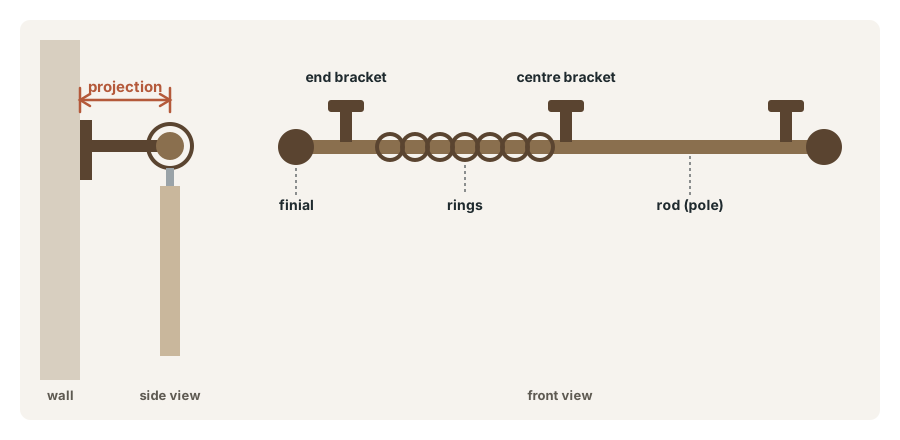
- Rod (pole): the main bar the curtains hang from.
- Brackets: fixed to the wall or ceiling to hold the rod. End brackets sit near each end; centre brackets support the middle of longer rods.
- Finials: decorative end pieces that stop the curtains sliding off. They can be simple caps, balls, spirals, crystal shapes and more.
- Rings: loops that slide along the rod, usually with a small eye at the bottom for a curtain hook or clip.
- Projection: the distance between the wall and the centre of the rod. It determines how much clearance there is for window frames, sills and blinds.
- Return: on a wraparound rod, the curved section that goes back to the wall.
Types of curtain rods
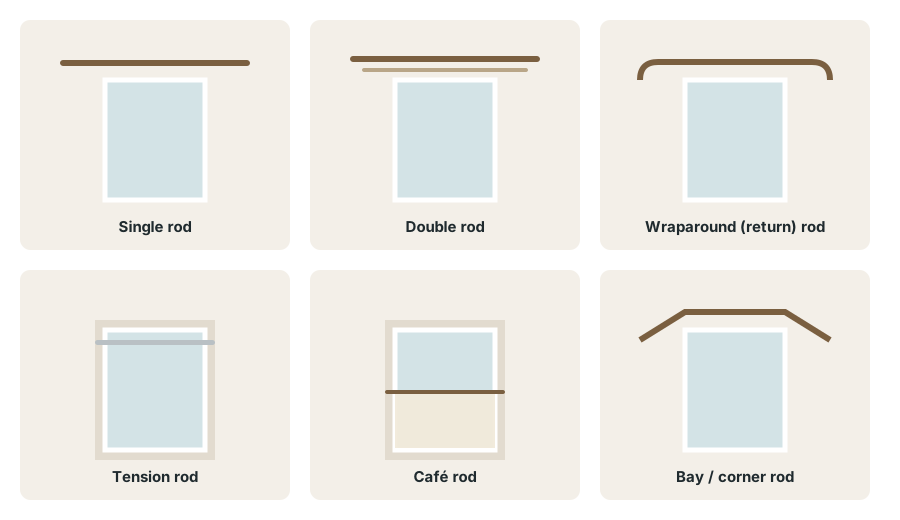
Single rod
The most common type: one rod for one layer of curtains. Ideal for most windows.
Double rod
Two parallel rods on the same brackets, the front rod slightly higher or further from the wall. The back rod usually holds sheers and the front rod holds heavier curtains. This lets you layer for privacy by day and darkness by night. See our sheer curtains guide for layering ideas.
Wraparound (return) rod
A rod that curves back to the wall at both ends. Curtains wrap around the curves, blocking light that would leak from the sides. Excellent for bedrooms and blackout curtains.
Tension rod
A spring-loaded rod that fits inside a window frame or alcove without screws. It's perfect for rentals, small windows, café curtains and lightweight fabrics, but it can't support heavy curtains.
Café rod
A thin, short rod mounted halfway up the window to hold café curtains covering the lower half. Popular in kitchens and bathrooms.
Bay and corner rods
Rods with adjustable or flexible joints that follow the angles of a bay window or turn a corner. They need careful measuring and usually use passing brackets or C-rings so the curtains can slide past the support brackets.
Traverse rod
A rod with an internal pulley and cord, often with sliding carriers instead of rings. Pulling the cord opens and closes the curtains without touching the fabric. Useful for wide, heavy or hard-to-reach curtains.
Telescopic (adjustable) rod
Two sections that slide inside each other, adjusting to different widths. Affordable and convenient, but the joint can stop rings from sliding smoothly and is weaker under heavy loads.
Magnetic and door rods
Small rods that attach with magnets to metal doors, or fixed at top and bottom of a door window to hold fabric flat. Useful for front doors and French doors.
Types of curtain tracks
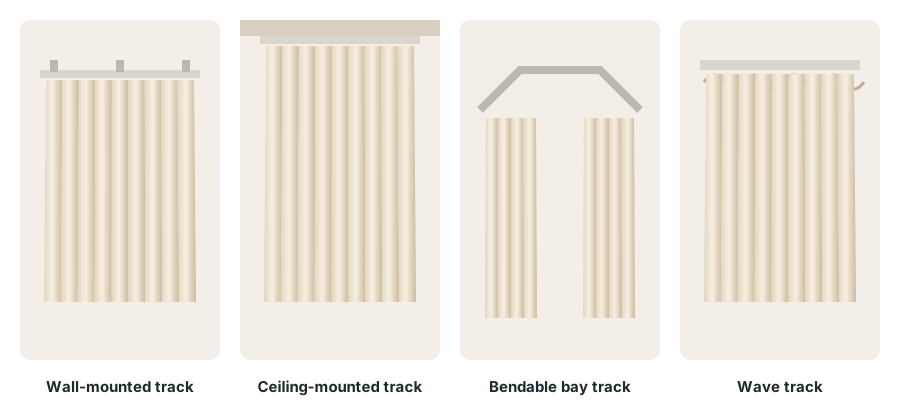
Wall-mounted track
Fixed to the wall above the window with brackets. The most common type, hidden behind a pleated or gathered heading.
Ceiling-mounted track
Fixed directly to the ceiling. Curtains hang from ceiling to floor, making rooms feel taller. It's ideal where there's little or no wall above the window, and for room dividers.
Bendable bay track
Aluminium or plastic tracks that can be bent by hand or with a tool to follow a bay window, so curtains glide all the way around without interruption.
Wave track
A track designed for wave (S-fold) curtains, with gliders connected by a cord at fixed spacing. The result is perfectly even, rippling folds. Wave tracks are popular in modern homes and hotels.
Corded and motorised tracks
Corded tracks open and close with a pull cord, protecting the fabric and making large curtains easy to use. Motorised tracks open with a remote, wall switch, timer or smart home system, and are especially helpful for very large or high windows.
Hospital and flexible ceiling tracks
Very flexible tracks used for curved room dividers, bed curtains and changing areas. For warehouse, studio and hall-sized curtains, see our guide to industrial blackout curtains.
Choosing the right rod diameter
The diameter of the rod should suit the weight of the curtains and the size of the window:
| Diameter | Best for |
|---|---|
| 10–16 mm (about ½ inch) | Café curtains, sheers, small windows, tension rods |
| 19–25 mm (¾–1 inch) | Most standard curtains in cotton, linen and polyester |
| 28–35 mm (1⅛–1⅜ inch) | Heavy, lined, blackout and velvet curtains; wide windows |
| 40–50 mm (1½–2 inch) | Very large windows, high ceilings, statement rods |
For eyelet curtains, check that the inner diameter of the eyelets is comfortably larger than the rod, usually by at least 10–15 mm, so they slide easily.
Choosing the right rod length
A curtain rod should be wider than the window so the curtains can stack beside the glass when open, rather than covering it:
- Standard rule: extend the rod 15–25 cm (6–10 inches) beyond the window frame on each side.
- For heavy curtains or to maximise light: extend further, up to 30 cm or more on each side, so the curtains stack fully off the glass.
- To make a narrow window look wider: extend the rod further on both sides.
- Measure without finials: rod lengths are usually given without the finials, which add a few centimetres on each end. Make sure there's space for them, especially near corners.
Our guide on how to measure windows for curtains explains exactly how to measure, and how high to hang curtain rods explains where to position them vertically.
Brackets and support
- End brackets sit 5–10 cm in from each end of the rod, leaving space for the finials and a ring outside the bracket to hold the curtain's outer edge.
- Centre brackets are needed when the rod is longer than about 150–180 cm. Add another bracket every 120–150 cm for heavy curtains.
- Passing brackets or C-rings let curtains slide past centre brackets. Ordinary closed rings stop at each bracket, which is fine if the curtains only open to the sides.
- Projection: choose brackets that hold the rod far enough from the wall to clear the window frame, sill, handles and any blinds. Typical projections are 7–12 cm; with a blind or deep sill you may need 15 cm or more.
- Ceiling brackets let you fix a rod or track to the ceiling where there's no room above the window.
Materials and finishes
Metal
Steel, iron, aluminium and brass rods are strong and come in many finishes: matte black, brushed nickel, chrome, antique bronze, brass and gold. Metal suits modern, industrial and classic rooms. Steel and iron are very strong; aluminium is light and rust-resistant.
Wood
Wooden rods feel warm and traditional. They come in natural, stained and painted finishes. Wood suits cottage, rustic, Scandinavian and traditional rooms, but long, thin wooden rods can bend without centre support.
Plastic and resin
Affordable and lightweight, used mostly for tracks, tension rods and children's rooms. Not suitable for heavy curtains.
Acrylic and glass
Clear acrylic rods with crystal finials create a light, glamorous look.
Matching finishes
Coordinate the rod finish with other metals in the room, such as door handles, lamps, picture frames or furniture legs. Black is versatile and modern; brass adds warmth; brushed nickel feels clean and contemporary; wood links to floors and furniture.
Rings, hooks, clips and gliders
The small parts that connect curtains to the rod or track matter as much as the rod itself:
- Plain rings slide over the rod and have an eye for a hook. Choose rings with an inner diameter clearly larger than the rod so they don't stick.
- Lined or silent rings have a plastic or rubber inner liner, which makes them quieter and smoother, and protects the rod's finish.
- Clip rings grip the top of the curtain directly with small clips. They're quick and easy, and turn flat panels, tea towels or fabric pieces into café curtains.
- Curtain hooks attach the heading tape or pleats to rings or gliders. Plastic hooks suit light curtains; metal pin hooks suit pinch pleats and heavy curtains.
- Gliders and runners run inside or along a track. Ball-bearing gliders run especially smoothly under heavy curtains.
- Overlap arms on tracks let the two curtains overlap in the centre, blocking the light gap where they meet.
Count the number of rings or gliders before buying. Pinch pleat curtains need one per pleat plus one at each end. Pencil pleat curtains usually need one every 8–10 cm. Eyelet curtains need none.
Hardware for special windows
Bay windows
Use a bendable bay track or a bay rod with angled connectors. For rods, choose passing brackets or C-rings so curtains can slide past the corner supports. Alternatively, hang separate curtains on each section of the bay, or hang one rod across the front of the bay to close it off completely.
For every option explained in detail, with measuring tips and styling ideas, read our guide to bay window curtain ideas.
Corner windows
Use a corner connector to join two rods at 90 degrees, or a single bendable track that turns the corner.
Arched windows
Mount the rod above the top of the arch so the curtains frame the whole window and the arch can be seen when they're open. Flexible arch rods are available for curtains that follow the curve, but these curtains are usually fixed and don't open.
Sliding glass doors and wide windows
Choose a strong rod of at least 28 mm, or a heavy-duty track, with centre brackets or C-rings. Extend the hardware well beyond the frame so the curtains stack completely off the glass and don't block the door. A cord or wand helps with very wide curtains.
French doors and doors that open inward
Use door rods fixed at the top and bottom of each glass panel, or mount a rod above and wide enough that the curtains can be pushed fully clear of the doors.
Dormer and attic windows
Swing-arm rods pivot open like a door, letting curtains swing away from the window. Small tension rods or rods fitted inside the recess also work well.
Windows close to a ceiling or corner
Use ceiling brackets or a ceiling track if there's no wall space above the window. If a wall is close to one side, choose a rod with a small end cap instead of a large finial, or a track that can run right up to the wall.
For a full guide to dressing wide windows and patio doors, including stackback and panel counts, read curtains for large windows and sliding glass doors.
Matching hardware to curtain headings
| Heading | Rod | Track |
|---|---|---|
| Eyelet (grommet) | Yes | No |
| Tab top | Yes | No |
| Rod pocket | Yes (thin rods) | No |
| Pencil pleat | Yes, with rings | Yes |
| Pinch pleat | Yes, with rings | Yes |
| Wave (S-fold) | Special wave rods only | Yes, wave track |
| Clip rings | Yes | No |
Learn more about each style in curtain headings compared.
Budget and quality
Curtain hardware ranges from very cheap to very expensive. Here's where it's worth spending:
- Spend more for heavy or wide curtains. A strong, solid rod and good brackets prevent sagging and save frustration.
- Spend more on windows you use every day. Smooth, quiet rings or gliders make a noticeable difference.
- Save on small and light windows. Simple rods and tension rods work perfectly with sheers and café curtains.
- Check the wall thickness of the rod. Cheap hollow rods with thin walls bend easily. Solid or thick-walled rods are much stronger.
- Check what's included. Some rod sets include brackets, finials, rings and screws; others sell them separately.
- Keep spare parts. Extra rings, hooks and gliders are useful later, when curtains are replaced or a part breaks.
Renter-friendly options
If you can't drill into walls, there are still good options:
- Tension rods inside the window frame or alcove for light curtains.
- No-drill brackets that fit onto the top of the window frame, holding a light rod.
- Adhesive hooks and rods rated for the curtain weight, for very light curtains only.
- Using existing holes: if the previous tenant left brackets or holes, reuse them where possible.
Always check your tenancy agreement, and ask your landlord before drilling. Many landlords are happy to allow curtain hardware if it's installed carefully.
Safety with cords and children
Corded tracks, traverse rods and blinds can be dangerous for young children and pets, because loose cords can form a loop. If you have children in the home:
- Choose cordless options: wands, motorised tracks or hand-drawn curtains.
- If you do use cords, fit a cord tensioner or cleat high on the wall, keeping cords tight and well out of reach.
- Never place a cot, bed or furniture that children can climb near a window with cords.
- Make sure rods and brackets are firmly fixed, because children may pull on curtains.
How to install a curtain rod
- Decide the height and width. Typically 10–15 cm above the frame, or halfway between the frame and ceiling, and 15–25 cm beyond each side.
- Mark the bracket positions with a pencil, using a spirit level to make sure both sides are at exactly the same height.
- Check what's behind the wall. Use a detector to avoid pipes and cables, and to find studs in stud walls.
- Drill and fix the brackets using the right fixings: wood screws into studs, wall plugs in masonry, or heavy-duty anchors in plasterboard.
- Fit any centre brackets in line with the end brackets.
- Put the rings on the rod, leaving one ring outside each end bracket for the curtain's outer edge, then place the rod in the brackets and tighten the screws.
- Add the finials and hang the curtains.
Our step-by-step guide on how to hang curtains goes into more detail.
Common mistakes
- A rod that's too short, so the curtains cover the glass when open.
- A rod that's too thin for heavy curtains, causing it to bend.
- No centre bracket on a long rod.
- Brackets with too little projection, so the curtains rub against the window frame or blinds.
- Hanging the rod too low, just above the frame, which makes ceilings feel lower.
- Weak wall fixings that pull out over time.
- Forgetting the outer ring, so the curtain edge can't sit beyond the bracket.
- Choosing the wrong hardware for the heading, such as eyelet curtains on a track.
Frequently asked questions
Are curtain tracks better than rods?
Neither is better overall. Tracks are smoother, more discreet and better for bays and heavy curtains; rods are more decorative, easier to install and suit more curtain styles.
How far should a curtain rod extend past the window?
Usually 15–25 cm on each side, or more for heavy curtains, so they stack beside the window when open.
When do I need a centre bracket?
For rods longer than about 150–180 cm, or for heavy curtains on shorter rods.
What size curtain rod do I need?
For most curtains, 19–25 mm in diameter. For heavy or very wide curtains, 28–35 mm or more.
Can I hang curtains without drilling?
Yes: tension rods, adhesive hooks for light curtains, and some no-drill brackets that clip onto window frames. They're best for lightweight curtains.
How high should I mount the brackets?
Usually 10–15 cm above the window frame, or halfway between the frame and the ceiling. Hanging higher makes the room feel taller, as long as the curtains are long enough to reach the floor.
Can I cut a curtain rod to size?
Most metal and wooden rods can be cut with a hacksaw or fine saw. Measure carefully, cut from the end that will be hidden by a finial, and smooth the edge before fitting.
Why do my curtain rings stick?
The rings may be too small for the rod, the rod may have a rough joint or a bend, or a centre bracket may be blocking them. Choose larger or lined rings, wipe the rod clean, and use C-rings or passing brackets if needed. A light wipe with a little furniture polish helps rings slide on wooden and metal rods.
Can a rod hold blackout and sheer curtains together?
Yes, on a double rod. The sheers go on the back rod and the blackout curtains on the front, so you can use them separately.
Should the rod match other metal finishes in the room?
It doesn't need to match exactly, but it should work with them. Repeating the finish somewhere else in the room, such as a lamp or picture frame, makes the choice look intentional.
The bottom line
Choose a rod when you want visible, decorative hardware and use eyelet, tab, rod pocket or ring curtains. Choose a track when you want a discreet look, smooth gliding, heavy curtains, a bay window or ceiling mounting. Pick a diameter that suits the curtain weight, extend the hardware 15–25 cm beyond each side of the window, add centre brackets for long rods, allow enough projection to clear the frame and blinds, and fix everything securely. With the right hardware, your curtains will look better, work better and last longer.
Keep reading
 Measuring
Curtain fullness explained: how wide should curtains be?
Thin, flat curtains are the most common curtain mistake, and fullness is the fix. Here's how wide your curtains should be, with simple formulas, worked examples and fullness by heading.
 Measuring
Curtain length guide: sill, apron, floor or puddle?
Curtain length changes how tall a room feels, how big a window looks and how well curtains block light. Here's how to choose the right length for every room, and how to get it exactly right.
 Measuring
How high and wide to hang curtain rods (with simple rules)
Where you hang the rod changes how big your windows look, how much light gets in, and how well curtains block it. Here are simple rules for every ceiling and window.