Room Ideas
Curtains for large windows and sliding glass doors: a complete guide

Large windows, picture windows, window walls and sliding glass doors bring wonderful light and views into a home. They also bring challenges: glare, heat in summer, cold in winter, lack of privacy at night, and the sheer size of the curtains needed to cover them. Ordinary ready-made curtains and standard rods often aren't wide enough, strong enough or practical enough.
This guide explains how to measure large windows and sliding doors, how to choose the right rods and tracks, how to work out the number and width of panels, which way the curtains should open, which fabrics and styles to use, and how to handle privacy, glare and temperature.
The challenges of large windows
- Width: a window or door 2.5–5 metres wide needs a lot of fabric, often several panels.
- Weight: wide, long curtains are heavy, especially when lined, so the hardware must be strong.
- Stackback: when open, a lot of fabric needs somewhere to go without blocking the view or the doorway.
- Ease of use: pulling heavy curtains across a wide window must be smooth and easy.
- Heat, cold and glare: large glass areas let in strong sun and lose heat in winter.
- Privacy: large windows act like a stage at night when the lights are on.
- Doors: sliding doors need curtains that stay completely clear of the opening when open.
Understanding stackback
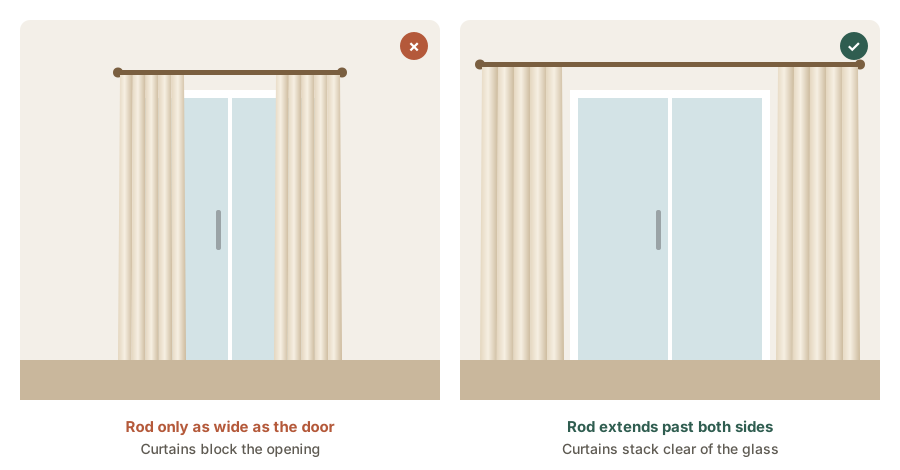
Stackback is the space the curtains take up when fully open. On a small window it hardly matters, but on a large window or door it can be substantial, often 20–35% of the width of the curtains' coverage area, depending on the fabric, heading and fullness.
If you don't plan for stackback, the open curtains will cover part of the glass, blocking light and the view, and on a sliding door they'll get in the way of people walking through. The solution is to extend the rod or track beyond the window so the curtains stack on the wall.
Rough stackback guide
| Curtain type | Approximate stackback |
|---|---|
| Wave (S-fold) on a track | About 15–20% of the track width |
| Pencil pleat or pinch pleat | About 20–30% |
| Eyelet | About 20–30% |
| Heavy lined or interlined curtains | About 30–35% or more |
These figures are rough; thick fabrics and high fullness stack wider. For a centre-opening curtain, half the stackback goes on each side. For example, a 300 cm track with about 25% stackback needs about 75 cm of stacking space in total: about 37 cm on each side. Extending the track about 35–40 cm beyond each side of the frame lets the curtains clear the glass completely.
How to measure large windows and sliding doors
- Measure the full width of the window or door frame, including any trim.
- Add the stackback space on each side, usually 25–50 cm per side for large windows, to get the rod or track length.
- Check the wall space on each side. Corners, adjoining walls, light switches, sockets and furniture can limit how far you can extend.
- Decide the height: usually 10–20 cm above the frame, or right up to the ceiling for a dramatic, tall look. On sliding doors, check that the door track and handles are cleared.
- Measure the drop from the rod or track to the floor.
- Check the floor: on sliding doors, curtains should finish about 1 cm above the floor so they don't catch on the door track or sweep up dirt.
- Check the projection: make sure the brackets hold the curtains far enough from the wall to clear door handles, frames and any blinds.
See our step-by-step guide on how to measure windows for curtains for more detail.
Which way should the curtains open?
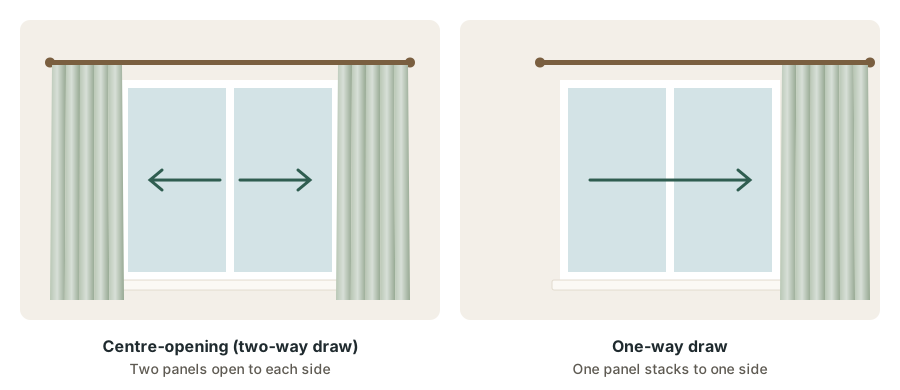
Centre-opening (two-way draw)
Two panels (or two groups of panels) meet in the middle and open to each side. It's balanced and symmetrical, ideal for picture windows and windows centred on a wall.
One-way draw
All the fabric moves to one side. This suits sliding doors where you only walk through one side, or windows next to a corner or wall where there's only space on one side. With a sliding door, stack the curtains on the side of the fixed panel, so the side that slides open stays clear.
Choosing for a sliding door
- If the door slides open on the right, stack the curtains to the left (one-way draw), or use a centre opening with extra space on the right.
- If you use the door several times a day, make sure the curtains on the opening side stack well clear of the frame.
- For double sliding doors that open from the centre, use a centre-opening curtain with plenty of stackback on both sides.
Rods or tracks for large windows?
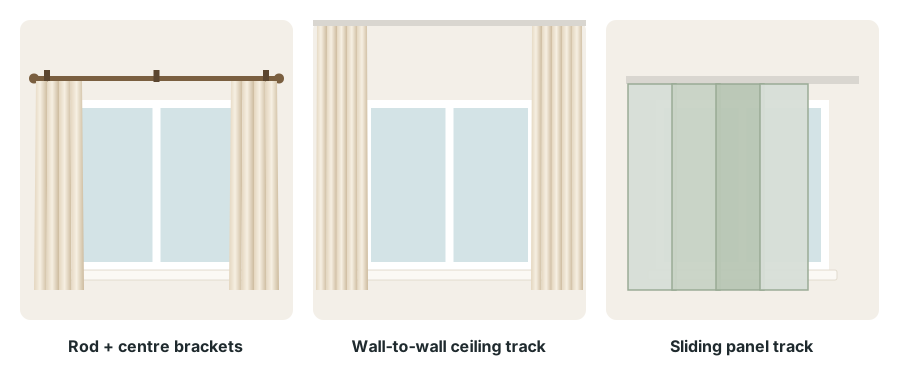
Curtain rods
A decorative rod works well for large windows if it's strong enough and well supported:
- Choose a diameter of at least 28–35 mm, or more for very wide windows and heavy fabrics.
- Use centre brackets every 120–150 cm.
- Use C-rings or passing rings so the curtains can slide past the centre brackets.
- For very long spans, choose rods sold in sections with strong joining connectors, or a custom-cut rod.
Curtain tracks
Tracks are often the best solution for large windows and sliding doors:
- Curtains glide very smoothly, even when heavy and wide.
- Brackets don't stop the gliders, so curtains run the full width.
- They can be fitted with a cord, a wand or a motor for easy opening.
- Ceiling-mounted tracks can run wall to wall, making the whole wall a soft curtained surface.
- Wave tracks give perfectly even folds that look tidy across a long span.
Panel tracks (sliding panels)
Panel tracks hold flat fabric panels that slide past each other, like large vertical blinds. They're modern, minimal and practical for sliding doors and very wide windows, and they stack neatly to one side.
Vertical blinds
Vertical blinds are a practical, budget-friendly option for sliding doors because the slats can be tilted for light control and pulled to one side. Curtains in front of them soften the look.
Read our curtain rods and tracks guide for more on each type.
How many panels do you need?
Ready-made curtain panels are usually 115–150 cm (45–60 inches) wide. For a large window, you'll need several panels. Here's how to work it out:
- Measure the rod or track length (window width plus stackback space).
- Multiply by the fullness you want: about 1.5–2 for most curtains, or 2–2.5 for sheers. See curtain fullness explained.
- Divide by the width of one panel and round up.
Example
A sliding door is 240 cm wide. Adding 40 cm on each side gives a 320 cm rod. For 2 times fullness, you need 640 cm of curtain width. With panels 140 cm wide, 640 ÷ 140 = 4.6, so round up to 5 panels. For a centre opening, an even number is easier to split evenly, so choose 6 panels: three on each side. With 6 panels you get about 2.6 times fullness, which looks generous; if that's too full, 4 panels give about 1.75 times.
When using several panels on one side, hang them so their edges overlap slightly. On a track or ring rod, you can hook adjacent panels together so they look like one wide curtain.
Choosing the right length
- Floor-length, just clearing the floor (about 1 cm above): the best choice for sliding doors and most large windows. Neat, practical and elegant.
- Breaking on the floor (2–5 cm extra): a relaxed, generous look for picture windows where nobody walks through.
- Puddling (10–20 cm extra): dramatic, but impractical for doors and harder to clean.
- Sill-length: rarely suits large windows, which look best with long, vertical lines.
If the floor isn't level, measure the drop in several places and use the shortest measurement for sliding doors, so no part of the curtain drags. Read the curtain length guide for more.
Choosing the fabric
Weight
Medium-weight fabrics are usually ideal: heavy enough to hang well across a large span, light enough to open easily and stack neatly. Very heavy fabrics need strong hardware and create wide stacks.
Lined or unlined?
- Lined curtains protect the fabric from sun damage, hang better, and add insulation. Strongly recommended for large, sunny windows.
- Blackout lining for bedrooms and media rooms. See the blackout curtains guide.
- Thermal lining to reduce heat loss and heat gain. See the thermal curtains guide.
- Unlined sheers to soften light and give daytime privacy.
Fabric choices
- Linen and linen blends: relaxed, elegant and light, beautiful on large windows.
- Polyester: durable, fade-resistant and affordable, ideal for sunny windows.
- Cotton: versatile and crisp.
- Velvet: luxurious and insulating, but heavy. See our velvet curtains guide.
- Sheers and voiles: filter light while preserving the view.
Compare them all in curtain fabrics compared.
Layering: the best solution for large windows
Large windows usually work best with two layers on a double rod or double track:
- Back layer: sheers or voiles that stay closed during the day, softening glare and giving privacy while keeping the view and light.
- Front layer: lined curtains that close at night for privacy, warmth and darkness.
Alternatively, combine a blind (roller, solar shade or vertical) with curtains. Solar shades reduce glare and heat while keeping the view, and the curtains add softness and night-time privacy. Our sheer curtains guide covers layering in more detail.
Headings for large curtains
- Wave (S-fold): the best choice for large windows on a track. Even, modern folds and compact stacking.
- Pinch pleat: elegant and formal, holding its shape well across wide spans.
- Eyelet: simple and modern on a strong rod, but can be harder to slide past centre brackets (use passing brackets or a track instead).
- Pencil pleat: versatile and affordable for tracks or rods with rings.
- Tab top and rod pocket: best avoided for large curtains that open and close often, because they don't slide easily.
See curtain headings compared for more about each style.
Controlling heat, cold and glare
- Glare: sheers or solar shades soften strong light, especially for TVs and computers.
- Summer heat: close lined or thermal curtains on sun-facing windows during the hottest part of the day. Light-coloured linings reflect more heat.
- Winter cold: close thermal or lined curtains at dusk to keep warmth in. Floor-length curtains that extend beyond the frame and a pelmet or ceiling track on top reduce draughts.
- Fading: strong sun fades furniture, floors and curtains. Lined curtains and UV-filtering sheers help protect them.
Privacy for large windows
Large windows can feel exposed, especially at night. Options include:
- Sheers for daytime privacy; lined curtains for night.
- Top-down, bottom-up shades for windows facing a street.
- Frosted film on the lower part of the glass where neighbours overlook you.
- Motorised curtains on a timer that close automatically at dusk.
Style ideas for large windows
Wall-to-wall curtains
Running a ceiling track from wall to wall and hanging floor-length curtains along the entire wall creates a soft, luxurious, hotel-like look. It hides awkward window shapes, makes the ceiling feel higher and improves acoustics.
Floor-to-ceiling curtains
Mounting the rod or track just below the ceiling makes large windows look even grander and the room taller.
Simple, plain fabrics
On very large windows, a lot of fabric is visible, so plain or subtly textured fabrics usually look calmer than busy patterns. If you choose a pattern, choose a large-scale design and moderate fullness so it can be seen. Read patterned vs. plain curtains.
Matching the walls
Curtains close to the wall colour make large windows feel seamless and calm. Contrasting curtains make a bolder statement.
Statement hardware
On a large window, a beautiful, thick rod with elegant finials becomes a design feature.
For more inspiration, see our living room curtain ideas.
Special types of large windows
Corner windows
Where two large windows meet at a corner, use a corner connector on a rod or a bendable track that turns the corner. Stack the curtains at the outer ends so the corner view stays open, or add a panel at the corner that can be drawn when needed.
Bay windows
A bendable bay track lets curtains run all the way around. Alternatively, hang curtains on each section of the bay, or hang one straight rod across the front of the bay to close it off at night.
Windows with transoms or arches above
Mount the rod above the transom or arch so the curtains frame the whole window and the top window stays visible when they're open. Leaving the arch bare keeps its shape on show.
Very tall windows and double-height rooms
Very tall curtains are heavy and hard to reach. Use a strong track with a long wand or a motor, and choose fabrics that hang straight under their own weight. For extremely tall windows, motorised blinds or curtains are often the most practical solution.
French doors
For French doors that open into the room, hang a rod high and wide enough that the curtains can be drawn completely clear of the doors' swing. Alternatively, fit door-mounted sheers or blinds on each door.
Bi-fold doors
Bi-fold doors fold into a stack at one or both ends, so the curtains need to stack beyond the folded doors. Extend the track well past the side where the doors fold, and choose a one-way draw if the doors fold to one side.
Motorised and corded curtains
For large windows, motorised or corded tracks make daily use much easier:
- Corded tracks open and close with a pull cord, so you don't need to handle heavy fabric. Fit a cord tensioner to keep children and pets safe.
- Wands attached to the leading edge let you pull curtains without touching the fabric.
- Motorised tracks open with a remote, switch, app, voice assistant or timer. They're ideal for very wide, very tall or hard-to-reach windows, and timers can close curtains automatically at dusk for privacy and warmth.
Motorised systems cost more and need a power supply or battery, but for large, heavy curtains used every day they can be well worth it.
Budget tips for large windows
- Use extra-wide ready-made panels and hook several together instead of ordering custom curtains.
- Choose a simple track rather than an expensive decorative rod; it will be hidden by the heading.
- Buy fabric by the roll if you sew. Wide fabrics (280–300 cm "railroaded" sheers, for example) can cover a tall window without seams.
- Prioritise the lining on sun-facing windows to protect the curtains from fading, so they last longer.
- Start with sheers and add lined curtains later if needed.
Caring for large curtains
Large curtains are heavy to take down, so regular light maintenance saves a lot of work:
- Vacuum them in place every few weeks with a soft brush attachment.
- Open and close them daily to stop dust settling in the folds.
- Check the care label before washing. Many large lined curtains need professional cleaning.
- Take panels down one at a time and label which hook positions they came from, so they go back correctly.
See how to wash curtains for detailed instructions.
Common mistakes
- Rods or tracks that are too short, so the curtains block the glass or doorway when open.
- Too few panels, leaving the curtains stretched flat when closed.
- Weak rods without centre brackets, which sag under the weight.
- Closed rings that catch on centre brackets, so curtains won't open fully.
- Curtains dragging on the floor of a sliding door, catching on the door track.
- Unlined curtains on sunny windows, which fade and let in heat.
- Too little projection, so the curtains catch on door handles.
- Busy small patterns across a very large area.
Frequently asked questions
How wide should a curtain rod be for a sliding door?
The width of the door frame plus about 25–50 cm on each side, so the curtains stack clear of the glass and the opening.
Are tracks better than rods for sliding doors?
Often, yes. Tracks glide more smoothly, don't stop at brackets and can be corded or motorised. Rods with C-rings or passing brackets also work well and are more decorative.
How many curtain panels do I need for a large window?
Multiply the rod length by your fullness (1.5–2.5) and divide by the panel width, then round up. Many large windows need four to eight panels.
Should curtains for sliding doors touch the floor?
They should finish just above the floor, about 1 cm, so they hang neatly without catching on the door track or collecting dirt.
What curtains are best for blocking heat from large windows?
Lined or thermal curtains, ideally layered with solar shades or sheers, closed during the hottest part of the day.
Can I use ready-made curtains on a large window?
Yes. Hang several panels on each side and hook or overlap their edges so they look like one wide curtain. Check that the length suits your rod height, and hem if needed.
Do I need a centre bracket on a sliding door rod?
Almost always. Most sliding door rods are longer than 180 cm, so they need at least one centre bracket. Use C-rings or passing rings so the curtains can slide past it.
Should curtains on a sliding door overlap in the middle?
Yes, if they open from the centre. An overlap of a few centimetres, or overlap arms on a track, stops a strip of light and cold air coming through where the curtains meet.
The bottom line
Large windows and sliding doors need wider, stronger and more carefully planned curtains than ordinary windows. Extend the rod or track well beyond the frame to allow for stackback, use strong hardware with centre brackets or a track, choose one-way or two-way draw according to how you use the door, work out the number of panels from the rod length and fullness, and layer sheers with lined curtains for light, privacy and comfort. With the right planning, your large windows will look stunning and work beautifully every day.
Keep reading
 Room Ideas
Bay window curtain ideas: how to measure, hang and style them
Bay windows are beautiful but tricky to dress. Here's how to choose between bent tracks, bay poles, separate rods and shades, how to measure every angle, and how to style a bay in any room.
 Room Ideas
Curtains for kids' rooms and nurseries: safety and style
Children's rooms need curtains that are safe, darken the room for sleep, wash easily and grow with your child. Here's how to choose curtains for nurseries and kids' bedrooms.
 Room Ideas
Curtains for small windows and small rooms: how to make them look bigger
The right curtains can make a small window look larger and a small room feel brighter and more spacious. Here's how to choose the style, colour, length and hardware for small spaces.