Fabrics
Blackout curtains: how they work and how to choose the right ones

Blackout curtains are one of the most popular curtain types, and for good reason. They help people sleep past sunrise, nap during the day, work night shifts, watch films without glare, and keep rooms cooler when the afternoon sun beats on the windows. But they're also one of the most misunderstood.
Many people buy "blackout" curtains, hang them, and are disappointed to find the room is still bright. Sometimes the fabric isn't truly blackout. More often, the fabric is fine, but light pours in around the edges because the curtains are too narrow, too short or hung too close to the window.
This guide explains how blackout curtains actually work, the difference between the main types, how to test them, how to choose the right size, and, most importantly, how to hang them so your room gets genuinely dark.
What makes a curtain "blackout"?
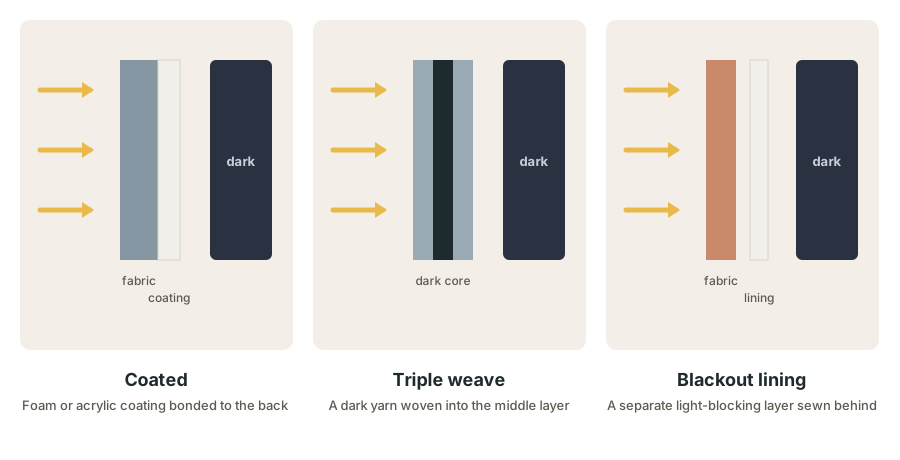
A blackout curtain is designed to stop nearly all light from passing through the fabric. Ordinary fabrics, even thick ones, let some light through the tiny gaps between their threads. Blackout curtains close those gaps with an extra light-blocking layer. There are three main ways to do this.
1. Coated blackout curtains
A coated curtain has a layer of foam or acrylic bonded to the back of the fabric. The coating is usually white, cream or grey, and it blocks light very effectively.
- Pros: very effective at blocking light; widely available; often affordable.
- Cons: can feel stiff and hang less naturally; the coating can crack or peel over time, especially if washed in hot water, tumble dried on high heat or ironed directly; may have a slight smell when new.
2. Triple weave blackout curtains
Triple weave curtains are woven with three layers of yarn, with a dark (usually black) yarn in the middle. The dark core absorbs light, while the outer layers give the fabric its colour and texture on both sides.
- Pros: soft and drapey, much like a normal curtain; no coating to crack; usually machine washable; look the same on both sides.
- Cons: some triple weave curtains are closer to "room-darkening" than true blackout, especially in light colours. Check the description and reviews.
3. Curtains with a blackout lining
Here, a separate blackout lining is sewn to the back of a normal decorative fabric, such as linen, cotton or velvet. This is the usual method for made-to-measure curtains.
- Pros: you get any decorative fabric you like with full blackout performance; the lining also protects the main fabric from sun fading; heavy linings improve the drape and insulation.
- Cons: heavier and usually more expensive; the two layers may need to be cleaned carefully, and some need dry cleaning.
You can also buy separate blackout liners that hook onto existing curtains or hang on the inner rod of a double rod. They're a budget-friendly way to make curtains you already love into blackout curtains.
Blackout vs. room-darkening vs. thermal
| Type | Light through the fabric | Typical use |
|---|---|---|
| Blackout | Almost none | Bedrooms, nurseries, home theatres, night-shift sleep |
| Room-darkening | A little; the room becomes dim | Living rooms, offices, bedrooms where some light is fine |
| Light-filtering | Soft, diffused light | Living and dining rooms |
| Thermal | Varies; the main job is insulation | Rooms that get too hot or too cold |
The words "blackout" and "room-darkening" are sometimes used loosely in product listings. If complete darkness matters to you, look for clear wording such as "full blackout" or "100% blackout lining", check customer photos and reviews, and do the simple test below once your curtains arrive.
Many blackout curtains are also sold as thermal. The dense coating or lining that blocks light also slows heat moving through the window, so they often do both jobs.
How to test blackout curtains
You can test any curtain in a minute:
- In a dark room, hold the fabric up and shine a bright phone torch through it from behind, or hold it up to a sunny window.
- True blackout: you'll see little or no light through the fabric.
- Room-darkening: you'll see a dull glow.
- Light-filtering: you'll clearly see light, and maybe the outline of your hand.
Also check the stitching and seams. Tiny needle holes along hems and seams can let pinpricks of light through. Better-made curtains place seams carefully or use a lining that covers them.
Finally, look at the grommets or heading. Light can shine through the gaps around grommet rings and through the fabric between pleats at the top. A heading that sits above the rod, or a valance, hides this.
Why your blackout curtains still let light in
Here's the part most guides leave out. Even perfect blackout fabric only blocks light that hits the fabric. Light finds its way around the curtain through four gaps.
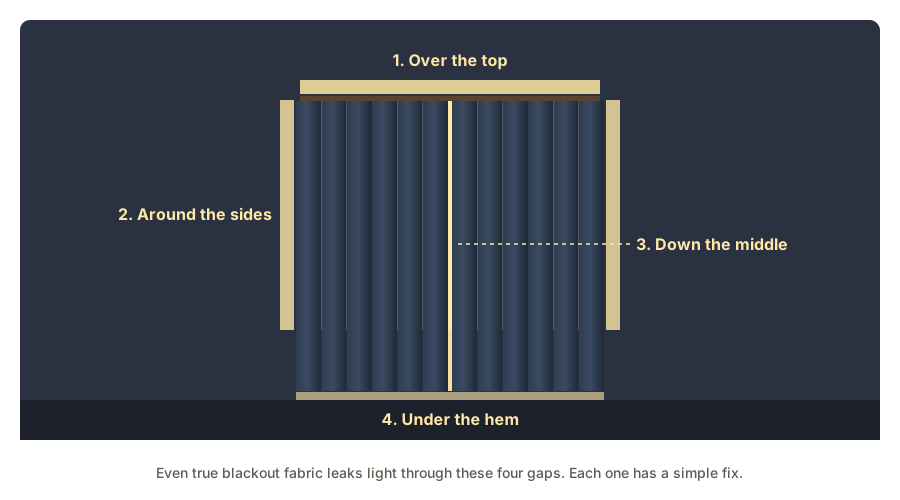
- Over the top: light shines up and over the rod when the rod is close to the window frame.
- Around the sides: light escapes between the curtain edges and the wall, especially when the rod is barely wider than the window.
- Down the middle: a thin line of light shows where the two panels meet.
- Under the hem: curtains that stop above the floor or sill leave a gap at the bottom.
The good news is that every one of these gaps has a simple fix.
How to get a truly dark room
Fix 1: Mount the rod high and wide
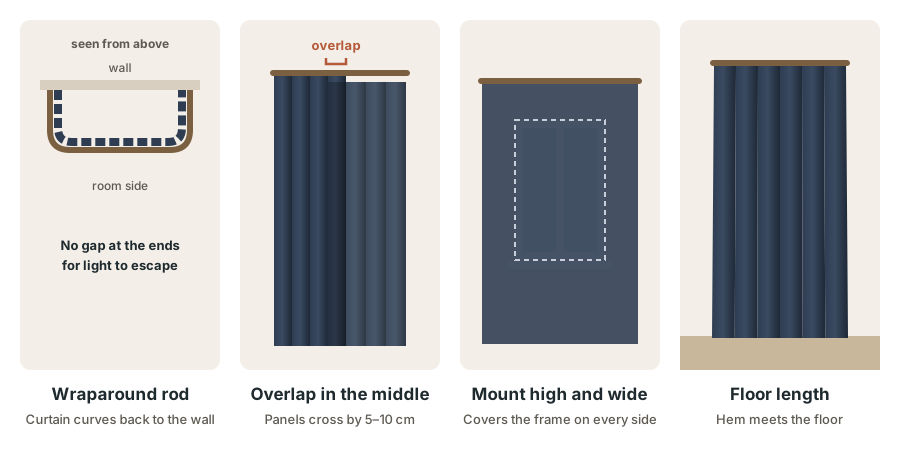
Hang the rod at least 10–15 cm (4–6 inches) above the window frame and extend it 15–25 cm (6–10 inches) or more beyond the frame on each side. The curtains then overlap the wall all around the window, blocking light from the top and sides. Our guide on how high and wide to hang curtain rods explains the details.
Fix 2: Block the top
- Mount the rod close to the ceiling if the window is near it, so there's no room for light to escape upward.
- Add a valance or cornice, a short fabric or boxed panel across the top that covers the rod and blocks upward light.
- Use a ceiling-mounted track, which lets the curtain hang from the very top.
- Choose a heading that sits above the rod, such as grommets or a back tab, rather than rings that leave a gap.
Fix 3: Close the sides
- Use a wraparound (return) rod. The ends curve back to the wall, and the curtain follows the curve, sealing the side gap. This is one of the most effective fixes.
- Add hook-and-loop strips or small magnets to hold the outer edges of the curtain against the wall or window frame.
- Choose extra width so the curtains overlap the wall generously when closed.
Fix 4: Close the middle
- Overlap the panels by 5–10 cm (2–4 inches) in the centre. Wider panels, or an extra panel, make this easy.
- Sew small magnets into the inner edges so the panels hold together.
- Use an overlap rod or a track with overlapping master carriers, which lets the two panels cross each other neatly.
- Use clips or a decorative clothes peg as a quick, renter-friendly fix.
Fix 5: Close the bottom
Choose floor-length curtains that touch the floor, or add a slight break of 2–5 cm so the hem rests on the floor. For windows above furniture, sill-length curtains that reach just below the sill and overlap the wall help too.
Fix 6: Layer with a blackout shade
For the darkest possible room, combine a blackout roller or cellular shade mounted inside or just outside the window frame with blackout curtains hung high and wide. The shade blocks light at the glass, and the curtains catch anything leaking around the shade's edges. This is the setup many people use in nurseries and for night-shift sleep.
Choosing the right blackout curtains
Size
Blackout curtains need to be generous to work well. Aim for:
- Width: at least 1.5–2 times the rod width in total, so the curtains overlap in the middle and cover the wall at the sides.
- Length: floor length, or a slight break, so no light escapes at the bottom.
Measure carefully using our step-by-step guide on how to measure windows for curtains.
Colour
With a proper blackout coating, weave or lining, the front colour doesn't change how much light comes through the fabric. A cream blackout curtain blocks light just as well as a navy one. However:
- Dark colours make the room feel darker and hide any faint glow at the edges.
- Light colours keep the room feeling bright and airy during the day when the curtains are open.
- Room-darkening and triple weave curtains do usually block more light in darker colours.
- A white or light-coloured back reflects sunlight away from the window, which helps keep the room cooler.
Heading
- Grommet: easy to open and close every day; the top of the fabric sits above the rod, which helps block light at the top.
- Pinch pleat on a track: excellent for made-to-measure blackout curtains, and works well with overlapping tracks.
- Rod pocket: blocks light at the top well, but is hard to open daily.
Weight and hardware
Blackout curtains are heavier than ordinary curtains, especially lined ones. Choose a sturdy rod of about 25 mm or more in diameter, fix the brackets securely into the wall with the right plugs for your wall type, and add a centre bracket on longer rods.
Fabric and feel
If you dislike the stiff feel of coated curtains, choose triple weave or a curtain with a sewn-in blackout lining. If budget matters most, coated polyester blackout curtains are the most affordable effective option.
Benefits of blackout curtains
Better sleep
A dark bedroom is widely recommended as part of good sleep habits. Blackout curtains are especially helpful when the sun rises early, when streetlights shine into the room, for babies and young children who nap during the day, and for anyone who sleeps during daylight hours.
Cooler rooms
By blocking direct sunlight, blackout curtains reduce how much heat enters through the window. Closing them during the hottest part of the day can make sunny rooms noticeably more comfortable and reduce the load on fans or air conditioning.
Privacy
Blackout curtains give complete privacy day and night, unlike sheers and light curtains that become see-through when lights are on inside.
Protection from fading
Sunlight fades floors, furniture, artwork and fabrics over time. Keeping blackout curtains closed in strong sun helps protect them.
Better screens
In living rooms and home theatres, blackout curtains remove glare from TVs and computer screens.
A little less noise
Heavy blackout curtains can soften some outside noise and reduce echo inside. They won't soundproof a room, but they can make it feel quieter.
Blackout curtains vs. blackout blinds and shades
Curtains aren't the only way to darken a room. Here's how they compare with blackout blinds and shades. For a fabric shade with real darkness, see our blackout roman shades guide.
| Blackout curtains | Blackout roller or cellular shade | Blinds (any type) | |
|---|---|---|---|
| Darkness | Very good when hung high, wide and long | Very good, but light can leak at the edges of an inside mount | Never fully dark; light passes between slats |
| Insulation | Good to very good | Good (cellular is excellent) | Low |
| Look | Soft, decorative, adds colour | Clean and minimal | Neat and structured |
| Space needed | Wall space beside the window | Very little | Very little |
| Best for | Bedrooms, living rooms, media rooms | Nurseries, small windows, layering | Daytime light control, not darkness |
For most bedrooms, blackout curtains alone are enough if they're hung correctly. When you need complete darkness, use a blackout shade and blackout curtains together. You can read more about the differences between these products in our guide to curtains, drapes, blinds and shades.
Step by step: hanging blackout curtains for maximum darkness
- Measure the window frame and decide on the rod position: at least 10–15 cm above the frame, or close to the ceiling, and 15–25 cm or more beyond each side.
- Choose the rod. A sturdy rod of around 25 mm or more, ideally a wraparound (return) rod. Add a centre bracket if it's long.
- Calculate the curtain size. Total width of about 1.5–2 times the rod width, and a length that reaches the floor or rests on it with a slight break.
- Install the brackets level and secure, using the right wall plugs for your wall.
- Hang the curtains and close them. Check for light in a dark room during the day.
- Close the remaining gaps. Add magnets or hook-and-loop strips at the sides, overlap the panels in the middle, and add a valance if light escapes over the top.
- Add a blackout shade behind the curtains if you still need more darkness.
DIY: turning your favourite curtains into blackout curtains
If you already have curtains you love, you don't need to replace them. There are three easy ways to add blackout performance:
Option 1: Hook-on blackout liners
Ready-made liners have a heading tape with slots for curtain hooks. You hook them onto the same rings or hooks as your curtain, so the liner hangs directly behind it. This works best with pinch pleat, pencil pleat and ring-top curtains.
Option 2: A second rod
Hang blackout curtains or plain blackout panels on the inner rod of a double rod, with your decorative curtains on the outer rod. During the day, open the blackout layer and close the decorative curtains; at night, close both.
Option 3: Sew in a lining
If you sew, cut a blackout lining fabric slightly narrower and shorter than the curtain, hem its edges, and stitch it to the back of the curtain along the top and sides. Leave the bottom hem loose so the two layers can hang naturally. Avoid sewing through the face of the curtain in many places, because each needle hole can let a pinprick of light through.
Special windows
Sliding glass doors
Use floor-length blackout curtains on a long rod that extends well past the door on the opening side. The panels must stack completely clear of the door so it can slide freely. Keep the hem just above the floor so it doesn't catch in the door track.
Bay windows
A bendable track or jointed bay rod lets one set of blackout curtains follow the bay and close as a single sheet. Separate curtains for each window section leave more gaps.
Windows above a bed or desk
Sill-length blackout curtains or a blackout roller shade keep the window covered without hanging over furniture. Mount the shade outside the recess so it overlaps the frame.
Caring for blackout curtains
- Read the care label first. Blackout curtains vary a lot.
- Vacuum regularly with a soft brush attachment to remove dust.
- Wash gently and cool if the label allows. Hot water can damage coatings and linings.
- Avoid high-heat tumble drying. Hang to dry, or use the lowest heat.
- Don't iron the coated side. If needed, iron the front on a low setting, or use a steamer.
- Air new coated curtains for a day or two if they have a smell when you unpack them.
- Spot clean marks on coated curtains with a damp cloth and mild soap rather than washing the whole curtain.
Best blackout setups for each room
Bedroom
Floor-length blackout curtains on a rod mounted high and wide, with panels that overlap in the middle. Add a blackout roller shade for the darkest result.
Nursery and children's rooms
A cordless blackout shade plus blackout curtains, with the rod mounted high and wide. Choose washable fabrics and keep any cords well out of reach.
Home theatre or media room
Heavy blackout drapes in a dark colour, on a ceiling track or wraparound rod, with generous overlap.
Living room
Room-darkening or blackout curtains in a lighter colour so the room still feels bright during the day, ideally layered with sheers.
Rooms that get very hot
Thermal blackout curtains with a light-coloured backing, closed during the hottest hours.
Garages, studios and large spaces
Heavy-duty vinyl or triple-weave curtains on a ceiling track or tensioned cable, sized well past the opening. Our guide to industrial blackout curtains covers materials, fire ratings and hardware for big spaces.
Common mistakes to avoid
- Buying room-darkening when you need blackout. Check the wording and test the fabric.
- Hanging blackout curtains right on the window frame. Light pours over the top and around the sides.
- Buying panels that only just cover the window. They can't overlap in the middle or at the sides.
- Choosing curtains that stop short of the floor. Light leaks underneath.
- Washing coated curtains in hot water or tumble drying them on high. The coating can crack.
- Using a thin rod. Heavy blackout curtains need a sturdy rod and secure brackets.
Frequently asked questions
Do blackout curtains really block 100% of light?
Good blackout fabric blocks nearly all light passing through it. Whether the room becomes fully dark depends on how the curtains are hung. Light around the edges is the usual problem, not the fabric itself.
Are blackout curtains worth it?
For bedrooms, nurseries, media rooms and rooms that overheat in the sun, yes. They're one of the most effective and affordable upgrades for sleep and comfort.
Do blackout curtains keep rooms cool?
They help by blocking direct sunlight, which carries a lot of heat. Keep them closed during the hottest part of the day for the best effect.
What colour blackout curtains are best?
With true blackout fabric, any colour blocks light. Dark colours make the room feel darker; light colours keep it bright by day.
Can I make my existing curtains blackout?
Yes. Add a hook-on blackout liner, or hang a blackout liner or blackout shade behind your curtains on a double rod.
Can blackout curtains be washed?
Many can be washed gently on a cool cycle. Coated curtains need extra care: avoid hot water, high-heat drying and direct ironing. Always follow the label.
The bottom line
Blackout curtains work by adding a light-blocking coating, a dark woven core, or a blackout lining. Choose true blackout if you need darkness, and test the fabric when it arrives. Then hang it properly: mount the rod high and wide, choose generous width so the panels overlap, go floor length, and add a wraparound rod, valance or blackout shade if you need even more darkness. Get these details right and you'll have a room that's genuinely dark whenever you need it.
Keep reading
 Fabrics
Industrial blackout curtains: a complete guide to heavy-duty light blocking
Warehouses, studios, workshops, halls and loft homes all need serious darkness at times. Here's how to choose, size, hang and seal industrial blackout curtains that really block light.
 Fabrics
Velvet curtains: a complete guide to choosing, hanging and caring for them
Velvet curtains look luxurious, block light, keep rooms warm and quieten noise. Here's everything you need to know about velvet types, colours, hardware, hanging and care.
 Fabrics
Thermal curtains: do they really keep rooms warm or cool?
Thermal curtains promise cooler summers, warmer nights and lower energy bills. Here's how they actually work, what they can and can't do, and how to choose and hang them for the best results.