Styles
Oak wooden blinds: shades, slat sizes, real oak vs oak-effect, and care

Oak wooden blinds are one of the most popular wooden blinds for a simple reason: oak goes with almost everything. Its light-to-mid honey tone and gentle grain bring warmth to a room without making it feel dark or heavy, and it sits happily alongside white walls, grey sofas, green plants and the wooden floors and furniture so many homes already have. Add the precise light control of tilting slats, and an oak wooden blind is both practical and beautiful.
This guide covers what oak wooden blinds are actually made of, the different shades of oak, real wood vs. oak-effect blinds, slat sizes and decorative tapes, which rooms they suit, how to pair them with your floors and furniture, measuring and fitting, everyday use and care.
What are oak wooden blinds?
Oak wooden blinds are venetian blinds with wooden slats in an oak colour and finish. Like all venetian blinds, the slats are held together by ladder strings or fabric tapes; you tilt them with a wand or cord to control light and privacy, and raise the whole blind to clear the window.
"Oak" usually describes the look rather than the wood species. Solid oak is a dense, heavy hardwood, which makes it expensive and impractical for long blind slats. So most oak wooden blinds are one of these:
- Real wood stained oak: a lightweight hardwood, usually basswood or paulownia, sometimes bamboo, stained and lacquered to an oak shade. This is the most common type of real wooden blind.
- Real oak or oak veneer: genuine oak, either solid or as a thin veneer on a lighter core. These show oak's distinctive open grain but are rarer and more expensive.
- Faux wood (oak effect): PVC or a wood composite printed or coloured to look like oak. It's moisture-resistant and tough, but heavier.
- Aluminium with an oak print: thin metal slats with a wood-grain finish; light, cheap and fine in damp rooms.
All of these are legitimate choices. The key is knowing which one you're buying, because they behave very differently in damp, sunlight and everyday use.
Shades of oak
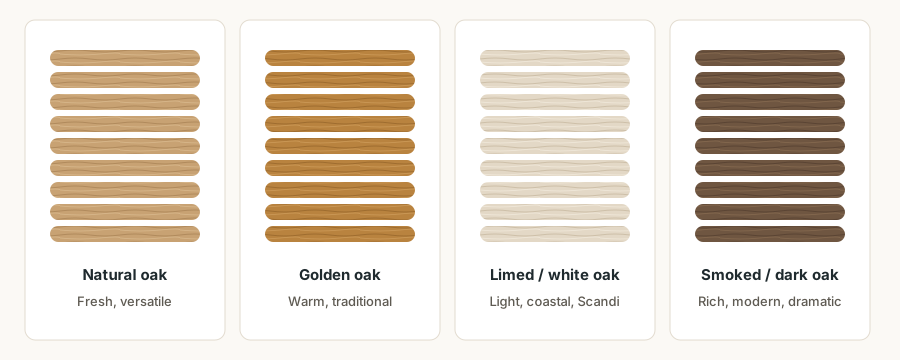
Every maker mixes its own stains, so "oak" can mean very different colours. The main families are:
- Natural oak: a light, fresh honey-beige that shows the grain clearly. The most versatile shade, at home in modern, Scandinavian and country rooms.
- Golden or rustic oak: warmer and more amber, with a traditional, cosy feel. Lovely with cream walls, cottage interiors and older homes.
- Limed, white-washed or white oak: pale and soft, with a hint of grain showing through a white or grey wash. Ideal for coastal, Scandinavian and Japandi styles, and for small rooms that need to feel light.
- Smoked or dark oak: deep brown, sometimes with a grey cast. Rich, modern and dramatic, best in rooms with plenty of light.
- Grey oak: a cool, weathered look that works with grey and blue schemes.
Look at samples in your own room, in daylight and at night under your lamps, and hold them next to your floor, furniture and window frame. Oak in particular can look golden in warm light and greenish-grey in cool light, so seeing it in place matters.
Real wood vs. oak-effect
Real wood oak blinds
- Look and feel: natural grain that varies from slat to slat, and a warm, genuine feel.
- Weight: lighter than faux wood, so larger blinds are easier to raise.
- Weak points: moisture and steam can warp or swell real wood; strong sun gradually changes the colour.
- Best for: living rooms, bedrooms, dining rooms, studies and hallways.
Faux wood oak-effect blinds
- Look: convincing from a few steps away; the grain is more regular up close.
- Durability: resists moisture, warping, fading and knocks, and wipes clean easily.
- Weight: heavier, so very large blinds may have size limits.
- Best for: kitchens, bathrooms, utility rooms and busy family homes.
Quick comparison
| Feature | Real wood (oak stain) | Real oak / veneer | Faux wood oak-effect | Oak-print aluminium |
|---|---|---|---|---|
| Look | Natural, varied | Authentic oak grain | Even, printed grain | Flat, printed |
| Weight | Light | Medium to heavy | Heavy | Very light |
| Damp rooms | Poor | Poor | Very good | Excellent |
| Fade resistance | Fair | Fair | Good | Good |
| Typical slats | 35–63 mm | 50–63 mm | 50–63 mm | 16–50 mm |
| Cost | Medium | High | Low to medium | Low |
For a darker wood with the same choices, see our walnut venetian blinds guide, and for slim metal blinds, our aluminium venetian blinds guide.
Oak's grain and character
Real oak has a distinctive open grain: long, flowing lines with occasional flecks and "cathedral" patterns. Stained basswood has a finer, smoother grain, while faux wood has a printed grain that repeats. None is better or worse, but if you love the texture of oak furniture, a blind with visible grain will feel more at home beside it.
Finishes also matter. A matt or satin lacquer looks natural and modern and hides fingerprints; a glossier finish looks more traditional and shows marks. Some oak blinds have a brushed or textured finish that you can feel, which adds to the natural look.
Slat sizes and decorative tapes
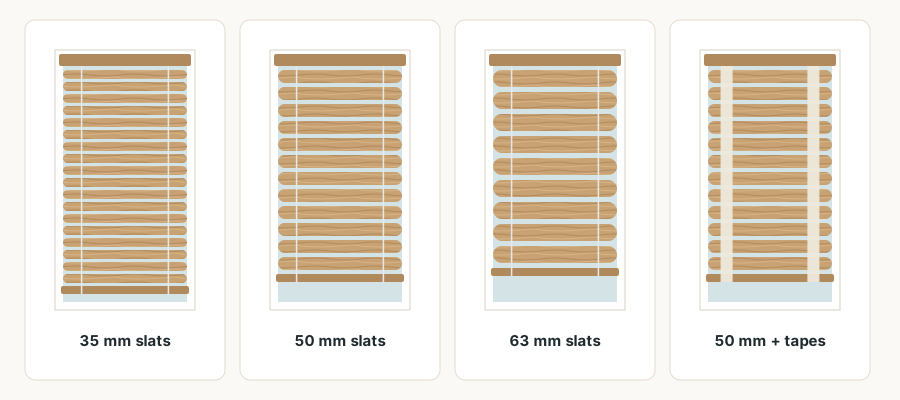
| Slat width | Look | Best for |
|---|---|---|
| 35 mm | Fine and neat | Small windows, narrow or shallow recesses, doors |
| 50 mm | The classic wooden blind | Most windows in most rooms |
| 63 mm | Wide, shutter-like | Large windows, tall rooms, a bold architectural look |
Wider slats give a clearer view when open and a bolder look, but they need more depth to tilt and make a deeper stack when the blind is raised. On a typical window, a 50 mm wooden blind stacks noticeably at the top, so if you want the full glass clear, fit the blind above the window or allow for it.
Ladder strings vs. tapes
- Ladder strings are thin and discreet, giving a clean, modern look. The small cord holes can let pinpricks of light through.
- Decorative tapes are wide fabric bands running down the front and back. They cover the cord holes, so less light gets in, and add colour and a tailored finish.
With oak, cream, ivory and natural linen tapes look soft and Scandinavian; grey and charcoal tapes look modern; navy, sage, mustard or terracotta tapes add personality and tie the blinds to your soft furnishings.
Where oak wooden blinds work best
Living rooms
Oak blinds bring warmth and texture, and tilting the slats softens bright sun on the TV. Layer them with linen or wool curtains for a cosy evening look. See living room curtain ideas.
Dining rooms
Oak blinds echo oak tables and chairs beautifully, and half-closed slats give a warm, intimate light at dinner.
Bedrooms
Wooden slats block more light than thin aluminium, but light still gets past the edges and slats. For proper darkness, add lined or blackout curtains; see our blackout curtains guide.
Home offices and studies
Oak adds a calm, natural feel, and angled slats cut screen glare without darkening the room.
Hallways and landings
Oak blinds suit hall windows near wooden stairs and floors, giving privacy from the street while letting light through.
Kitchens and bathrooms
Choose faux wood oak-effect or oak-print aluminium here. Real wood can warp in steam and splashes. See kitchen curtain ideas.
Conservatories and sunny windows
Strong sun changes the colour of real wood over time, and heat can stress the slats. Faux wood copes better in very sunny spots.
Styling oak blinds with floors and furniture
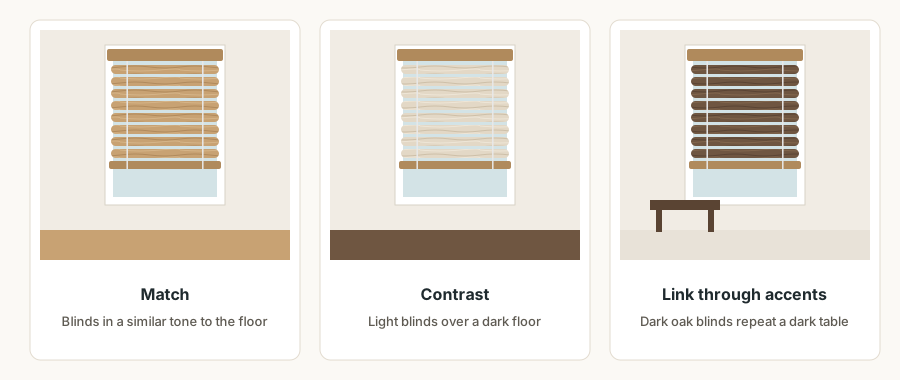
Most homes already have some wood, so the question is how your oak blinds will sit next to it. There are three good approaches:
- Match: choose blinds close in tone to your floor or main furniture. The room feels calm and joined-up. Bring a sample home, because a near-match that's slightly off can look like a mistake.
- Contrast: choose a clearly different tone, such as limed oak blinds over a dark floor, or smoked oak blinds in a pale room. A confident contrast looks deliberate.
- Link through accents: repeat the blinds' tone in two or three smaller pieces, like a picture frame, a shelf or a side table, so the blinds feel planned.
Wall colours that suit oak
- White and warm white: fresh and bright; oak glows against them.
- Sage, olive and soft green: natural and calming, a classic pairing with wood.
- Warm greys and greige: modern and balanced.
- Soft blues and navy: blue is opposite orange on the colour wheel, so it makes oak's warmth stand out.
- Terracotta, blush and clay: earthy and on-trend.
Interior styles
- Scandinavian: natural or limed oak with white walls, simple shapes and soft textiles.
- Japandi: natural or smoked oak, muted colours and minimal decor.
- Country and cottage: golden oak with tapes, florals and checks.
- Modern: natural oak with ladder strings and wide slats, in a pared-back room.
- Coastal: limed oak with whites, blues and sandy neutrals.
For more on colour choices, see how to choose curtain colours.
Valances and finishing touches
Most oak wooden blinds come with a matching wooden valance, a strip of wood that clips to the front of the headrail and hides the mechanism. It gives the blind a finished, furniture-like look, especially when the blind sits inside the recess where the top is on show. Valances can be flat, bevelled or shaped, so choose one that suits your window frames: a simple flat valance looks modern, while a shaped or moulded one suits period homes.
Other small details make a difference too. Wooden tilt wands and bottom-rail end caps in the same oak as the slats look more polished than plastic ones. Hold-down brackets stop blinds on doors from swinging. And a matching oak blind on every window in a room, even in different sizes, gives a calm, consistent look.
Oak blinds vs. oak shutters
Oak blinds and oak plantation shutters both give a wooden, slatted look, but they're quite different:
| Oak wooden blinds | Oak shutters | |
|---|---|---|
| How they open | Slats tilt; the whole blind lifts up | Louvres tilt; panels swing open like doors |
| View when open | Clear once raised (except the stack) | Panels fold back to the side of the window |
| Fitting | Simple brackets, easy DIY | Made-to-measure frames, usually professionally fitted |
| Insulation and sturdiness | Moderate | Higher |
| Cost | Much lower | Much higher |
If you love the shutter look but not the price, oak blinds with wide 63 mm slats and a matching valance give a similar effect for far less.
Combining oak blinds with curtains
Oak blinds and curtains make a lovely layered window. The blind controls light during the day; curtains add softness, warmth and darkness at night.
- Natural linen curtains in oatmeal, white or sage keep things light and relaxed; see our linen curtains guide.
- Velvet curtains in rust, forest green or navy look rich with oak; see our velvet curtains guide.
- Sheer curtains soften the slats and add privacy; see our sheer curtains guide.
Hang the curtain pole far enough from the wall to clear the blind and its valance, and choose a pole finish that works with oak: matching wood, black, brushed brass or antique bronze.
Measuring and fitting oak wooden blinds
Oak wooden blinds are usually made to measure. Measure each window separately with a steel tape, in millimetres, and check whether the supplier wants recess or finished sizes.
Inside the recess
- Measure the width at the top, middle and bottom, and use the smallest.
- Measure the drop at the left, centre and right, and use the smallest.
- Check the recess depth: wooden slats need more depth than aluminium to tilt freely, and wider slats need more still. Note any handles that stick out.
Outside the recess
- Measure the opening and add 5–10 cm on each side.
- Measure from where the headrail will sit, allowing for the stack, to just below the sill.
Our guide to fitted horizontal blinds explains measuring and the different fitting methods in more detail.
Fitting
- Mark the brackets near each end of the headrail, plus a centre bracket on wide blinds, and check they're level.
- Fix them firmly: wooden blinds are heavier than aluminium, so use proper wall plugs or screw into timber.
- Clip in the headrail, fit the matching wooden valance, and attach the tilt wand.
- Fit cord safety devices high and out of children's reach.
- Test by raising, lowering and tilting the blind.
See how to hang curtains for advice on fixings and finding studs.
Size limits and weight
Wooden blinds get heavy as they get bigger, and faux wood is heavier still. Makers set maximum widths and drops so blinds stay safe and easy to lift. For very wide windows, split the window into two or three blinds, choose real wood rather than faux to save weight, or ask about motorised or lift-assisted options.
Child and pet safety
Looped cords on blinds can be a strangulation hazard for young children. Choose cordless or motorised oak blinds in family homes, fit any cord safety devices supplied, keep cords tight and out of reach, and move cots, beds and climbable furniture away from windows. Pets can chew and bend slats, so faux wood is a tougher choice where cats or dogs like to look out of the window. See curtains for kids' rooms and nurseries.
Using your oak blinds
- Daytime privacy: tilt the slats so the room-side edge is higher, bouncing light onto the ceiling and blocking views in.
- Most light: set the slats level, or raise the blind.
- Night: close the slats fully for privacy when the lights are on.
- Raise the blind with the slats level, not closed, to reduce strain on the cords.
Sunlight and colour change
Real oak and oak-stained woods change colour in sunlight over time. Pale oak often deepens towards amber, while some stains gradually lighten. This happens slowly and evenly if the whole blind gets the same light. To keep the change even, tilt the slats in different directions from time to time, close the blind during the strongest midday sun, and consider faux wood for very sunny, south- or west-facing windows.
Cleaning and caring for oak wooden blinds
Real wood
- Dust weekly with a microfibre cloth, a lambswool duster or a vacuum with a soft brush. Close the slats one way, dust, then the other way.
- For marks, use a barely damp cloth and dry straight away. Never soak real wood or use steam cleaners.
- Avoid strong chemical cleaners and abrasive pads, which can strip the lacquer.
- An occasional wipe with a wood-safe polish on a cloth can refresh the finish; check the maker's advice first.
Faux wood and aluminium
- Dust regularly and wipe with warm water and a little washing-up liquid when needed, then dry to avoid streaks.
Tapes
- Vacuum gently with a brush attachment and spot clean with a damp cloth and mild soap, testing an out-of-sight spot first.
Small repairs
- A warped or cracked slat can often be replaced by ordering a spare from the supplier.
- A blind that won't lock: pull the cord slightly towards the centre of the window and release.
- An uneven bottom rail: lower the blind fully, open the slats, and raise it again.
Common mistakes
- Putting real wood in a bathroom or above a steaming kettle.
- Choosing an oak that almost matches the floor, which can look like a mistake. Match closely or contrast clearly.
- Forgetting the stack, so the raised blind blocks the top of the view.
- Ignoring recess depth, so wide slats hit the window handles.
- Choosing faux wood for a very wide window without checking the weight limit.
- Skipping samples: oak shades vary hugely between makers.
- Leaving cords loose in a home with young children.
Frequently asked questions
Are oak wooden blinds made of real oak?
Some are, but most are a lighter hardwood such as basswood stained to an oak colour. Others are faux wood or aluminium with an oak finish. Check the product description for the material.
Can I use oak wooden blinds in a bathroom?
Choose faux wood oak-effect or oak-print aluminium for bathrooms. Real wood can warp in steam and humidity.
What colour walls go with oak blinds?
White, warm white, sage green, warm grey, soft blue, navy and terracotta all suit oak.
Should my oak blinds match my oak floor?
They don't have to. Either choose a close match or a clear contrast, and repeat the blind's tone somewhere else in the room so it looks intentional.
What slat size is best for oak blinds?
50 mm suits most windows. Choose 35 mm for small windows and 63 mm for large windows or a shutter-like look.
Will oak blinds go out of fashion?
Oak has been a favourite in homes for centuries and suits many styles, from cottage to Scandinavian to modern. Choosing a natural or limed shade with simple ladder strings or neutral tapes keeps the look timeless, and you can refresh the room around it with new curtains, cushions and wall colours.
How do I stop oak blinds from rattling?
Blinds can tap against the frame when a window is open. Lower them only part way when the window is open, fit hold-down brackets on doors, or choose a blind with tapes, which tends to move less in a breeze.
Do oak blinds keep a room warm?
Wood is a natural insulator, so closed wooden blinds reduce heat loss through the glass a little more than aluminium. For real warmth, add thermal curtains; see our thermal curtains guide.
The bottom line
Oak wooden blinds bring light, natural warmth and precise light control to almost any room. Choose real wood for living rooms, bedrooms and dining rooms where you want genuine grain and a lighter blind, and faux wood or oak-print aluminium for kitchens, bathrooms and very sunny windows. Pick your oak shade by seeing samples in your own light, choose 50 mm slats for most windows, decide between minimal ladder strings and decorative tapes, and either match or clearly contrast your floors. Measure carefully, choose cordless control in family homes, and dust gently rather than washing, and your oak blinds will look lovely for many years.
Keep reading
 Styles
Fitted horizontal blinds: a complete guide to made-to-measure blinds that fit perfectly
Fitted horizontal blinds are made to the exact size of your window, so they look neat and control light properly. Compare types, fitting methods, measuring and care.
 Styles
Blackout roman shades: how to choose, measure and fit them for a truly dark room
Blackout roman shades combine soft fabric folds with real darkness. Learn the styles, linings, mounts, measuring, cord safety and tricks that stop light leaking around the edges.
 Styles
Walnut venetian blinds: real wood vs faux wood, styling and care
Rich, warm and timeless, walnut venetian blinds bring the look of dark wood to any window. Compare real and faux wood, slat sizes and tapes, and learn how to style and care for them.