Fabrics
Velvet curtains: a complete guide to choosing, hanging and caring for them

Velvet curtains have a reputation for luxury, and it's well deserved. Their soft, dense pile catches the light and gives every fold a deep, glowing colour that no flat fabric can match. They're also wonderfully practical: velvet blocks light, keeps rooms warmer in winter, absorbs sound and hangs in heavy, graceful folds.
But velvet is different from other curtain fabrics. It's heavy, it has a direction, it shows marks in its own way, and it needs the right hardware and care. This guide explains the different types of velvet, their advantages and disadvantages, how to choose a colour, how to hang velvet curtains properly, and how to keep them looking beautiful for years.
What is velvet?
Velvet is a woven fabric with a short, dense pile: thousands of tiny cut fibres standing upright on the surface. That pile is what makes velvet feel soft and look rich. The fibres reflect light differently depending on the angle you look from, which is why velvet seems to change colour as it moves and why its folds look so deep.
The word "velvet" describes the structure of the fabric, not the fibre. Velvet can be made from polyester, cotton, silk, viscose (rayon), linen or blends. Each fibre gives a different look, feel, weight and price.
Types of velvet for curtains
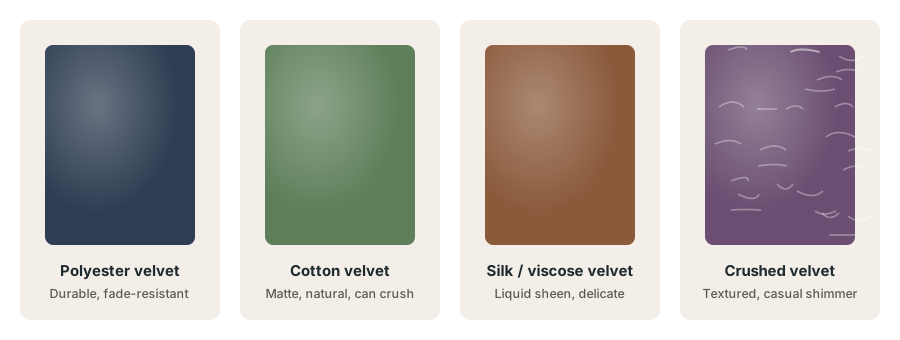
Polyester velvet
The most common velvet for ready-made curtains. Modern polyester velvet is soft, has a pleasant sheen and comes in a huge range of colours.
- Pros: affordable, durable, resists fading and creasing, often machine washable, holds its colour well.
- Cons: can look slightly shinier and less natural than cotton; can build up static and attract dust and pet hair.
- Best for: most homes, sunny windows, families and anyone on a budget.
Cotton velvet
Cotton velvet has a matte, natural appearance and a soft, slightly dry handle. It's a favourite of interior designers for its understated richness.
- Pros: natural look, deep matte colour, breathable, beautiful drape.
- Cons: more expensive, crushes and marks more easily, fades faster in strong sun, usually needs dry cleaning.
- Best for: living rooms, dining rooms and bedrooms where a refined, classic look is wanted.
Silk and viscose velvet
Silk velvet, and its more affordable cousin viscose velvet, has a liquid sheen and a very fluid drape.
- Pros: the most luxurious look, beautiful lustre, soft and fluid.
- Cons: very expensive (silk), delicate, damaged by sun and water, dry clean only.
- Best for: formal rooms and windows that don't receive strong direct sunlight.
Crushed velvet
Crushed velvet is deliberately twisted or pressed so the pile lies in different directions, creating a shimmering, textured surface.
- Pros: hides creases and marks, eye-catching, casual and glamorous at once.
- Cons: a more decorative, less classic look; can feel dated in some interiors.
- Best for: bedrooms, glamorous or eclectic interiors and high-use areas where marks would show on smooth velvet.
Linen velvet and blends
Linen velvet and cotton-linen blends have a dry, slightly irregular texture and a relaxed, earthy look. They're less common but beautiful in natural colour palettes.
Advantages of velvet curtains
- Luxurious appearance: velvet instantly makes a room feel richer and more finished.
- Light blocking: the dense pile blocks much more light than cotton or linen of similar colour, especially when lined.
- Insulation: velvet traps air, helping keep warmth in during winter and heat out during summer. See our thermal curtains guide for more on insulation.
- Sound absorption: heavy, dense curtains soften echoes and reduce outside noise.
- Beautiful drape: velvet's weight makes it hang straight and fold deeply.
- Colour depth: colours look deeper and more saturated in velvet than in flat fabrics.
- Privacy: velvet is opaque, so it gives complete privacy when closed.
Disadvantages of velvet curtains
- Heavy: velvet needs strong rods and brackets.
- Attracts dust and pet hair, especially polyester velvet.
- Shows marks: crushing, handprints and pressure marks can show on smooth velvet.
- Harder to clean: many velvets need dry cleaning or careful hand care.
- Can fade: natural fibre velvets fade in strong sun.
- Can feel heavy in summer or in small, warm rooms.
- More expensive than many other curtain fabrics, especially in cotton or silk.
Understanding pile direction
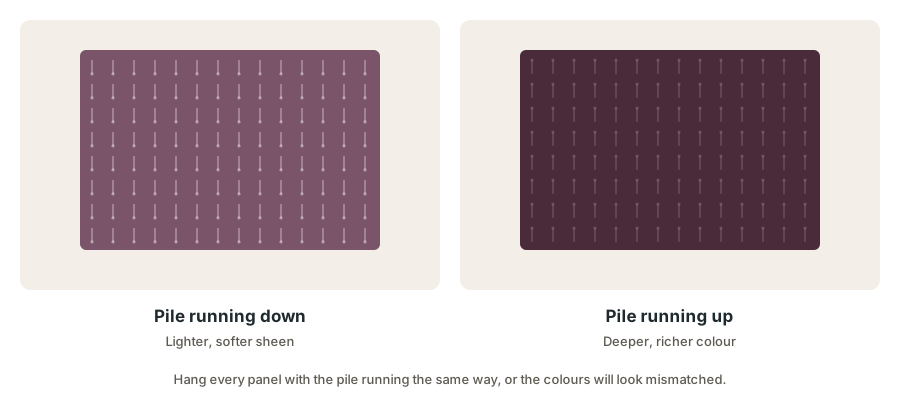
Velvet's pile leans slightly in one direction, like the fur on an animal. Stroke it one way and it feels smooth; stroke it the other way and it feels slightly rough. This is called the nap or pile direction, and it affects colour:
- Pile running down (smooth when you stroke downward) reflects more light, so the colour looks lighter and shinier. It also sheds dust more easily.
- Pile running up (smooth when you stroke upward) absorbs more light, so the colour looks deeper and richer.
Either direction is fine, but all panels must hang with the pile running the same way. If one panel is upside down compared to the other, they'll look like two different colours. Ready-made velvet curtains are made correctly, but check if you've taken them down for cleaning. If you sew velvet curtains yourself, mark the pile direction on every piece before cutting.
Velvet compared with other heavy curtain fabrics
| Fabric | Look | Light blocking | Insulation | Care | Price |
|---|---|---|---|---|---|
| Polyester velvet | Soft sheen, rich colour | High | Good | Often washable | Low–medium |
| Cotton velvet | Matte, refined | High | Good | Usually dry clean | Medium–high |
| Chenille | Soft, textured, casual | Medium–high | Good | Varies | Medium |
| Heavy linen | Natural, relaxed | Low unless lined | Moderate | Often washable | Medium |
| Wool / wool blend | Warm, tailored | Medium–high | Very good | Dry clean | High |
| Faux suede | Smooth, matte | Medium–high | Good | Often washable | Low–medium |
Velvet stands out for the depth of its colour and its combination of light blocking, insulation and sound absorption. For a full comparison of everyday fabrics, see curtain fabrics compared.
Choosing a velvet colour
Velvet makes colours look deeper, so choose with that in mind. Look at a sample in folds rather than flat, and in both daylight and lamplight.
Jewel tones
Emerald, sapphire, ruby, amethyst and teal are the classic velvet colours. They look sumptuous and dramatic, perfect for living rooms, dining rooms and bedrooms.
Earthy tones
Rust, terracotta, ochre, olive and chocolate brown feel warm, relaxed and contemporary. They pair beautifully with wood, leather and natural materials.
Soft neutrals
Champagne, oatmeal, taupe, dove grey and soft white velvet give a quiet luxury that works in almost any room.
Pastels
Blush pink, powder blue, sage and lilac velvet feel soft and modern, especially in bedrooms.
Dark colours
Navy, charcoal, forest green and black velvet are dramatic and cocooning. They block light very well, making them excellent for bedrooms and media rooms.
For more on balancing colours across a room, see our guide on how to choose curtain colours.
Where to use velvet curtains
Living rooms
Velvet is a natural choice for living rooms, adding warmth, comfort and elegance. Floor-length velvet curtains hung high make a strong statement. See our living room curtain ideas for inspiration.
Bedrooms
Lined velvet curtains in a dark colour create a cosy, dark room that supports good sleep. Their sound absorption is a bonus. Our guide to the best curtains for bedrooms covers blackout options in more detail.
Dining rooms
Velvet suits formal dining rooms, where it adds drama and softens the acoustics of hard surfaces.
Media rooms and home cinemas
Dark velvet blocks light and absorbs sound, ideal for watching films.
Where to avoid velvet
- Kitchens, where grease and cooking smells cling to the pile.
- Bathrooms and damp rooms, where humidity can flatten and damage the pile and encourage mould.
- Very sunny windows, unless the velvet is polyester or well lined, since natural fibres fade.
- Small, hot rooms in warm climates, where heavy curtains can feel oppressive.
Styling velvet curtains
Velvet is a confident fabric, and a few styling choices help it look its best:
- Balance the richness with lighter textures elsewhere: linen cushions, a jute rug, wooden furniture or a plain sheer behind the velvet.
- Repeat the colour once or twice in the room, such as a cushion, a throw or artwork, so the curtains feel connected.
- Pick hardware to match the mood: brass and antique gold feel warm and classic; black metal feels modern; wood feels relaxed.
- Layer with sheers on a double rod for daytime privacy and softened light, while keeping the velvet for evening.
- Use tiebacks or holdbacks to sweep heavy velvet off the glass during the day and let in more light.
- Try tone-on-tone: velvet curtains in a deeper shade of the wall colour create an elegant, enveloping look.
Velvet in warm and humid climates
Velvet is associated with cold-weather comfort, but it can work in warm climates too with a few adjustments:
- Choose lighter colours, which absorb less heat.
- Use polyester velvet, which resists humidity and fading better than natural fibres.
- Add a thermal or blackout lining: closed during the hottest part of the day, it keeps sun heat out and helps air conditioning work more efficiently.
- Keep the room well ventilated and vacuum the curtains regularly to prevent dust and mould in humid weather.
- Consider velvet only in air-conditioned bedrooms and living rooms, with lighter cotton or linen elsewhere.
Lining velvet curtains
Velvet is already quite opaque, but lining still helps:
- Standard lining protects the velvet from sun and dust, adds body and gives a neat appearance from outside.
- Blackout lining blocks almost all light, perfect for bedrooms. See our blackout curtains guide.
- Thermal lining improves insulation further.
- Interlining, a soft layer between velvet and lining, adds a padded, luxurious fullness and even more insulation. It's typical of high-end made-to-measure curtains.
Lining also means the curtains are heavier, so take the extra weight into account when choosing hardware.
Rods, tracks and brackets for velvet
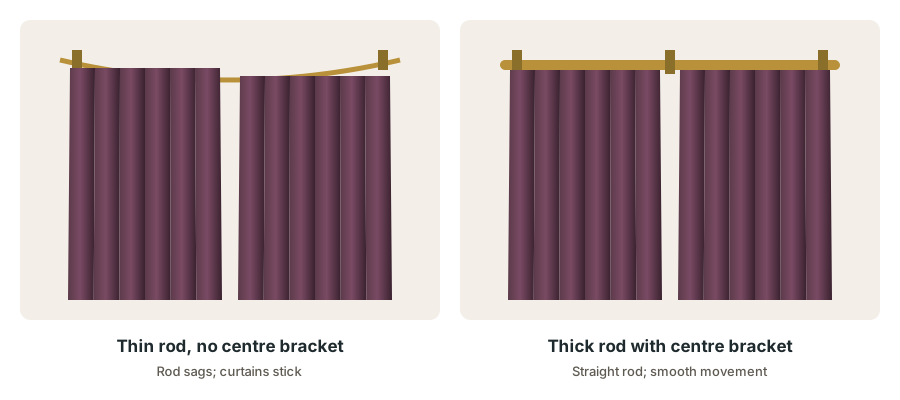
Velvet curtains can weigh several kilograms per panel, especially when lined. Weak hardware will sag, bend or pull out of the wall.
- Choose a sturdy rod: at least 25 mm (1 inch) in diameter for most windows, and 28–35 mm for wide windows or heavy lined velvet.
- Add centre brackets on rods longer than about 150–180 cm, and every 120–150 cm after that.
- Use proper wall fixings: screw brackets into wall studs, masonry with wall plugs, or use heavy-duty anchors in plasterboard. Never rely on the small plugs supplied for very heavy curtains without checking.
- Consider a track: heavy-duty curtain tracks carry heavy curtains smoothly and can be fitted with a cord or wand for easy opening.
- Use smooth rings or gliders. Velvet is heavy, so rings with a liner or ball-bearing gliders make the curtains much easier to open and close.
Our curtain rods and tracks guide explains how to choose the right hardware in more detail.
The best headings for velvet curtains
- Pinch pleat: the classic choice for velvet, giving formal, structured folds.
- Ring top or hook-on rings: easy to open and close, and suitable for heavy fabrics.
- Wave (S-fold): gives smooth, modern, even folds on a track.
- Eyelet (grommet): popular for ready-made velvet; make sure the rod is thick enough and the eyelets are large enough to slide easily.
- Pencil pleat: works, but the gathered heading can look bulky with thick velvet.
- Rod pocket: best avoided for heavy velvet, because the fabric drags on the rod and is hard to open.
See curtain headings compared for more about each style.
How long should velvet curtains be?
Velvet looks best floor-length. Choose one of these lengths:
- Just kissing the floor (about 0.5–1 cm above): the most popular, tailored and practical choice.
- Breaking (2–5 cm extra): a relaxed, slightly luxurious look.
- Puddling (10–20 cm extra): a dramatic, romantic look for formal rooms, but it collects dust and isn't practical in busy areas or homes with pets.
Short sill-length velvet curtains tend to look awkward because the heavy fabric looks cut off. Our curtain length guide explains each option.
How much fullness for velvet?
Because velvet is thick, it doesn't need as much fullness as lightweight fabrics. Around 1.75 to 2 times the rod width is usually ideal. Too much velvet becomes bulky, stacks very wide when open and blocks the window. Too little looks flat and skimpy. Learn more in curtain fullness explained.
How to hang velvet curtains
- Unpack and hang early. Take the curtains out of their packaging as soon as possible so the creases can start to drop.
- Check the pile direction on all panels before hanging.
- Fit strong brackets high and wide: about 10–15 cm above the window frame and 15–25 cm beyond each side, so the curtains stack off the glass.
- Hang the curtains and spread them evenly along the rod.
- Train the folds. Open the curtains fully, arrange them into neat even folds, and tie them loosely with soft fabric strips for two or three days. This "dresses" the curtains so they fall neatly.
- Steam out creases, as explained below.
For full step-by-step instructions, read how to hang curtains.
Caring for velvet curtains
Regular care
- Vacuum regularly with a soft brush attachment on low suction, working in the direction of the pile.
- Use a lint roller or a damp rubber glove to remove pet hair.
- Shake gently or open and close them often to stop dust settling.
- Rotate panels occasionally if one side gets more sun.
Steaming
Steam is the best way to remove creases and restore crushed pile. Hold a garment steamer a few centimetres from the fabric and move it slowly from top to bottom. Don't press the steamer onto the velvet. After steaming, brush the pile gently with a soft brush in the right direction and let the curtains dry completely before touching them.
Never iron velvet directly
Ironing flattens and shines the pile permanently. If you must iron, iron lightly on the reverse side with the velvet face down on a thick towel, or use a special needle board.
Spot cleaning
Blot spills immediately with a clean, dry cloth. Don't rub, because rubbing crushes the pile. For marks, use a cloth dampened with water and a little mild detergent, test it in a hidden area first, then blot dry and brush the pile.
Washing
Always follow the care label. Many polyester velvets can be machine washed on a gentle, cold cycle, inside a large laundry bag, and hung to dry. Cotton, silk and viscose velvets, and almost all lined velvet curtains, should be professionally dry cleaned. Our guide on how to wash curtains covers each method in detail.
Buying checklist for velvet curtains
- Fibre: polyester for durability and easy care; cotton or silk for a refined look in protected windows.
- Weight: heavier velvet drapes better. Very thin, cheap velvet can look flat and shiny.
- Lining: check whether the curtains are lined, blackout lined or unlined.
- Heading: eyelets, pinch pleats or a tape for hooks. Make sure it matches your rod or track.
- Size: measure carefully and allow for fullness. See how to measure windows for curtains.
- Care label: check whether they can be washed at home.
- Colour: order a sample if possible, because velvet colours look different on screens and in real light.
- Pile direction: if buying several panels, check they all have the pile running the same way.
Common mistakes with velvet curtains
- Hardware that's too weak, causing sagging rods or brackets pulling out of the wall.
- Panels with opposite pile directions, so they look like different colours.
- Ironing the face of the velvet, leaving shiny flat patches.
- Too much fullness, making bulky stacks that block light.
- Unlined natural velvet in sunny windows, which fades quickly.
- Short velvet curtains that look heavy and cut off.
- Using velvet in kitchens and bathrooms, where it collects grease and moisture.
Frequently asked questions
Are velvet curtains good for blocking light?
Yes. Velvet blocks much more light than most fabrics, especially in dark colours. For complete darkness, choose velvet with a blackout lining.
Do velvet curtains keep a room warm?
Yes. The dense pile and weight provide good insulation, and lined or interlined velvet is even better.
Are velvet curtains out of style?
No. Velvet has been popular for centuries and is widely used in modern interiors too, especially in earthy and jewel tones.
Can velvet curtains be machine washed?
Some polyester velvets can, on a gentle cold cycle. Check the care label. Cotton, silk, viscose and lined velvet curtains generally need dry cleaning.
How do I get creases out of velvet curtains?
Hang them for a few days, then steam gently without touching the fabric and brush the pile. Never iron the front of velvet.
Are velvet curtains good with pets?
Polyester velvet is durable, but all velvet attracts pet hair. Keep a lint roller handy and avoid puddled lengths that pets can lie on.
Is velvet good for small rooms?
It can be, in a light or mid colour and with modest fullness. Dark, heavy velvet can make a small room feel smaller, so hang it high and wide and keep it floor-length rather than puddled.
How long do velvet curtains last?
Good quality, lined velvet curtains can last ten years or more with regular vacuuming and gentle care. Sun exposure and frequent washing are the main things that shorten their life.
Why do my velvet curtains look like two different colours?
One panel is almost certainly hanging with its pile running in the opposite direction. Take it down, turn it the other way up if the heading allows, or check that the panels came from the same batch.
The bottom line
Velvet curtains bring luxury, warmth, quiet and darkness to a room. Polyester velvet is the most practical and affordable; cotton gives a refined matte look; silk and viscose are the most luxurious; crushed velvet hides marks. Hang all panels with the pile running the same way, use sturdy hardware with centre brackets, choose floor-length with around double fullness, and line them for sun protection and extra insulation. Care for them by vacuuming, steaming and spot cleaning gently, and your velvet curtains will look rich and beautiful for many years.
Keep reading
 Fabrics
Industrial blackout curtains: a complete guide to heavy-duty light blocking
Warehouses, studios, workshops, halls and loft homes all need serious darkness at times. Here's how to choose, size, hang and seal industrial blackout curtains that really block light.
 Fabrics
Thermal curtains: do they really keep rooms warm or cool?
Thermal curtains promise cooler summers, warmer nights and lower energy bills. Here's how they actually work, what they can and can't do, and how to choose and hang them for the best results.
 Fabrics
Sheer curtains: how to choose, hang and layer them
Sheer curtains soften light, add privacy by day and make rooms feel airy. Here's how to choose the right sheers, how much fabric you need, how to layer them and how to care for them.