Styles
Curtain types explained: a beginner's guide

Walk into any home store or scroll through any online shop and you'll meet a confusing list of curtain names: rod pocket, grommet, pinch pleat, room-darkening, thermal, apron length, café curtains. Some of these words describe how a curtain hangs, some describe how much light it blocks, and some describe how long it is. Shops rarely explain the difference, so it's easy to buy curtains that look wrong, won't slide, or leave the room brighter than you wanted.
The good news is that almost every curtain can be described by just three things:
- How it hangs from the rod or track. This is called the heading.
- How much light it lets through, which depends on the fabric and the lining.
- How long it is, measured from where it hangs to where the hem ends.
Once you understand those three, every product name starts to make sense. A "grommet blackout floor-length panel", for example, is simply a curtain with metal rings at the top, a light-blocking fabric, and a hem that reaches the floor. This guide walks through each part in detail, explains the other curtain words you'll come across, and finishes with simple recommendations for every room in the house.
Why the type of curtain matters
It's tempting to choose curtains purely on colour or pattern, and of course looks matter. But the type of curtain decides how it behaves every single day. A beautiful curtain on the wrong heading can be a struggle to open each morning. A pretty unlined cotton in a bedroom that faces the morning sun can wake you at dawn. A curtain that's too short makes the ceiling look lower and the window look smaller, no matter how lovely the fabric is.
Choosing the right type first, and the colour second, avoids almost all of the common curtain regrets. It also saves money, because you buy the right hardware and the right size the first time.
Part 1: Curtain types by heading
The heading is the top edge of the curtain, the part that attaches to the rod or track. It changes three things: the look of the folds, how easily the curtain opens and closes, and which hardware you need. The illustration below shows the six headings you're most likely to see.
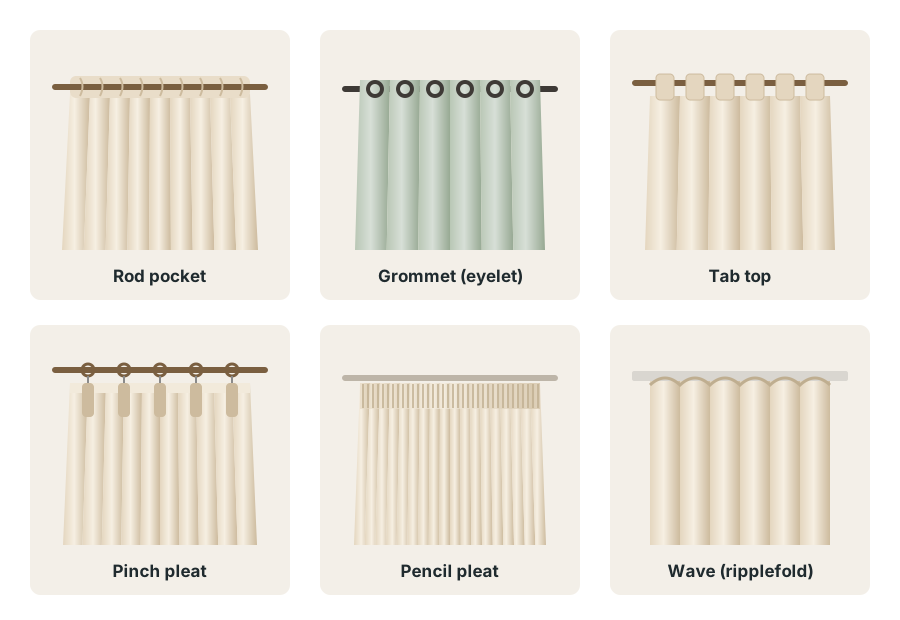
Rod pocket
A rod pocket curtain has a sewn channel along the top, and the rod slides straight through it. The fabric bunches into soft, casual gathers along the rod. Many rod pocket curtains also have a short ruffle of fabric above the pocket, called a header, which forms a frilly edge above the rod.
Rod pocket curtains are usually the cheapest option, and they're easy to put up because you don't need rings or hooks. The downside is friction: the fabric grips the rod, so sliding the curtains open and closed every day is awkward and can wear the fabric over time.
- Best for: curtains that mostly stay in place, sheers, café curtains, valances and tight budgets.
- Avoid if: you need to open and close the curtains every day.
- Hardware: any standard round rod or a slim tension rod for small windows.
Grommet (eyelet)
Grommet curtains have large metal or plastic rings punched through the top of the fabric. The rod threads through the rings, and the fabric naturally folds into deep, even waves. In the UK and many other countries, these are called eyelet curtains.
Grommets are one of the most popular ready-made styles because they look clean and modern and slide easily. Because the fabric folds behind and in front of the rod, the rod itself is partly hidden when the curtains are closed.
- Best for: living rooms, bedrooms and any curtain you open and close daily.
- Watch out for: the rod must fit through the rings. Check the ring's inner size against your rod's thickness before you buy.
- Hardware: a round rod with end finials. The brackets must sit at the ends, because grommets can't slide past a middle bracket.
Tab top
Tab top curtains have fabric loops sewn along the top that sit over the rod, leaving small gaps where the rod shows through. The look is relaxed and informal, which suits farmhouse, cottage, coastal and children's rooms.
Because fabric tabs drag on the rod, tab tops don't glide as smoothly as grommets. They work best on curtains you open occasionally, or on lightweight fabrics.
- Best for: casual styles and decorative panels.
- Hardware: a round rod, ideally with a smooth finish so the tabs slide more easily.
Back tab (hidden tab)
Back tab curtains hide the loops on the back of the fabric. From the front, you see a neat, flat top edge with soft folds falling below, and the rod is hidden. Many back tab curtains also have a rod pocket, so you can hang them either way.
They give a tailored, almost pleated look without the cost of pinch pleats. Like other fabric headings, they slide less easily than grommets or rings.
- Best for: a tidy, tailored look on a budget.
Pinch pleat
Pinch pleat curtains have groups of two or three folds stitched together at regular intervals along the top. A stiff tape inside the heading keeps the pleats crisp. The curtain hangs from small pin hooks or clips attached to rings or to the gliders of a track. The result is neat, regular columns of fabric that fall straight down.
Pinch pleats are the classic "drapery" look found in hotels and formal rooms. They work especially well with heavier fabrics like velvet, lined cotton and linen blends, because those fabrics hold the pleat shape.
- Best for: formal and traditional rooms, heavy or lined fabrics, and curtains that are opened often.
- Watch out for: pinch pleats usually cost more, and you need rings or a track with hooks.
- Hardware: a rod with rings, or a curtain track.
You may also see variations such as goblet pleats, which are rounded and cup-shaped, and inverted box pleats, which are flat folds turned to the back. They follow the same idea with a different decorative shape.
Pencil pleat
Pencil pleat curtains have a gathering tape sewn across the back. When you pull the cords in the tape, the fabric bunches into narrow, tight folds that look like a row of pencils. This heading is very common in the UK, Europe and Australia.
The big advantage is flexibility. Because you can gather the tape more or less tightly, one curtain can fit a range of window widths. The curtain hangs from hooks placed into pockets in the tape.
- Best for: traditional looks, and windows where you need flexible width.
- Hardware: a track or a rod with rings and hooks.
Wave (ripplefold)
Wave curtains hang from a special track with evenly spaced carriers. The fabric forms smooth, continuous S-shaped folds that look the same from inside the room and from outside the window. They are the go-to choice in modern hotels, offices and contemporary homes.
Wave curtains glide very easily and stack neatly when open. The trade-off is cost: you need a compatible track and a special heading tape, so they're usually the most expensive option.
- Best for: large windows, sliding doors and minimalist interiors.
- Hardware: a wave-compatible ceiling or wall track.
Quick comparison of curtain headings
| Heading | Look | How easily it slides | Typical cost |
|---|---|---|---|
| Rod pocket | Soft, gathered, casual | Poor | Low |
| Grommet | Deep, even, modern folds | Very good | Low to medium |
| Tab top | Relaxed, informal | Fair | Low |
| Back tab | Neat, tailored | Fair | Low to medium |
| Pinch pleat | Crisp, formal columns | Very good (on rings or track) | Medium to high |
| Pencil pleat | Tight, traditional gathers | Good (on rings or track) | Low to medium |
| Wave | Smooth, continuous S-folds | Excellent | High |
Part 2: Curtain types by light control
The second big question is how much light you want to block. Shops use four main labels, and they sit on a scale from almost see-through to almost completely dark.
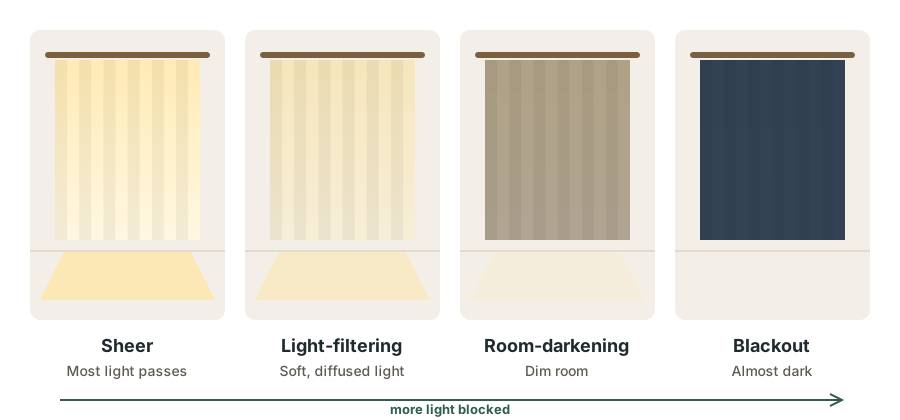
Sheer and voile curtains
Sheers are thin, translucent curtains, usually made from polyester voile, linen or cotton gauze. They soften harsh sunlight, give a little daytime privacy, and make a room feel airy. At night, when the lights are on inside, people outside can usually see through them.
Sheers are rarely used alone in bedrooms. Instead, they're often layered behind heavier curtains so you can have soft daylight during the day and full coverage at night.
Light-filtering curtains
Light-filtering curtains are made from medium-weight fabrics like cotton, linen blends or polyester. They let a soft, diffused glow into the room while blocking direct glare and giving more privacy than sheers. Most everyday curtains sold for living and dining rooms fall into this group.
Room-darkening curtains
Room-darkening curtains block most of the light. They're usually made from a tightly woven or densely layered fabric. The room becomes dim but not fully dark, which many people prefer for living rooms with TVs, home offices with screen glare, or bedrooms where complete darkness isn't needed.
Blackout curtains
Blackout curtains block nearly all light. They achieve this with a special coating, a triple-weave fabric, or a separate blackout lining sewn to the back. They're ideal for bedrooms, nurseries, home theatres and anyone who works night shifts.
Two important tips:
- "Room-darkening" and "blackout" are not the same. Room-darkening still lets some light through. If you need true darkness, look for products described as blackout, and read reviews to confirm.
- Light leaks around the edges. Even a perfect blackout fabric lets light in around the sides and the top if the rod sits too close to the window. Mounting the rod higher and wider than the frame makes a big difference. Our guide on how high and wide to hang curtain rods explains exactly how.
Thermal curtains
Thermal (or insulated) curtains have a dense lining, often foam-backed or multi-layered, designed to reduce heat moving through the window. In hot climates, they help keep the afternoon sun from heating a room. In cold climates, they help keep warmth in at night. Many thermal curtains are also room-darkening or blackout, so they do two jobs at once.
Thermal curtains help most when they're closed, fit the window generously, and reach the sill or the floor, so less air moves around the edges.
Understanding curtain linings
Many curtains are described by their lining rather than their fabric. The lining is a second layer of fabric sewn to the back of the curtain. Here's what each option means:
- Unlined: a single layer of fabric. Light and airy, filters plenty of light, easy to wash. Can fade faster in strong sun.
- Lined: a plain cotton or polyester layer on the back. It protects the main fabric from sun damage, makes the curtain hang better, and blocks a little more light.
- Blackout lined: a coated lining that blocks nearly all light.
- Thermal lined: a thicker insulating lining for temperature control.
- Interlined: an extra soft layer between the fabric and the lining. It gives a full, luxurious look and extra insulation. It's mainly found on made-to-measure curtains.
As a general rule, lined curtains look more expensive and last longer, while unlined curtains feel lighter and more relaxed.
Part 3: Curtain types by length
Length changes how a whole room feels. There are four standard lengths, shown below from shortest to longest.
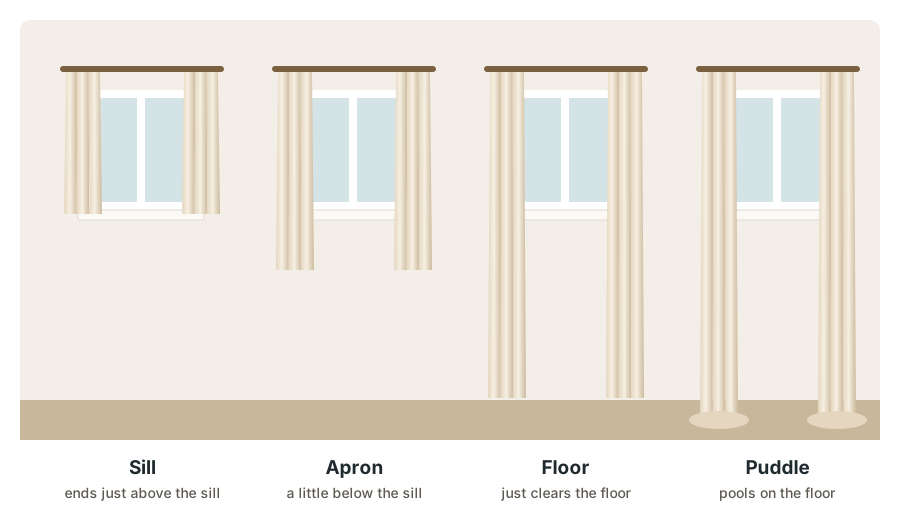
- Sill length: the hem stops about 1 cm (½ inch) above the window sill. It's neat and practical for kitchens, bathrooms, and windows above a sink, counter, bed or radiator.
- Apron length: the hem falls about 10–15 cm (4–6 inches) below the sill. It's a tidy middle ground that covers the bottom of the window frame without reaching the floor.
- Floor length: the hem just touches the floor or floats about 1 cm above it. This is the most popular choice in living rooms and bedrooms because it draws the eye down and makes ceilings feel higher.
- Puddle length: an extra 5–20 cm of fabric pools on the floor. It looks romantic and formal, but it collects dust and isn't practical for curtains you open often or homes with pets.
There's also a popular in-between style called a break, where the curtain is 2–5 cm longer than the floor so the hem just bends slightly, like a well-tailored trouser leg.
When in doubt, choose floor length. It suits almost every room and makes windows look bigger. To get the length exactly right, follow our step-by-step guide on how to measure windows for curtains.
Curtains vs. drapes: what's the difference?
You'll often see the words "curtains" and "drapes" used for the same thing, and in everyday conversation that's perfectly fine. Strictly speaking, though, there is a difference in American usage:
- Curtains are usually lighter, often unlined panels. They come in many lengths, from short café curtains to floor-length panels.
- Drapes (or draperies) are heavier, usually lined, and almost always floor length. They often have pleated headings and are designed to block light and add a formal look.
In British English, "curtains" covers both, and "drapes" is used less often. Whichever word a shop uses, check the description for the fabric weight, lining and heading, because those tell you how the product will actually behave.
Other curtain types worth knowing
Café curtains
Café curtains cover only the lower half of a window. They're hung on a slim rod placed across the middle of the window frame. They give privacy at eye level while letting light in through the top half, which makes them a favourite for kitchens, bathrooms and street-facing windows.
Tier curtains
Tier curtains are short panels, often sold in pairs. They're sometimes combined with a valance above, or hung in two layers to cover the whole window.
Valances
A valance is a short strip of fabric hung across the top of a window. It can be used alone for a decorative finish, or above curtains to hide the rod and the heading. Valances come in many styles, from straight and tailored to gathered, scalloped or balloon-shaped.
Swags and scarves
Swags are lengths of fabric draped in soft curves across the top of a window, often with long tails at the sides. A scarf is a single long piece of fabric looped over a rod or through holders. Both are mainly decorative and are usually combined with blinds or sheers for actual privacy.
Panels and panel pairs
Most ready-made curtains are sold as single panels. A window normally needs two panels, one on each side, that meet in the middle. Some products are sold as a pair. Always check whether the price and the listed width refer to one panel or two. This simple detail catches out many first-time buyers.
Double and layered curtains
Layered curtains combine a sheer on an inner rod with heavier curtains on an outer rod. A double rod holds both layers on a single set of brackets. Layering gives you the most control: sheers alone for soft daytime light, both layers closed for full privacy and darkness.
Choosing the right curtain type for each room
Here's how to combine heading, light control and length for the rooms in most homes.
Bedrooms
Sleep is the priority, so choose blackout or room-darkening curtains. Floor length on a rod mounted higher and wider than the window blocks the most light. Grommet or pinch pleat headings make daily opening and closing easy. If you also want soft daytime light, add sheers on a double rod.
Living rooms
Living rooms usually need softened daylight and a finished look. Light-filtering curtains in linen, cotton or a linen-look polyester are a reliable choice. Floor length makes the room feel taller. For a TV wall that gets afternoon glare, room-darkening curtains or a layered sheer-plus-curtain setup work well.
Dining rooms
Dining rooms are a good place for a more formal look. Pinch pleat curtains in a lined fabric, at floor or break length, create an elegant backdrop.
Kitchens
Kitchens need practical, washable fabrics that stay well away from the stove. Café curtains, short tier curtains, sill-length panels or a simple valance are the usual choices. Cotton and polyester blends are easy to wash and resist stains.
Bathrooms
Bathrooms need privacy and fabrics that handle humidity. Short café curtains or a sill-length polyester curtain over a frosted window are practical options. Avoid delicate fabrics like silk, which can be damaged by moisture.
Children's rooms and nurseries
Blackout curtains help with naps and early summer sunrises. For safety, choose cordless styles and keep any cords or tiebacks well out of reach of small children. Machine-washable fabrics make life easier.
Home offices
Screen glare is the main problem. Light-filtering or room-darkening curtains, or sheers combined with curtains, let you control the light through the day.
For more detailed advice, see our guides to kitchen curtain ideas, curtains for kids' rooms and nurseries, curtains for small windows and small rooms and curtains for large windows and sliding glass doors. If you are deciding between fabrics and patterns, read the velvet curtains guide and patterned vs. plain curtains.
Simple combinations that work almost everywhere
If you'd rather not think about every detail, these combinations suit most homes:
- Living room: floor-length, light-filtering grommet curtains in a neutral linen-look fabric.
- Bedroom: floor-length blackout grommet or pinch pleat curtains, mounted high and wide.
- Kitchen: washable cotton café curtains or a sill-length rod pocket panel.
- Any room that needs flexibility: sheers and heavier curtains on a double rod.
Common mistakes to avoid
- Buying curtains that are too narrow. Curtains need extra width to form folds. Two flat panels that only just cover the window look thin and skimpy when closed.
- Hanging the rod right on top of the frame. This makes windows look small and lets light leak above the curtains. Raising the rod helps almost every window.
- Choosing length by guesswork. Curtains that hover 5–10 cm above the floor look like they shrank. Measure carefully, or choose a length you can hem.
- Mixing up "room-darkening" and "blackout". If darkness matters, read the description and reviews closely.
- Forgetting about the hardware. Grommets need a rod that fits through the rings; pinch pleats need rings or a track. Buy the curtains and the hardware together.
- Ignoring care instructions. Some fabrics, especially linen and blackout-coated curtains, need gentle washing. Check the label before you buy if easy cleaning matters.
Frequently asked questions
What is the most popular curtain type?
Grommet curtains are among the most popular ready-made styles because they look clean, slide easily and work with standard round rods. Pinch pleats are the most popular choice for made-to-measure and formal curtains.
Which curtains are best for a bedroom?
Blackout or room-darkening curtains, ideally floor length and mounted wider than the window so less light escapes around the edges.
Can I mix sheer and heavy curtains?
Yes. Layering sheers behind heavier curtains on a double rod gives you daytime privacy with soft light, plus darkness at night.
Are lined curtains better than unlined?
Lined curtains hang better, block more light, protect the fabric from sun fading and usually look more expensive. Unlined curtains are lighter, cheaper and easier to wash. Neither is "better"; it depends on the room and the look you want.
What is the difference between a curtain rod and a curtain track?
A rod is a straight pole that the curtain hangs from, usually visible and often decorative. A track is a slim rail, mounted on the wall or ceiling, with small gliders that the curtain hooks onto. Tracks are less visible and glide very smoothly, and they can bend around bay windows.
How many curtain panels do I need for one window?
Most windows need two panels, one for each side. Very narrow windows can use a single panel pulled to one side. Wide windows and sliding doors may need four or more panels to get enough fullness.
The bottom line
Every curtain can be understood by its heading, its light control and its length. Pick the heading that matches how often you'll open and close the curtains, the light control that matches the room's purpose, and a length that makes the window look its best. Get those three right, and choosing a colour or pattern becomes the easy, fun part.
Next step: learn how to measure your windows for curtains so your new curtains fit perfectly the first time.
Keep reading
 Styles
Oak wooden blinds: shades, slat sizes, real oak vs oak-effect, and care
Oak wooden blinds bring light, natural warmth to any room. Compare oak shades, real wood and oak-effect options, slat sizes and tapes, and learn how to style and care for them.
 Styles
Fitted horizontal blinds: a complete guide to made-to-measure blinds that fit perfectly
Fitted horizontal blinds are made to the exact size of your window, so they look neat and control light properly. Compare types, fitting methods, measuring and care.
 Styles
Blackout roman shades: how to choose, measure and fit them for a truly dark room
Blackout roman shades combine soft fabric folds with real darkness. Learn the styles, linings, mounts, measuring, cord safety and tricks that stop light leaking around the edges.