Fabrics
Thermal curtains: do they really keep rooms warm or cool?

Windows are one of the weakest points in a home when it comes to temperature. On hot, sunny days, heat pours in through the glass and warms the room. On cool nights, warmth escapes out through the same glass. That's why rooms with large windows often feel too hot in the afternoon and too cold in the evening.
Thermal curtains, also called insulated or energy-saving curtains, are designed to slow that heat movement. They're one of the simplest and most affordable ways to make rooms more comfortable. But they're also surrounded by big claims, and many people are unsure whether they genuinely work, or whether they're just ordinary curtains with a clever label.
This guide explains how thermal curtains actually work, what they can and can't do, how they compare with blackout curtains, and how to choose and hang them so you get the most benefit.
What are thermal curtains?
Thermal curtains are curtains with an extra insulating layer. Instead of a single thin fabric, they combine a decorative face fabric with a dense lining that slows the movement of heat. Many also have a light-coloured or reflective backing that faces the window.
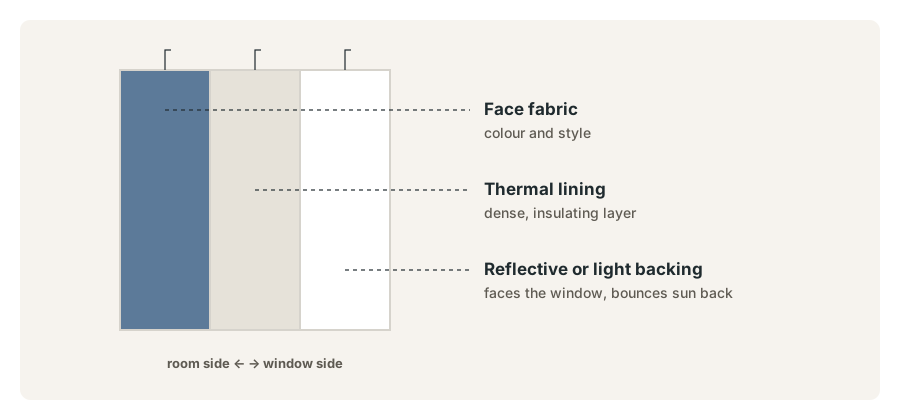
Common constructions include:
- Foam-backed curtains: a layer of acrylic foam bonded to the back of the fabric. This is common in affordable ready-made thermal curtains and usually also blocks light.
- Triple-weave curtains: three layers woven together, with a dense middle layer. Softer than foam-backed fabric.
- Curtains with a separate thermal lining: a thick, insulating lining sewn behind a normal fabric. Common in made-to-measure curtains.
- Interlined curtains: a soft, thick layer (sometimes called bump) sandwiched between the face fabric and the lining. The traditional, luxurious way to insulate curtains.
How thermal curtains work
Heat moves through windows in three main ways, and thermal curtains help with each:
1. Blocking sunlight (radiation)
Sunlight passing through glass carries heat into the room. A closed curtain with a dense or reflective backing stops much of that sunlight before it reaches the room. A light-coloured backing reflects some of it back out through the glass.
2. Trapping still air (conduction)
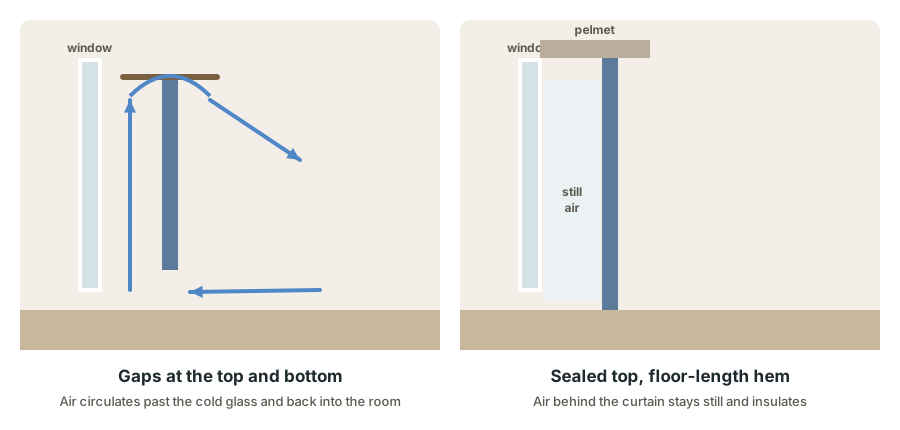
Still air is a good insulator. When a thermal curtain is closed, it traps a layer of air between itself and the window. The dense fabric and the air layer together slow heat moving between the glass and the room.
3. Reducing air movement (convection)
On cold nights, air touching the cold glass cools, sinks, and spills into the room as a draught, while warm room air is pulled in at the top to replace it. A curtain that's sealed at the top and reaches the floor reduces this circulation, which is why fit matters so much.
Do thermal curtains really work?
Yes, but with realistic expectations. Thermal curtains can noticeably improve comfort near windows and reduce how much heat comes in or escapes through the glass. Energy agencies and researchers generally agree that well-fitted, insulated window coverings help reduce heat gain in summer and heat loss in winter.
How much they help depends on several factors:
- The window: they make the biggest difference on older, single-glazed or large windows. On modern, well-insulated double or triple glazing, the improvement is smaller.
- The fit: curtains that are too narrow, too short or hung with gaps lose much of their benefit.
- The fabric: denser, multi-layered fabrics insulate better than thin ones.
- How you use them: they only work when closed at the right times.
- The climate and the room: rooms with big, sunny windows benefit most.
What thermal curtains can't do is replace air conditioning, heating or proper window insulation. They're one helpful layer in keeping a home comfortable, not a complete solution. Be wary of products that promise very large, specific savings on energy bills; actual savings depend on your home, climate and habits.
Keeping rooms cool in hot weather
In hot, sunny climates, the main job of thermal curtains is to stop the sun heating the room.
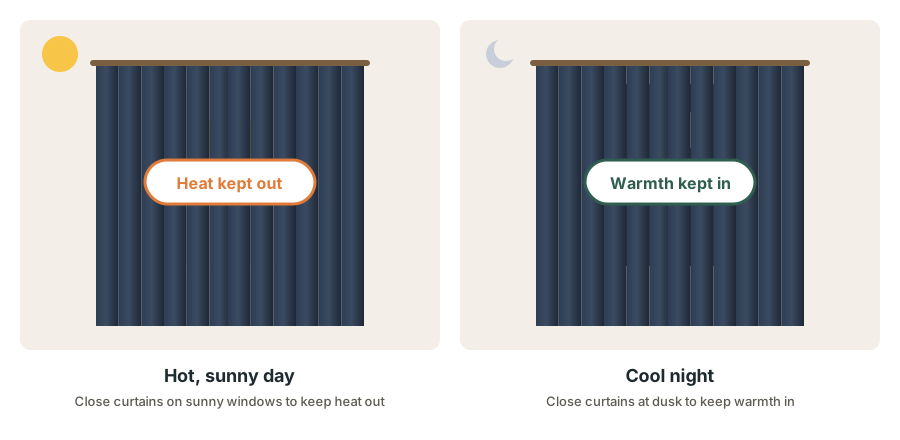
- Close them before the room heats up. Draw thermal curtains on sunny windows in the late morning or early afternoon, before strong sun has warmed the room. Once a room is hot, curtains can only slow further heating.
- Prioritise the sunniest windows. Windows that get strong afternoon sun usually heat rooms the most.
- Choose a white or light-coloured backing facing the window. It reflects more sunlight back out.
- Keep curtains closed while you're out during the hottest part of the day.
- Help your air conditioner. By reducing the heat coming through the glass, closed thermal curtains can reduce how hard an air conditioner has to work. Keep curtains clear of the unit's airflow.
- Open them in the evening when it's cooler outside, to let heat escape and air circulate.
Keeping rooms warm on cool nights
- Close curtains at dusk, before the room cools, to trap warmth inside.
- Open them on sunny days to let free solar warmth in.
- Seal the top and sides so cold air can't spill out from behind the curtain.
- Don't cover heaters or radiators; floor-length curtains in front of a heater send its warmth toward the cold glass. Use sill-length curtains, or tuck curtains behind the heater.
Thermal curtains vs. blackout curtains
| Thermal curtains | Blackout curtains | |
|---|---|---|
| Main purpose | Slow heat moving through the window | Block light |
| Light blocking | Varies; many also block light | Almost all light through the fabric |
| Insulation | Designed for it | Often good, because the fabric is dense |
| Weight | Usually heavier | Medium to heavy |
| Best for | Hot or cold rooms, draughty windows | Bedrooms, nurseries, media rooms |
Many products are sold as "thermal blackout" curtains because the same dense coating or lining both blocks light and insulates. If you want both, look for products that clearly describe both features. If you want insulation but not darkness, for example in a living room, look for thermal curtains with a light-filtering face fabric, or thermal linings behind light curtains. Our blackout curtains guide explains blackout constructions in more detail.
How to choose thermal curtains
Check the construction
Look for a clear description of what makes the curtain thermal: foam backing, triple weave, a thermal lining or interlining. Vague terms like "energy saving" without any explanation are less reliable.
Choose a heavy, dense fabric
Heavier, tightly woven fabrics insulate better. Velvet, heavy cotton and lined polyester are good choices. Thin, unlined fabrics provide little insulation, whatever the label says.
Look at the backing colour
A white, cream or silver backing that faces the window reflects sunlight and looks neat from outside. This matters most on sunny windows.
Choose the right size
- Width: at least 1.5–2 times the rod width, so the curtains overlap in the middle and extend past the window frame on both sides.
- Length: floor length, or a slight break so the hem rests on the floor. For windows above heaters, sill length that reaches just below the sill.
See our guides to measuring windows, curtain fullness and curtain length.
Choose a suitable heading
Thermal curtains are heavy, so they need a heading that slides easily: grommets, rings or a track. Rod pocket headings become very stiff with heavy fabric. Our curtain headings guide compares the options.
Choose a sturdy rod
A rod of about 25 mm or more, with a centre bracket on longer rods, and brackets fixed securely into the wall.
How to hang thermal curtains for the best results
Fit makes a bigger difference than any fabric label. A modest thermal curtain hung well will outperform an expensive one hung badly.
- Mount the rod high and wide. Place it at least 10–15 cm above the frame (or close to the ceiling) and extend it well beyond each side, so the curtain covers the whole window and some wall. Our guide on how high and wide to hang curtain rods explains the details.
- Seal the top. A pelmet, cornice or valance over the top of the curtains, or a ceiling-mounted track, stops warm or cool air circulating over the top.
- Seal the sides. A wraparound (return) rod brings the curtain edges back to the wall. Hook-and-loop strips or small magnets along the outer edges work too.
- Overlap the middle. Wide enough panels should cross by 5–10 cm in the centre.
- Reach the floor. A hem that touches or rests on the floor stops air spilling out underneath.
Which windows benefit most?
- Large windows and glass doors: more glass means more heat moving in and out, so thermal curtains make a bigger difference.
- Single-glazed or older windows: they insulate poorly, so a good curtain adds proportionally more.
- Windows that get strong afternoon sun: these heat rooms the most in warm weather.
- Draughty windows: curtains reduce the chilly feel of air moving near the glass, though sealing gaps in the frame is even better.
- Bedrooms: comfortable temperatures help with sleep, and thermal curtains often double as blackout.
- Rooms you use most: treat the living room and bedrooms first if you're on a budget.
Modern, well-sealed double or triple glazing already insulates well, so thermal curtains add less there, though they still help with sun on hot days.
A simple daily routine
Thermal curtains work best when you use them at the right moments. A typical routine in hot weather:
- Early morning: open curtains and windows to let cooler air in.
- Mid to late morning: close curtains on windows that will get strong sun.
- Afternoon: keep sunny-side curtains closed through the hottest hours.
- Evening: open curtains (and windows if it's cooler outside) to let heat escape.
In cooler weather, reverse it: open curtains on sunny windows during the day to let in free warmth, and close all curtains at dusk to keep it in. Motorised tracks or shades can follow this routine automatically on a schedule.
Thermal curtains compared with other options
| Option | Helps in heat | Helps in cold | Notes |
|---|---|---|---|
| Thermal curtains | Good | Good | Must be closed and well fitted |
| Cellular (honeycomb) shades | Good | Very good | Excellent combined with curtains |
| Solar or reflective window film | Good | Limited | Works all the time, keeps the view |
| Blinds | Limited | Limited | Good light control, little insulation |
| External awnings or shade sails | Very good | None | Stop sun before it hits the glass |
| Weatherstripping frames | Some | Good | Fixes draughts curtains can't |
The most effective approach usually combines two or three of these, starting with whatever is cheapest for your situation.
Thermal curtains for each room
Bedroom
Thermal blackout curtains give darkness and temperature control together. Our guide to the best curtains for bedrooms covers sizing and layering.
Living room
Thermal curtains with a light-filtering face fabric, or thermal linings behind your favourite curtains, keep the room comfortable without making it dark. Pair them with sheers for daytime light.
Nursery and children's rooms
Thermal blackout curtains help keep the room comfortable for naps. Choose cordless products and washable fabrics.
Home office
Close thermal curtains on the sunny window during the hottest hours, and use sheers or blinds for glare control the rest of the day.
Rentals
Hook-on thermal liners or ready-made thermal curtains are easy to install and take with you when you move.
Thermal curtain buying checklist
- A clear description of the thermal construction (foam backing, triple weave, thermal lining or interlining).
- A dense, heavy face fabric.
- A light or reflective backing for sunny windows.
- Total width of 1.5–2× the rod width.
- Floor length, or sill length near heaters.
- A heading that slides easily.
- A sturdy rod and secure brackets.
- Care instructions you can live with.
Thermal linings: upgrading curtains you already own
You don't have to replace curtains you love. Thermal linings can be added to existing curtains:
- Hook-on thermal liners hang from the same hooks or rings as your curtain, behind it. They're easy to remove for washing or in seasons when you don't need them.
- Sewn-in thermal linings can be added by a curtain maker or a confident home sewer.
- A second rod holding plain thermal curtains behind your decorative ones gives the same effect.
Other ways to boost insulation
- Layer with cellular (honeycomb) shades. Their air pockets insulate well, and combined with thermal curtains they make a strong team. Our guide to curtains, drapes, blinds and shades explains cellular shades.
- Seal gaps around window frames with weatherstripping; curtains can't fix draughts coming through gaps in the frame itself.
- Use window film designed to reduce solar heat on very sunny windows.
- Plant shade outside, such as trees, awnings or shade sails, which stop sun before it reaches the glass.
Thermal curtains in humid climates
In warm, humid places, closed curtains can trap moisture against cool, air-conditioned glass, which can encourage condensation and mildew. To avoid problems:
- Choose synthetic or blended fabrics, which resist mildew better than cotton or linen.
- Open curtains regularly to let air circulate, especially in the evening and early morning.
- Wipe away condensation on windows and frames.
- Wash or air curtains regularly, following the care label.
Common myths about thermal curtains
"Thermal curtains will cut my energy bill in half."
Unlikely. They help, especially with large or older windows, but heating and cooling costs depend on insulation, the building, the climate and how you use your home. Treat big savings claims with caution.
"Any thick curtain is a thermal curtain."
Thickness helps, but dense, layered construction and a good fit matter more. A loosely woven thick fabric can insulate less than a thinner fabric with a proper thermal lining.
"Dark curtains keep rooms cooler."
A dark fabric facing the window absorbs more heat, which can then warm the room. What matters most is the side facing the glass: a light or reflective backing bounces more sunlight back out.
"Thermal curtains only matter in cold climates."
They're just as useful in hot climates, where blocking afternoon sun can make a big difference to comfort.
"I can leave them closed all the time."
Keeping curtains closed constantly blocks useful daylight and, in humid climates, can encourage condensation and mildew. Open them when the outside air or sun is helpful.
Making your own thermal curtains
If you sew, you can turn almost any curtain fabric into a thermal curtain:
- Choose a thermal lining fabric, often sold by the metre with a coated or brushed back.
- Cut the lining slightly narrower and shorter than the curtain fabric.
- Sew the lining to the curtain along the sides and top, with right sides facing, then turn it the right way out.
- Hem the face fabric and the lining separately, with the lining a few centimetres shorter.
- Add a heading, such as heading tape or grommets, through both layers.
For extra insulation, add an interlining layer between the face fabric and the lining. Our guide on how to hem curtains covers hemming lined curtains.
Caring for thermal curtains
- Read the care label. Foam-backed and coated curtains need gentle handling.
- Vacuum regularly with a soft brush attachment.
- Wash cool and gently if allowed. Hot water and high-heat drying can crack foam backings.
- Don't iron the backing. Use a steamer on the face fabric if needed.
- Consider professional cleaning for interlined and heavy lined curtains.
Our guide on how to wash and clean curtains covers every fabric type.
Common thermal curtain mistakes
- Expecting curtains to replace insulation or air conditioning. They help, but they're one layer of the solution.
- Hanging them close to the frame with gaps all around.
- Choosing panels that are too narrow to overlap.
- Curtains that stop short of the floor, letting air spill out.
- Leaving them open on hot afternoons or closed on sunny cool days.
- Covering heaters with floor-length curtains.
- Washing foam-backed curtains hot, which damages the backing.
Frequently asked questions
Do thermal curtains keep heat out?
Yes. When closed on sunny windows, they block much of the sunlight and slow heat moving through the glass, helping rooms stay cooler.
Do thermal curtains keep rooms warm?
Yes, when closed at dusk and hung so they seal well at the top, sides and bottom. They slow the loss of warmth through the glass.
Are thermal curtains the same as blackout curtains?
Not exactly. Thermal curtains are designed to insulate; blackout curtains are designed to block light. Many products do both.
Which colour thermal curtains are best?
A light or reflective backing facing the window helps most in sunny climates. The front can be any colour you like.
Do thermal curtains save money?
They can help reduce heating and cooling needs, especially with large or older windows, but savings vary widely. Treat any specific percentage claims with caution.
Can I wash thermal curtains?
Many can be washed gently on a cool cycle. Foam-backed curtains need extra care. Always follow the care label.
Do thermal curtains help with noise?
Their dense, layered fabric absorbs some sound inside the room and can soften higher-pitched outside noise a little. They won't soundproof a room, but they can make it feel quieter.
Can I use thermal curtains with air conditioning?
Yes. Closing them on sunny windows reduces the heat coming in, so the room stays cooler. Keep the curtains clear of the air conditioner's airflow.
How long do thermal curtains last?
Well-made thermal curtains can last many years with gentle care. Foam backings may eventually crack, especially if washed or dried hot.
Do thermal curtains work on sliding glass doors?
Yes, and they're especially useful there because sliding doors are large areas of glass. Hang them on a long rod or track that extends well past the opening, with a floor-length hem that floats just above the door track.
The bottom line
Thermal curtains work by blocking sunlight, trapping still air and reducing draughts. They genuinely help keep rooms cooler on hot days and warmer on cool nights, especially with large, sunny or older windows. To get the full benefit, choose a dense, well-made curtain with a light backing, size it generously, hang it high, wide and long, seal the gaps, and close it at the right times. Used this way, thermal curtains are one of the easiest comfort upgrades you can make.
Keep reading
 Fabrics
Industrial blackout curtains: a complete guide to heavy-duty light blocking
Warehouses, studios, workshops, halls and loft homes all need serious darkness at times. Here's how to choose, size, hang and seal industrial blackout curtains that really block light.
 Fabrics
Velvet curtains: a complete guide to choosing, hanging and caring for them
Velvet curtains look luxurious, block light, keep rooms warm and quieten noise. Here's everything you need to know about velvet types, colours, hardware, hanging and care.
 Fabrics
Sheer curtains: how to choose, hang and layer them
Sheer curtains soften light, add privacy by day and make rooms feel airy. Here's how to choose the right sheers, how much fabric you need, how to layer them and how to care for them.