Room Ideas
Curtains for small windows and small rooms: how to make them look bigger

Small windows and small rooms are common, especially in apartments, older houses, bathrooms, box rooms and attics. They can feel dark and cramped, and choosing curtains for them is tricky: the wrong curtains can make a small window look even smaller and a small room feel even more crowded.
The right curtains do the opposite. With a few simple techniques, you can make a small window look larger, let in as much light as possible, and make a small room feel taller, wider and more open. This guide explains how.
The golden rule: hang curtains high and wide
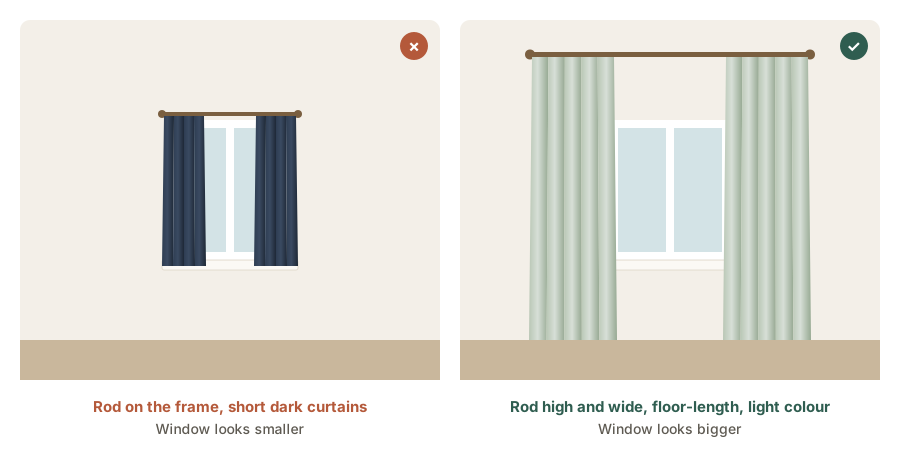
The single most effective trick for small windows is to hang the rod higher and wider than the window itself:
- Higher: mount the rod well above the window frame, halfway between the frame and the ceiling, or even just below the ceiling. This draws the eye upward and makes the window and the room feel taller.
- Wider: extend the rod 20–40 cm beyond each side of the frame. When the curtains are open, they cover the wall rather than the glass, so the window appears larger and lets in all available light.
When the curtains are open, nobody can see where the glass ends, so the eye reads the whole curtained area as "window". It's an old interior designer's trick, and it works remarkably well. Our guide on how high to hang curtain rods explains the measurements in detail.
How high and how wide?
| Situation | Rod height | Rod extension each side |
|---|---|---|
| Standard small window | 15–25 cm above the frame | 20–30 cm |
| Low ceiling | Just below the ceiling | 20–30 cm |
| Very small window, plenty of wall | Halfway between frame and ceiling, or higher | 30–40 cm |
| Window near a corner | As above | As far as the corner allows; extend more on the open side if needed |
A worked example
Imagine a small bedroom window that's 80 cm wide and 100 cm tall. The top of the frame is 150 cm from the floor, and the ceiling is 240 cm high.
- Rod height: halfway between the top of the frame (150 cm) and the ceiling (240 cm) is 195 cm. Mount the rod at about 195–210 cm from the floor.
- Rod width: 80 cm window + 30 cm on each side = 140 cm. A 150 cm rod gives a little extra room for the finials.
- Curtain length: from the rod (say 200 cm) to just above the floor = about 199 cm (measure from where the curtain will actually hang, which depends on the heading). A standard ready-made length of around 200–213 cm (79–84 inches) can be hemmed to fit.
- Curtain width: for 1.5–2 times fullness on a 140 cm rod, you need 210–280 cm of total curtain width, for example two panels of about 120–140 cm each.
The result: curtains that start well above the window, cover the wall on each side when open, and run all the way to the floor. The 80 cm window now reads as a much larger, more elegant feature. For full measuring instructions, see how to measure windows for curtains.
Floor-length or short curtains?
It seems logical to choose short curtains for a small window, but in most rooms floor-length curtains make a small window look bigger. Long vertical lines make ceilings feel higher and the window feel more important. Short curtains that stop at the sill emphasise how small the window is.
When floor-length is best
- Living rooms and bedrooms.
- Rooms with low ceilings, where height is needed.
- When there's nothing under the window, such as a radiator, desk or bed.
When short curtains are better
- Kitchens and bathrooms, where long fabric is impractical. See our kitchen curtain ideas.
- Windows above a radiator, which long curtains would cover, trapping heat behind them.
- Windows above a desk, bed headboard, bench or worktop.
- Children's rooms, where shorter curtains are safer and more practical.
If you choose short curtains, end them neatly at the sill or 10–15 cm below it, never at an awkward in-between length. Our curtain length guide explains all the options.
Choosing colours for small rooms
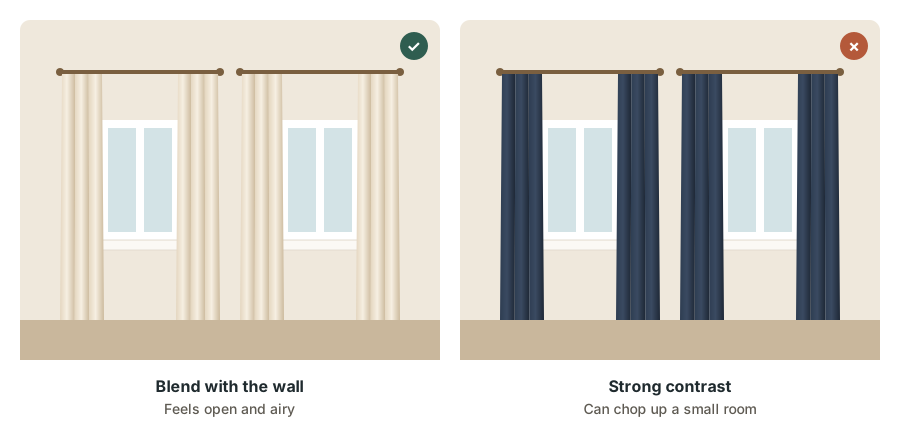
Blend with the wall
Curtains in a colour close to the wall colour create a smooth, uninterrupted surface, so the room feels bigger. White curtains on white walls, cream on cream, or soft grey on soft grey all work well. The curtains add softness and texture without visually cutting up the space.
Choose light colours
Light colours reflect light, making small rooms feel brighter and airier. White, ivory, cream, pale grey, soft sage, pale blue and blush pink are all good choices.
Strong contrast: use with care
Dark curtains on a light wall create strong vertical blocks that can make a small room feel chopped up and crowded, especially if there are several windows. That doesn't mean dark curtains are never right: in a small bedroom, dark curtains on dark walls create a cosy, cocooning feel. The key is to avoid sharp contrast.
Monochrome rooms
Painting the walls, trim and curtains in similar tones, called a "colour-drenched" look, makes small rooms feel larger and more deliberate, whether the colour is light or dark.
For more colour advice, read how to choose curtain colours.
Best curtain styles for small windows
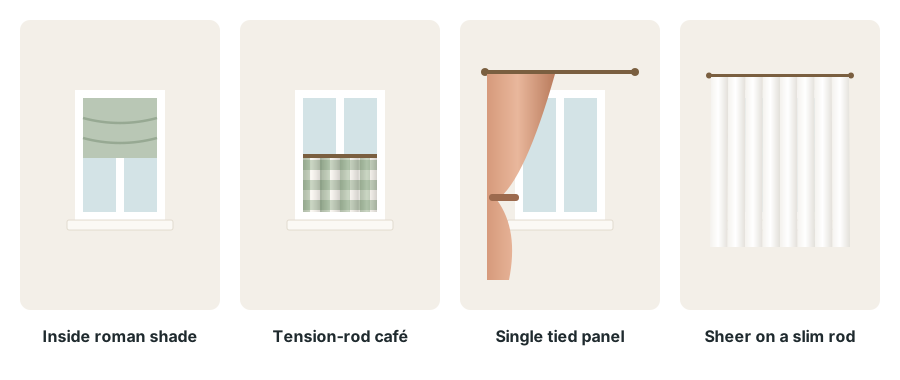
Roman shades
A roman shade fitted inside the frame is neat, uses no wall space and lifts clear of the glass. It's ideal for small windows in bathrooms, kitchens and alcoves, or above a desk or bed. For bedrooms, see our guide to blackout roman shades.
Café curtains on a tension rod
Café curtains cover the lower part of the window, giving privacy while leaving the top open for light. A tension rod fits inside the frame with no drilling.
A single panel
For a small window near a corner or where there's no space on one side, use one curtain panel that pulls to one side. Tied back during the day, it adds softness without blocking much light.
Sheer curtains
Sheers filter light rather than block it, so they give privacy while keeping a small room bright. Their lightness means they never feel heavy or bulky. See our sheer curtains guide.
Light, simple panels
Plain, lightweight curtains with an eyelet, tab top or ring top heading stack neatly when open, taking up less space than heavy pleated curtains.
Layered sheer and curtain
On a double rod, sheers for daytime and lined curtains for night give flexibility, as long as both are kept fairly light.
Styles to avoid
- Heavy swags, deep valances and elaborate pelmets cover the top of the window and make it look shorter.
- Very full, heavy curtains stack thickly beside the window and overwhelm the space.
- Puddled curtains, which take up floor space and look heavy in a small room.
Fabrics for small spaces
- Linen and linen blends: light, airy and textured, perfect for a relaxed look. See our linen curtains guide.
- Cotton: crisp and versatile, in light weights.
- Voile and sheers: maximise light and give privacy.
- Lightweight polyester: practical, affordable and easy to wash.
Heavy fabrics like velvet, chenille and thick blackout curtains can work in small bedrooms but take up more space when open. If you need blackout in a small room, choose a slim blackout lining or a blackout roller blind behind lighter curtains.
Patterns in small rooms
- Plain or subtly textured fabrics are the safest and calmest choice.
- Small-scale patterns look neat and balanced on small windows. Large patterns get cut off and look busy.
- Vertical stripes make low ceilings feel higher.
- Tone-on-tone patterns add interest without visual clutter.
Read patterned vs. plain curtains for more on pattern scale.
Fullness and stacking
Fullness is the amount of fabric relative to the rod width. In small rooms, aim for about 1.5 to 2 times fullness. Less looks skimpy; much more creates bulky stacks that take up space and block light.
The stack is the bundle of fabric beside the window when the curtains are open. Planning the rod so the stack sits on the wall, not the glass, is the key to letting in light. Learn more in curtain fullness explained.
Best curtain headings for small spaces
The heading affects how much space the curtains take up when open:
- Eyelet (grommet): neat, even folds that stack compactly. A good everyday choice.
- Ring top or clip rings: slide easily and stack neatly; suit light fabrics.
- Tab top: relaxed and simple, but stacks slightly wider and doesn't slide as easily.
- Rod pocket: ideal for curtains that stay mostly in one position, such as café curtains or sheers, because they don't slide easily.
- Pencil pleat: gathers tightly, so it can stack quite compactly on a track.
- Wave (S-fold): very slim, even stacks on a track and a clean modern look, excellent for small rooms.
- Pinch pleat: elegant, but stacks wider; better for larger windows.
Compare them all in curtain headings compared.
Hardware for small windows
- Slim rods (16–25 mm) look proportionate in small rooms. Very thick rods can look heavy.
- Small, simple finials or end caps save space, especially near corners.
- Ceiling-mounted tracks make low-ceilinged rooms feel taller, because the curtains run right from the ceiling to the floor.
- Tension rods fit inside frames, perfect for café curtains and alcoves.
- Hardware in the wall colour blends in, keeping the look clean.
- Swing-arm rods are useful for dormer windows.
See our curtain rods and tracks guide for all the options.
Awkward small windows
Windows near a corner
Use a single curtain that opens away from the corner, or a roman shade inside the frame. A short end cap instead of a finial helps the rod fit.
Windows over a radiator
Choose sill-length curtains or a roman shade so warm air can circulate. Long curtains over a radiator trap heat behind them and send it up the window instead of into the room.
Deep-set windows
Fit a roman shade or a tension rod with café curtains inside the recess, or hang curtains outside the recess on a rod extended well beyond it.
High, narrow windows
Leave them bare if they don't need privacy, or use a simple roller or roman shade. Curtains on very high windows are hard to reach and open.
Bathroom windows
Choose moisture-resistant fabrics, café curtains, a roman shade in polyester, or frosted window film for privacy without fabric.
Mismatched windows in one room
Hang all rods at the same height and use curtains of the same length, so the windows look consistent even if their sizes differ.
Ideas for different small rooms
Small bedrooms
Floor-length curtains hung high and wide, in a colour close to the walls, make a small bedroom feel calm and taller. For darkness, choose a blackout lining or a blackout roller blind fitted behind light curtains, rather than very thick curtains that take up space. If the bed is under the window, use a roman shade or short curtains so they don't drape over the headboard. Our guide to the best curtains for bedrooms covers more options.
Small living rooms
Light, floor-length curtains in linen or cotton, with sheers if privacy is needed. Keep the stack off the glass so every bit of daylight gets in. Choose the same colour for all windows to keep the room looking unified. See our living room curtain ideas.
Studio apartments
In a studio, curtains can do double duty as room dividers. A ceiling track with floor-length curtains can separate the sleeping area, hide a wardrobe or close off a kitchen. Use the same fabric at the windows and for the divider so the space feels cohesive.
Box rooms and nurseries
Choose light, washable fabrics, short or floor-length curtains well secured, and a blackout blind for naps. Keep any cords out of reach of children.
Attic and loft rooms
Sloping ceilings and roof windows usually need fitted blinds made for that window type. For dormer windows, use swing-arm rods, a roman shade or café curtains inside the dormer.
Small bathrooms
Use café curtains in quick-drying fabric, a waterproof roman shade or frosted film. Avoid long fabric that will absorb moisture.
Balancing light and privacy
Small windows don't let in much light to begin with, so every centimetre counts. These options give privacy without losing too much brightness:
- Sheers or voiles during the day, with heavier curtains or a blind for night.
- Café curtains on the lower half, leaving the top clear.
- Top-down, bottom-up shades, which cover the lower part while leaving the top open.
- Frosted or patterned window film, which hides the view without blocking light.
- Light-filtering fabrics in pale colours, which glow when the sun shines through them.
Renting with small windows
If you can't drill, a tension rod inside the frame, no-drill brackets that clip onto the window frame, or adhesive-backed rods for very light curtains all work well. Even in a rental, try to choose a solution that lets the curtains clear the glass when open, so you don't lose any light.
Making a small room feel larger
Curtains are one part of the picture. Combine them with these techniques:
- Keep the window clear: don't block it with tall furniture.
- Use mirrors opposite or beside the window to reflect light.
- Choose light, reflective surfaces for walls and floors.
- Limit clutter on windowsills.
- Use furniture with legs, which lets you see more floor and makes the room feel more open.
- Light the room well in the evening, with lamps in corners.
Budget-friendly upgrades
- Move the rod before buying new curtains. Simply raising and widening the existing rod can transform a small window for the cost of a longer rod.
- Lengthen short curtains by adding a contrasting band of fabric at the hem, so they reach the floor from a higher rod.
- Use ready-made panels in standard sizes and hem them to length. Our guide on how to hem curtains shows you how, with or without sewing.
- Add an inexpensive sheer layer for privacy instead of keeping heavy curtains closed during the day.
- Paint the rod to match the wall for a clean, seamless look.
Step by step: transforming a small window
- Clear the area. Move tall furniture away from the window and clear the windowsill.
- Measure the wall space above and beside the window, noting the ceiling height, corners, radiators and sockets.
- Plan the rod position: high (halfway to the ceiling or higher) and wide (20–40 cm each side).
- Choose the length: floor-length if nothing is in the way; sill-length or a shade if there's a radiator, desk or bed.
- Pick a light colour that blends with the walls, in a light fabric.
- Calculate fullness at about 1.5–2 times the rod width.
- Install the rod securely and level, as shown in how to hang curtains.
- Hang the curtains, make sure they stack fully off the glass when open, and train the folds for a few days.
Take a photo before and after. Most people are surprised by how much bigger the window looks once the curtains are hung high and wide.
Common mistakes
- Mounting the rod right on the window frame, which makes the window look smaller.
- A rod that's too short, so the open curtains cover the glass and block light.
- Curtains that end at an awkward length, between the sill and the floor.
- Heavy, dark curtains that contrast sharply with light walls.
- Large patterns on small windows.
- Too much fabric, causing bulky stacks.
- Elaborate valances and swags that shorten the window.
Frequently asked questions
Should curtains be long or short on a small window?
In living rooms and bedrooms, floor-length curtains usually make small windows look bigger. Use short curtains where long ones aren't practical, such as over radiators, desks or in kitchens and bathrooms.
What colour curtains make a small room look bigger?
Light colours that match or blend with the walls, such as white, cream, pale grey and soft pastels.
How far should a rod extend beyond a small window?
About 20–40 cm on each side, so the curtains stack on the wall rather than covering the glass.
Are blinds better than curtains for small windows?
Blinds and roman shades take up less space and suit small windows in kitchens, bathrooms and above furniture. Curtains hung high and wide do more to make a window look larger. Many people combine both.
Can I use dark curtains in a small room?
Yes, especially in bedrooms, if the walls are also dark, so there's little contrast. Dark curtains against light walls tend to make small rooms feel smaller.
What curtains are best for a small window with a radiator underneath?
Sill-length curtains, a roman shade or a roller blind, so warm air from the radiator can rise into the room instead of being trapped behind the fabric.
Should all the windows in a small room have the same curtains?
Yes, generally. Matching curtains at the same height make the room look calmer and more organised, which helps a small space feel larger.
Do valances make small windows look smaller?
A deep valance mounted on the frame does, because it covers the top of the glass. If you love valances, mount a shallow one well above the window so it sits on the wall, not the glass.
What length rod do I need for a 90 cm window?
About 130–170 cm, giving 20–40 cm on each side, plus a little room for the finials.
The bottom line
To make a small window look bigger and a small room feel larger, hang the rod high and wide so the curtains frame the wall rather than the glass, choose floor-length curtains where practical, pick light colours that blend with the walls, use light fabrics with moderate fullness, and keep patterns small or subtle. Where long curtains aren't practical, use a neat roman shade, café curtains or sheers. With these simple techniques, even the smallest window can look generous and bright.
Keep reading
 Room Ideas
Bay window curtain ideas: how to measure, hang and style them
Bay windows are beautiful but tricky to dress. Here's how to choose between bent tracks, bay poles, separate rods and shades, how to measure every angle, and how to style a bay in any room.
 Room Ideas
Curtains for kids' rooms and nurseries: safety and style
Children's rooms need curtains that are safe, darken the room for sleep, wash easily and grow with your child. Here's how to choose curtains for nurseries and kids' bedrooms.
 Room Ideas
Curtains for large windows and sliding glass doors: a complete guide
Big windows and sliding doors need curtains that are wide enough, strong enough and easy to use. Here's how to measure, choose the hardware, fabric, fullness and style for large openings.