Styles
Curtains vs. drapes vs. blinds vs. shades: what's the difference?

"Window treatment" is the umbrella term for anything you put on a window to control light, privacy or temperature, or simply to make it look finished. The four you'll hear about most are curtains, drapes, blinds and shades. People often use these words as if they mean the same thing, and shops don't always help, but they are genuinely different products. They are built differently, they behave differently, and they suit different rooms.
Understanding the difference saves money and frustration. It helps you choose the right product for each window, combine products when one isn't enough, and read shop descriptions with confidence. This guide explains each of the four in plain language, compares them side by side, and finishes with practical recommendations for every room in your home.
The short answer
- Curtains are fabric panels that hang from a rod or track and slide open to the sides. They're usually lighter and often unlined.
- Drapes are also fabric panels that slide to the sides, but they're heavier, lined and usually floor length. In everyday speech, "drapes" and "curtains" are often used interchangeably.
- Blinds are made of hard slats (wood, faux wood, aluminium or vinyl) that tilt to control light and lift up to open.
- Shades are made of a single piece of soft fabric or material that rolls up or folds up to open. They don't have slats.
The simplest way to remember it: curtains and drapes open sideways; blinds and shades open upwards. Blinds have slats; shades don't.
Curtains
Curtains are panels of fabric that hang from a rod or track above the window. You open them by sliding them to the sides. They're the most flexible window treatment because they come in an almost endless range of fabrics, colours, patterns, lengths and headings.
What makes something a curtain
In American usage, "curtains" typically means lighter-weight panels, often unlined, that may be any length, from short café curtains to full floor-length panels. In British and many other forms of English, "curtains" is the general word for all fabric panels, including heavy lined ones.
Strengths
- Huge choice of colours, patterns and textures.
- Soften a room and add warmth, colour and texture.
- Easy to change for a new look, often without new hardware.
- Can make windows look bigger when hung high and wide.
- Many are machine washable.
Weaknesses
- Lighter curtains don't block much light or heat on their own.
- They take up wall space beside the window when open.
- They can be impractical near sinks, stoves or busy work surfaces.
If you want to understand curtain styles in more depth, our guide to curtain types explains every heading, light level and length.
Drapes
Drapes, or draperies, are a heavier, more formal version of curtains. They're usually made from thicker fabrics such as velvet, heavy cotton, linen blends or damask, and are almost always lined. Many have pleated headings, such as pinch pleats, and hang to the floor or slightly beyond it.
Strengths
- Block much more light than unlined curtains, especially with blackout lining.
- Help insulate the window, keeping heat out in summer and in during cold nights.
- Absorb some sound, making rooms feel quieter and less echoey.
- Look elegant and finished, especially in living rooms, dining rooms and bedrooms.
Weaknesses
- Usually more expensive than light curtains.
- Heavier, so they need strong rods and well-fixed brackets.
- Often need dry cleaning or careful washing.
- Can feel heavy in small or very casual rooms.
So are curtains and drapes really different?
Yes and no. Technically, drapes are heavier, lined, floor-length fabric panels, while curtains are a broader and lighter category. In real life, many products sit somewhere in between, and shops use both words freely. Rather than worrying about the label, look at three details in the product description: the fabric weight, whether it's lined, and the heading. Those tell you how the product will actually look and behave.
Blinds
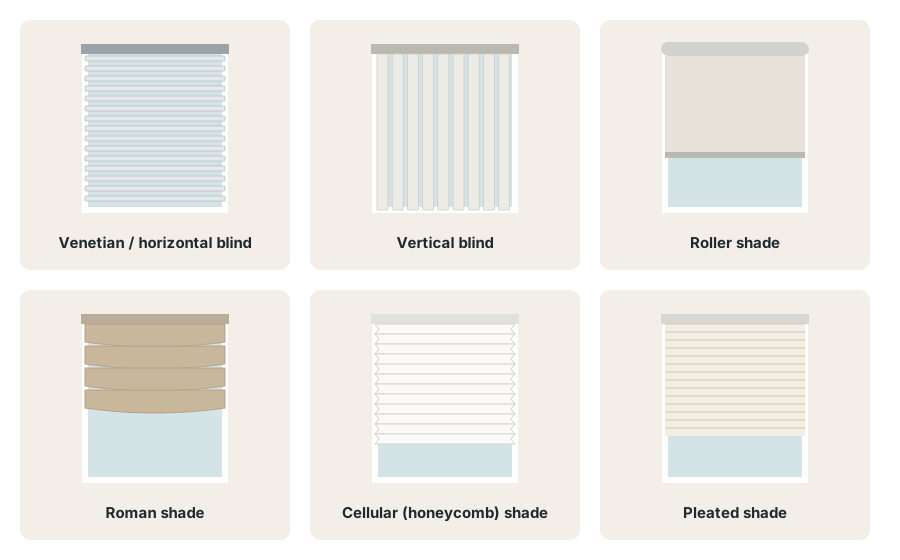
Blinds are made of individual slats, also called louvres or vanes, joined together with cords or tapes. You can tilt the slats to let in more or less light without raising the blind, and lift the whole blind to open the window completely. Because the slats are hard, blinds give very precise control over light and privacy.
Main types of blinds
- Venetian (horizontal) blinds: thin horizontal slats, usually aluminium. Affordable, practical and easy to wipe clean, which suits kitchens and bathrooms. See our aluminium venetian blinds guide.
- Wood and faux wood blinds: wider horizontal slats in real wood or wood-look materials. Warm and stylish. Faux wood (usually PVC or composite) handles humidity better than real wood. Our walnut venetian blinds guide compares the two, and our oak wooden blinds guide covers lighter wood tones. For made-to-measure options, see fitted horizontal blinds.
- Vertical blinds: tall slats that hang from a top track and slide sideways. Common on sliding doors and very wide windows.
Strengths
- Excellent light control: tilt the slats to direct light up, down or block it.
- Take up very little wall space and sit neatly inside or just outside the window frame.
- Easy to wipe clean; aluminium and faux wood handle moisture well.
- Durable and long-lasting.
Weaknesses
- Never fully blackout: light leaks between the slats and around the edges.
- Can look hard or office-like on their own.
- Slats collect dust and can bend or break.
- Little insulation compared with heavy drapes or cellular shades.
Shades
Shades are made from a single continuous piece of fabric or material. Instead of tilting, they open by rolling up, folding up, or stacking up from the bottom. Because there are no slats, they give a softer, cleaner look than blinds, and many block light more evenly.
Main types of shades
- Roller shades: a flat sheet of fabric that rolls around a tube at the top. Simple, inexpensive and available in sheer, light-filtering and blackout versions.
- Roman shades: fabric that folds into soft horizontal pleats as it's raised. They look like a tailored curtain and suit living rooms and bedrooms.
- Cellular (honeycomb) shades: made of connected fabric cells that trap air. They're among the best window coverings for insulation and come in light-filtering and blackout versions.
- Pleated shades: crisp, accordion-style pleats in a single layer of fabric. Similar to cellular shades in look, but without the insulating air pockets.
- Solar shades: a special mesh that cuts glare and heat while keeping a view outside during the day. Popular in sunny rooms and offices.
- Sheer or dual shades: layers of sheer and solid fabric that can be adjusted to soften or block light, combining some of the advantages of blinds and shades.
Strengths
- Clean, simple look that suits modern rooms.
- Blackout roller and cellular shades can make a room very dark.
- Cellular shades offer excellent insulation.
- Take up very little space.
Weaknesses
- Fabric shades are harder to clean than blinds; many need spot cleaning only.
- Less adjustable light control than tilting blinds: they're either up, down or somewhere in between.
- Some light can leak around the edges of inside-mounted shades.
Side-by-side comparison
| Feature | Curtains | Drapes | Blinds | Shades |
|---|---|---|---|---|
| Material | Fabric, often light | Heavy, lined fabric | Hard slats | Soft fabric or mesh |
| How it opens | Slides sideways | Slides sideways | Tilts and lifts | Rolls or folds up |
| Light control | Low to medium | High | Precise, adjustable | Low to very high |
| Privacy | Medium | High | High (slats closed) | High (opaque types) |
| Insulation | Low | High | Low | Medium to high (cellular) |
| Space needed | Wall space at sides | More wall space | Very little | Very little |
| Cleaning | Often washable | Often dry clean | Wipe or dust | Dust or spot clean |
| Look | Soft, decorative | Formal, luxurious | Neat, structured | Clean, minimal |
| Typical cost | Low to medium | Medium to high | Low to medium | Low to high |
How they compare on the things that matter
Light control
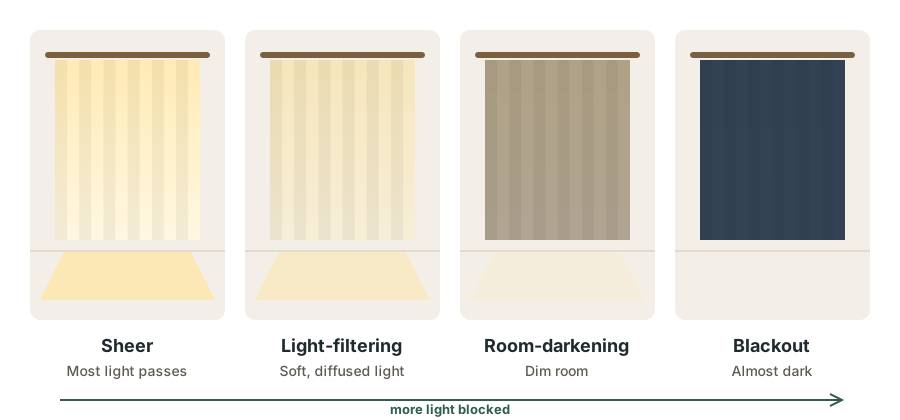
For blocking light completely, the best options are blackout drapes, blackout roller shades and blackout cellular shades, especially when combined. Blinds give the most precise control during the day, because you can tilt the slats to bounce light toward the ceiling while keeping privacy. Light curtains and sheers mainly soften light rather than block it.
Privacy
Closed drapes, opaque shades and closed blinds all give full privacy. Light curtains and sheers give some privacy during the day but much less at night when the lights are on inside. If privacy matters around the clock, combine a sheer with an opaque layer, or choose a top-down/bottom-up shade that covers the lower part of the window while letting light in at the top.
Insulation
Heavy lined drapes and cellular shades are the best insulators. Blinds do little on their own. In hot climates, blocking strong afternoon sun with a lined curtain or a solar shade noticeably cuts heat coming in through the glass. In cooler weather, closing heavy curtains at night helps keep warmth in.
Style
Curtains and drapes add softness, colour, pattern and height. Blinds and shades are more architectural: they emphasise clean lines and keep the window itself in focus. Many of the best-looking rooms use both.
Space and practicality
Where wall space is limited, or the window sits above a sink, bath, counter or bed, blinds and shades are more practical than curtains. They stay within the window area and don't get in the way.
Cleaning and upkeep
Aluminium and faux wood blinds wipe clean quickly, which is why they're common in kitchens and bathrooms. Many curtains can be machine washed. Drapes and fabric shades often need more careful cleaning, such as vacuuming with a brush attachment or professional cleaning.
Child safety: choose cordless
Window covering cords can be a strangulation hazard for young children and pets. Safety organisations recommend cordless products, especially in homes with young children. When choosing blinds and shades, look for cordless, motorised or wand-operated designs. If you already have corded products, keep cords short and secured high out of reach with a cleat, and never place a cot, bed or furniture that children can climb near a window cord.
Layering: why you might want more than one
You don't have to choose just one. Combining a practical layer with a decorative layer often gives the best of both worlds.
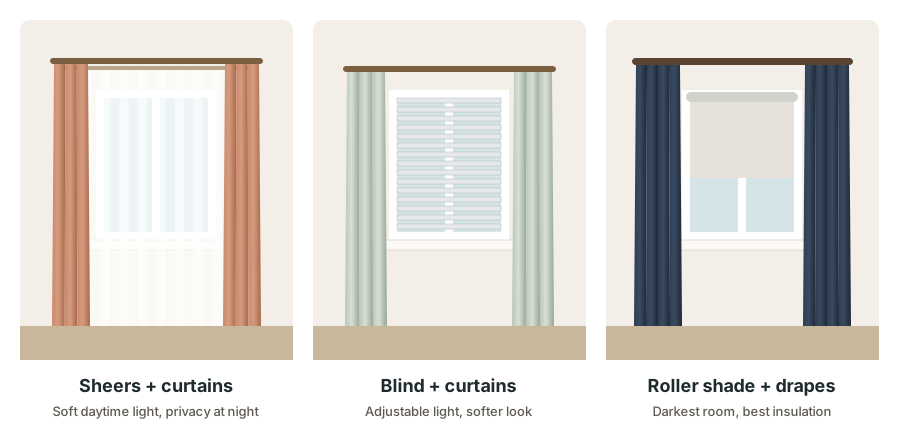
- Sheers + curtains: soft daytime light and privacy from the sheers, with full coverage at night from the curtains. A double rod holds both.
- Blinds + curtains: the blind handles daily light control; the curtains add softness, colour and extra coverage. Popular in living rooms and bedrooms.
- Blackout roller shade + drapes: the darkest possible room, with the best insulation. Ideal for bedrooms, nurseries and shift workers.
- Roman shade + side panels: stationary curtain panels at the sides for decoration, with a roman shade doing the actual work. Good for windows where curtains don't need to close.
When layering, mount the blind or shade inside the window frame (if the recess allows), and hang the curtains on a rod above and beyond the frame. Our guide to hanging curtain rods covers the right height and width.
The best choice for each room
Living room
Curtains or drapes for warmth and style, optionally layered with sheers, wood blinds or a light-filtering roman shade for daytime glare control. If the TV gets sun glare, a solar shade or blind behind curtains helps.
Bedroom
Blackout drapes, a blackout roller or cellular shade, or both together. Layering gives the darkest room and the best sleep conditions. Read our full guide to blackout curtains for how to stop light leaking around the edges.
Kitchen
Faux wood or aluminium blinds, roller shades or café curtains. They stay clear of the stove and sink and are easy to clean. Avoid long curtains near cooking areas.
Bathroom
Moisture-resistant faux wood or aluminium blinds, vinyl roller shades, or a short polyester café curtain. Avoid real wood and delicate fabrics, which can warp or mildew in humidity.
Home office
Blinds or solar shades control glare on screens while keeping daylight. Add curtains if the room also needs softening or soundproofing.
Children's room and nursery
Cordless blackout shades for naps, combined with soft, washable curtains for style. Always choose cordless designs.
Sliding glass doors
Floor-length curtains or drapes on a long rod, vertical blinds, or sliding panel tracks. Make sure the treatment stacks fully clear of the door opening.
Dining room
Drapes or lined curtains for an elegant, finished look, optionally with sheers or a roman shade for daytime privacy.
For room-by-room ideas, see kitchen curtain ideas, curtains for kids' rooms and nurseries and curtains for large windows and sliding glass doors.
Inside mount vs. outside mount for blinds and shades
Blinds and shades can be fitted in two ways, and the choice affects both the look and the light:
- Inside mount: the blind or shade fits inside the window recess. It looks neat and built-in and shows off the window trim. It needs enough recess depth, and some light leaks around the edges.
- Outside mount: the blind or shade is fixed to the wall or frame above the window and overlaps the opening on all sides. It blocks more light, hides an unattractive frame, and can make a small window look bigger.
For bedrooms where darkness matters, an outside mount, or an inside mount combined with curtains, is usually the better choice.
Measuring for blinds and shades
Blinds and shades must fit precisely, so measure carefully with a steel tape:
- Inside mount: measure the width inside the recess at the top, middle and bottom, and use the narrowest. Measure the height at the left, centre and right, and use the longest. Check the recess depth against the product's minimum depth.
- Outside mount: measure the area you want to cover, adding several centimetres on each side and above the opening to reduce light gaps.
- Note obstructions such as handles, locks, tiles or window cranks that could get in the way of the blind.
- Check how the shop wants measurements given. Many manufacturers make small deductions for inside mounts automatically, so don't subtract anything yourself unless the instructions say to.
For curtains, the measuring process is different, because the rod usually sits above and beyond the window. Our guide on how to measure windows for curtains walks through it step by step.
Motorised and smart window treatments
Blinds, shades and curtain tracks can all be motorised. A motor raises, lowers or opens the treatment at the touch of a button, a remote, a phone app or a voice assistant, and many can run on a schedule.
- Pros: convenient for large, high or hard-to-reach windows; no cords, which is safer for children and pets; can close automatically during the hottest part of the day to keep rooms cool.
- Cons: more expensive; batteries need charging or replacing, or the motor needs a power supply; repairs can be costlier than with manual products.
Motorised curtain tracks are a good way to automate heavy drapes on wide windows, while motorised roller and cellular shades are the most common smart option overall.
A quick decision guide
Answer these questions to narrow down your choice:
- Do you need complete darkness? Choose blackout curtains, a blackout shade, or both.
- Is the window near water, heat or a work surface? Choose blinds or shades rather than long curtains.
- Do you want to adjust light finely during the day? Choose blinds, or a dual shade.
- Is insulation a priority? Choose cellular shades or heavy lined drapes.
- Do you want softness, colour and height? Choose curtains or drapes.
- Are there young children in the home? Choose cordless or motorised products.
- Still undecided? Combine a practical layer (blind or shade) with a decorative layer (curtains).
What about cost?
Prices vary widely by size, material and whether a product is ready-made or made to measure, so it helps to think in relative terms:
- Lowest cost: ready-made light curtains, basic aluminium or vinyl blinds, simple roller shades.
- Middle: lined or blackout ready-made curtains, faux wood blinds, standard roman and cellular shades.
- Highest cost: made-to-measure drapes in premium fabrics, real wood blinds, motorised shades and wave curtains on tracks.
If your budget is limited, spend it where it matters most: blackout coverage in bedrooms, and generous, full curtains in the room guests see first. Inexpensive blinds or shades can handle practical rooms like kitchens and bathrooms.
Common mistakes to avoid
- Expecting blinds to black out a room. Light always leaks between slats. Add blackout curtains or a blackout shade if you need darkness.
- Hanging long curtains near a stove or sink. Choose blinds, shades or short curtains instead.
- Choosing real wood in a bathroom. Humidity can warp it. Faux wood or aluminium is safer.
- Ignoring cord safety. Choose cordless products in homes with children.
- Measuring inside-mount blinds or shades from the wrong place. Measure inside the recess at the top, middle and bottom, and use the narrowest width.
- Treating one product as the answer for every window. Different rooms have different needs; mixing products is normal.
Frequently asked questions
Are blinds or curtains better?
Neither is better overall. Blinds are more practical, precise and space-saving; curtains are softer, more decorative and better at insulation when lined. Many rooms benefit from both.
What's the difference between blinds and shades?
Blinds have individual hard slats that tilt. Shades are a single piece of soft material that rolls or folds up.
Are drapes the same as curtains?
In everyday speech, mostly yes. Strictly speaking, drapes are heavier, lined and usually floor length, while curtains are lighter and come in many lengths.
Which window treatment blocks the most light?
A blackout roller or cellular shade combined with blackout drapes, mounted high and wide, gives the darkest result.
Which window treatment is best for insulation?
Cellular (honeycomb) shades and heavy lined or thermal drapes are the best insulators, and they work even better together.
Can I use curtains and blinds together?
Yes. Mount the blind inside or just outside the window frame and the curtain rod above and beyond it, so both can move freely.
The bottom line
Curtains and drapes are fabric panels that open sideways and bring softness, colour and insulation. Blinds have tilting slats and give precise light control. Shades are single pieces of fabric that roll or fold up for a clean, simple look. The right choice depends on each room's needs: light, privacy, moisture, space, safety and style. And when one isn't enough, layering two together usually solves the problem beautifully.
Keep reading
 Styles
Oak wooden blinds: shades, slat sizes, real oak vs oak-effect, and care
Oak wooden blinds bring light, natural warmth to any room. Compare oak shades, real wood and oak-effect options, slat sizes and tapes, and learn how to style and care for them.
 Styles
Fitted horizontal blinds: a complete guide to made-to-measure blinds that fit perfectly
Fitted horizontal blinds are made to the exact size of your window, so they look neat and control light properly. Compare types, fitting methods, measuring and care.
 Styles
Blackout roman shades: how to choose, measure and fit them for a truly dark room
Blackout roman shades combine soft fabric folds with real darkness. Learn the styles, linings, mounts, measuring, cord safety and tricks that stop light leaking around the edges.