DIY & Sewing
How to make curtains look expensive on a budget

Made-to-measure curtains can cost a small fortune, but the luxurious look that makes them special isn't really about price. It comes from a few key qualities: curtains hung at the right height and width, the right length, plenty of fullness, neat even folds, good hardware and thoughtful details. The good news is that you can recreate almost all of these with inexpensive ready-made curtains and a little effort.
This guide shares the most effective tricks for making budget curtains look expensive, from the free ones that just involve moving the rod, to small upgrades that cost very little.
Why some curtains look expensive and others don't
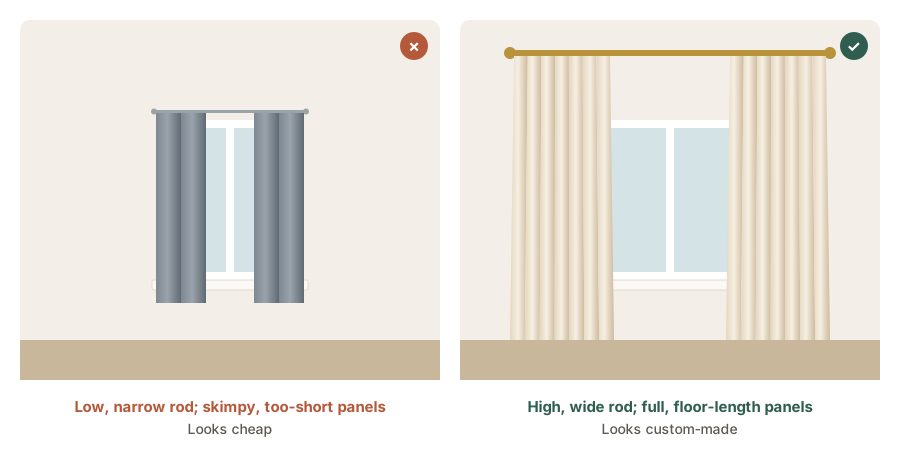
Designers know that expensive-looking curtains share some common features:
- They're hung high and wide, so the window looks bigger and grander.
- They're the right length, just touching or kissing the floor.
- They're full, with plenty of fabric, so they fall in deep, generous folds even when closed.
- The folds are neat and even, not random and crumpled.
- They're lined, so they hang with weight and the colour looks rich.
- The hardware is substantial and suits the room.
- They have finishing details: pleats, borders, trims or tiebacks.
Cheap-looking curtains usually break these rules: they hang just above the window frame, stop at an awkward length, are stretched flat across the window, look thin and see-through, and hang from a flimsy rod. Fixing these problems costs very little.
1. Hang the rod high and wide (free)
This is the most powerful trick of all, and it's free if you already have a long enough rod.
- Hang high: mount the rod at least 10–15 cm above the window frame, or halfway between the frame and the ceiling. In rooms with low ceilings, go right up to just below the ceiling.
- Hang wide: extend the rod 15–30 cm beyond each side of the window, so the open curtains stack on the wall rather than covering the glass.
This makes the window look larger, the ceiling higher and the room brighter, which is exactly what made-to-measure curtains do. Our guide on how high to hang curtain rods explains the measurements in detail.
2. Get the length exactly right
Curtains that stop a few centimetres above the floor, or halfway between the sill and the floor, are a giveaway of ready-made curtains bought in the wrong size. Expensive curtains are always the right length:
- Kissing the floor (0.5–1 cm above): crisp and tailored, the most popular high-end look.
- Breaking (2–5 cm extra): relaxed and slightly luxurious.
- Puddling (10–20 cm extra): romantic and dramatic, for formal rooms.
The trick is to buy curtains longer than you need and hem them to exactly the right length. Ready-made curtains come in standard lengths such as about 213 cm (84 inches), 244 cm (96 inches) and 274 cm (108 inches). Choose the next length up from your measurement and shorten them. Our guide on how to hem curtains shows you how, including no-sew options. See the curtain length guide for help choosing.
If your curtains are too short
- Lower the rod a little, if it still sits above the frame.
- Use clip rings to add a few centimetres.
- Add a contrasting band of fabric at the bottom, a classic designer detail that looks deliberate.
- Add a header of matching or contrasting fabric at the top.
3. Add fullness: double up the panels
Skimpy curtains that only just cover the window when closed look cheap. Expensive curtains are generously full, usually 2 to 2.5 times the width of the rod.
The budget solution is simple: buy twice as many panels. Instead of one panel on each side, hang two. Budget curtains are often inexpensive enough that doubling up still costs far less than one pair of made-to-measure curtains. Hook or clip the edges of the two panels together so they look like one wide curtain. Learn more in curtain fullness explained.
4. Upgrade the heading with pleats
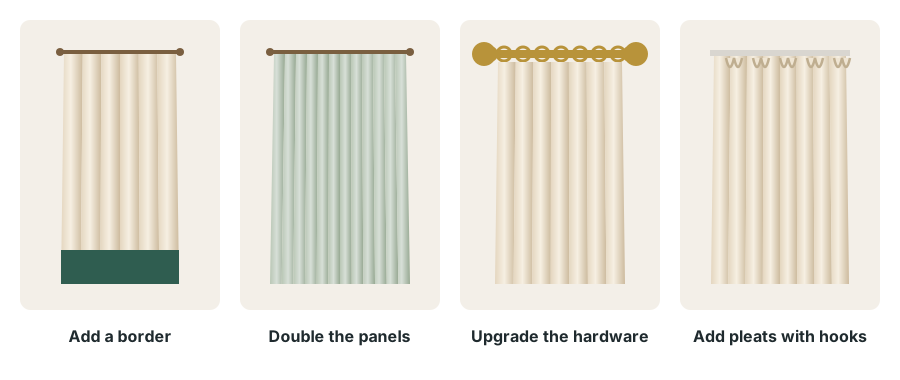
Pinch pleats are a hallmark of custom curtains. You can recreate them on simple flat-panel or rod pocket curtains:
- Pleater hooks: special four-pronged hooks slide into pleat tape or the back of the curtain to form neat pinch pleats. Hang them from rings or a track.
- Pinch pleat tape: sew or iron on pleat tape across the back of the curtain top, then insert pleater hooks.
- Clip rings with folded pleats: fold the top into even pleats before clipping each ring on, for a simple tailored look.
- Back tabs: many ready-made curtains have hidden back tabs. Hanging them by the back tabs rather than the rod pocket creates soft, wide, even folds that look more expensive.
Our guide to curtain headings explains each style.
5. Add a lining
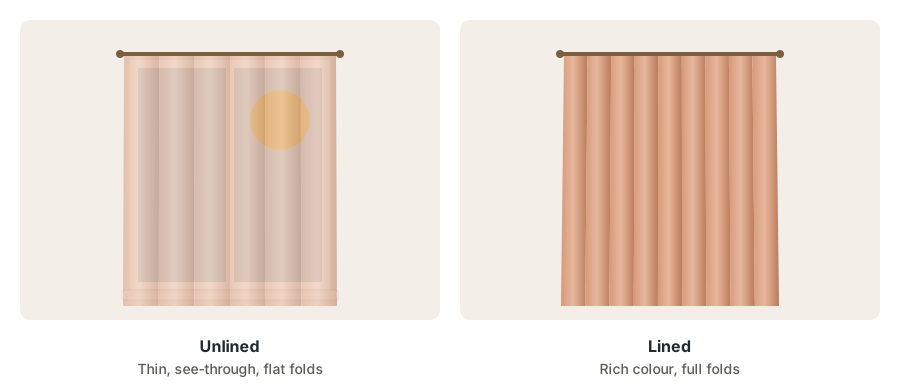
Thin, unlined curtains look flimsy and let light shine through unevenly, showing every seam and imperfection. Lining makes a huge difference:
- Curtains hang with more weight and form deeper folds.
- Colours look richer and more even.
- The curtains look neat from outside the house too.
- They block more light, insulate better and protect the fabric from fading.
Budget lining options
- Separate liners: inexpensive ready-made liners hang behind the curtain from the same hooks or rings, with no sewing.
- Iron-on or sew-in lining: attach lining fabric to the back of the curtain along the top and sides.
- Blackout or thermal liners: add light blocking or insulation at the same time. See our blackout curtains guide and thermal curtains guide.
6. Upgrade the hardware
A thin, wobbly rod makes any curtain look cheap, while a substantial rod makes even simple curtains look considered:
- Choose a thicker rod: 25–35 mm diameter looks substantial on most windows.
- Pick a classic finish: brass, antique gold, matte black, bronze or natural wood. Avoid shiny, thin chrome in traditional rooms.
- Add rings: curtains hung from rings look more expensive than curtains threaded directly onto a rod, and they open more easily.
- Choose simple, elegant finials. Overly fussy finials can look cheap.
- Use centre brackets so the rod doesn't sag.
- Spray-paint an old rod: metal spray paint in matte black or brass can transform tired hardware for very little money.
Our curtain rods and tracks guide covers all the options.
7. Add borders and trims
Designer curtains often have a contrasting border, a feature that's easy to add yourself:
- Leading edge border: a strip of contrasting fabric or grosgrain ribbon down the inner edges, where the curtains meet. This is a classic, tailored look.
- Hem band: a deep band of contrasting fabric at the bottom, which also adds length.
- Top band: a band across the top, below the heading.
- Trims: pom-poms, tassel fringe, braid or velvet ribbon add personality.
Use fabric glue or iron-on adhesive for a no-sew version, or stitch it by hand or machine. Choose a colour from elsewhere in the room, such as cushions or artwork.
8. Choose fabrics that look expensive
Some fabrics look high-end even when they're inexpensive:
- Linen and linen-look fabrics: natural texture always looks relaxed and luxurious. See our linen curtains guide.
- Velvet: polyester velvet is affordable and looks rich. See our velvet curtains guide.
- Heavy cotton and textured weaves: substantial and natural-looking.
- Matte fabrics: generally look more expensive than shiny ones.
Fabrics that can look cheap
- Very thin, shiny polyester.
- Fabrics with visible creases from packaging that never drop out.
- Busy, low-quality printed patterns with blurry edges.
- Stiff, plasticky blackout fabrics with a shiny surface.
Compare fabrics in curtain fabrics compared.
9. Choose colours wisely
- Neutrals such as ivory, oatmeal, stone and soft grey look calm and timeless, the colours used in most high-end interiors.
- Deep, rich colours like navy, forest green, rust and charcoal look sophisticated, especially in velvet or heavy linen.
- Match the walls for a seamless, designer look.
- Avoid very bright, saturated colours in thin fabrics, which can look cheap.
Read how to choose curtain colours for more ideas.
10. Steam and train the folds
Creases from packaging instantly make curtains look cheap. Expensive curtains are dressed carefully:
- Steam out the creases after hanging, using a garment steamer or the steam setting on your iron, held just away from the fabric.
- Train the folds: open the curtains, arrange them into neat, even folds from top to bottom, and tie them loosely with soft fabric strips in three places. Leave them for two or three days.
- Add weights to the hem corners so the edges hang straight.
11. Layer for a finished look
Expensive windows often have several layers. Adding a sheer behind your curtains on a double rod, or a roman shade or blind inside the window frame, creates depth and looks thoughtfully designed. Sheers are inexpensive and transform how light enters the room. See our sheer curtains guide.
12. Add tiebacks and holdbacks
Simple tiebacks in the curtain fabric, rope or leather, or metal holdbacks that match the rod, add a finished, designed look. Position them about a third of the way up from the floor for a classic look.
13. Keep every window consistent
In a room with several windows, mismatched curtains at different heights look accidental. Expensive interiors are consistent:
- Hang all rods at the same height, even if the windows are different sizes.
- Use the same fabric, colour and heading on every window in the room.
- Make all the curtains the same length relative to the floor.
- Use matching hardware throughout, and ideally in connecting rooms too.
14. Check the view from outside
Curtains are seen from the street too. Faded, mismatched or unlined curtains look untidy from outside, while lined curtains with a neutral lining look neat and uniform. If you have several windows on the front of the house, choose linings in the same colour (white or cream is classic) so the house looks cared for from the outside.
A simple makeover, step by step
Here's how a typical budget makeover might look for a living room window with a pair of short, thin ready-made curtains on a narrow rod just above the frame:
- Move the rod up to halfway between the frame and the ceiling, and replace it with a longer, thicker rod that extends about 25 cm beyond each side of the window.
- Buy two extra panels of the same curtains in the next standard length, so there are two panels on each side.
- Hang the curtains on rings using the back tabs or pleater hooks for even folds.
- Add separate liners behind the curtains, hung from the same rings.
- Hem the curtains so they just kiss the floor.
- Add a contrasting ribbon down the leading edges, in a colour taken from the cushions.
- Steam and train the folds for a few days.
The total cost is usually a fraction of made-to-measure curtains, and the result looks completely different: taller, fuller, richer and more polished.
Which upgrades give the most value?
| Upgrade | Cost | Effort | Impact |
|---|---|---|---|
| Hang the rod high and wide | Free to low | Low | Very high |
| Hem to the right length | Very low | Low–medium | Very high |
| Steam and train the folds | Free | Low | High |
| Double the panels | Low–medium | Low | Very high |
| Add a lining | Low–medium | Low–medium | High |
| Rings and pleater hooks | Low | Low | High |
| Thicker rod or painted hardware | Low–medium | Medium | High |
| Contrasting border or trim | Low | Medium | Medium–high |
| Add sheers behind | Low | Low | Medium |
| Tiebacks and holdbacks | Low | Low | Medium |
If your budget is very tight, start at the top of the table. Moving the rod, getting the length right and steaming the folds cost almost nothing and transform most windows.
Shopping checklist for budget curtains
- Feel the weight: heavier fabric drapes better. Hold a panel up to the light; if it's very see-through, plan to add a liner.
- Check the length options: buy the next standard length longer than you need and hem it.
- Check the heading: back tabs, rod pockets or plain tops are the most flexible, because you can hang them with rings or pleater hooks.
- Buy all panels at once from the same batch, so the colour matches exactly.
- Read the care label: washable curtains are cheaper to look after.
- Check the return policy, in case the colour looks different at home.
- Look at the seams and hems: straight, even stitching is a sign of better quality.
Smart places to find affordable curtain fabric
- Sales and outlet stores: home stores regularly discount curtains, especially at the end of a season.
- Extra-long ready-mades: buying a longer standard size and hemming it is often cheaper than custom sizes.
- Fabric remnants and end-of-roll: perfect for borders, tiebacks, valances and small windows.
- Flat bedsheets: large, soft, already hemmed and available in linen and cotton; add clip rings or a rod pocket.
- Linen tablecloths: beautiful for small windows and café curtains.
- Cotton drop cloths: sturdy, natural-looking canvas, popular for rustic and farmhouse curtains. Wash them first to soften them and remove sizing.
- Second-hand curtains: high-quality lined curtains often appear in charity shops and online marketplaces. Check they're long and wide enough, and clean them before hanging.
Room-by-room tips
Living room
Go for floor-length, full curtains in linen or velvet with a substantial rod, hung as high as possible. Add sheers for daytime privacy. See our living room curtain ideas.
Bedroom
Use a blackout liner behind a beautiful face fabric, with a wraparound rod to block side light. Soft, calm colours look restful and expensive. Our guide to the best curtains for bedrooms has more ideas.
Dining room
Pinch pleats, rich colours and a contrasting border look formal and elegant. Tiebacks keep the curtains tidy.
Kitchen
Crisp linen café curtains or a roman shade on a slim brass rod look effortlessly stylish. See our kitchen curtain ideas.
Small rooms
Light, floor-length curtains hung high and wide in a colour that matches the walls make a small room look bigger and more refined. Read curtains for small windows and small rooms.
What to spend on, and what to save on
Spend a little more on the rod and brackets, the lining for sunny or bedroom windows, and the main curtains in the room you use most, usually the living room. Save on sheers, curtains in guest rooms and small windows, trims you can add yourself, and tiebacks you can make from leftover fabric. Small, careful choices add up to a big difference.
Common mistakes that make curtains look cheap
- Hanging the rod just above the window frame.
- Curtains that are too short or an awkward length.
- Not enough fullness: curtains stretched flat across the window.
- Visible packaging creases.
- Thin, see-through, unlined fabric.
- A thin, sagging or wobbly rod.
- Mismatched panels with different colours or lengths.
- Curtains covering the glass when open, blocking light.
Simple DIY projects that add value
- Dye plain curtains: natural fabrics such as cotton and linen take fabric dye well. Dyeing white curtains a soft, muddy colour like sage, stone or clay instantly makes them look more designer. Always follow the dye maker's instructions, and test a small hidden area first.
- Stencil or block-print a border: fabric paint and a simple stencil can add a hand-printed border along the hem or leading edge.
- Add a valance or pelmet: a simple fabric-covered board above the window hides the rod and adds a tailored, architectural look.
- Make fabric tiebacks: sew simple tiebacks from leftover fabric or the contrast border fabric.
For sewing projects, our beginner's guide on how to sew simple unlined curtains covers the basic techniques.
Frequently asked questions
What is the cheapest way to make curtains look expensive?
Hang the rod higher and wider, and make sure the curtains reach the floor. These two changes cost little or nothing and make the biggest difference.
Do lined curtains look more expensive?
Yes. Lining adds weight, makes colours look richer and helps the curtains hang in neat, full folds.
How many curtain panels do I need for a luxurious look?
Enough for about 2 to 2.5 times the rod width. For many windows, that means two panels on each side rather than one.
Should curtains touch the floor?
Yes, for the most expensive look they should just touch or kiss the floor. Curtains that hover several centimetres above the floor look like they're the wrong size.
Can I make cheap blackout curtains look nice?
Yes. Hang them high and wide, hem them to the right length, use rings or pleater hooks, and consider hanging a decorative curtain in front with the blackout curtain behind on a double rod.
Is it worth buying expensive curtain rods?
A sturdy, well-finished rod is worth spending a little more on, because it's visible and supports the curtains. It doesn't need to be the most expensive; a solid metal or wooden rod of a good thickness is enough.
Can I use bedsheets as curtains?
Yes. Flat sheets are large and already hemmed. Use clip rings or sew a rod pocket at the top. Linen and heavy cotton sheets look best; thin polyester sheets can look cheap.
How do I get rid of packaging creases quickly?
Hang the curtains first, then steam them from top to bottom. Stubborn creases can be ironed on the back of the fabric at the right temperature for the fibre, or tumbled briefly with a damp towel if the care label allows.
Do grommet (eyelet) curtains look cheap?
Not necessarily. Eyelet curtains in a good fabric, with enough fullness and the right length, look modern and smart. Thin fabric with shiny plastic eyelets on a skinny rod is what looks cheap.
The bottom line
Expensive-looking curtains are about how they're hung and finished, not how much they cost. Hang the rod high and wide, get the length right, double up panels for fullness, add pleats and a lining, upgrade the hardware, add a contrasting border, choose rich textures and calm colours, and steam and train the folds. With these simple tricks, budget curtains can look like they were made to measure.
Keep reading
 DIY & Sewing
How to sew simple unlined curtains: a beginner's step-by-step guide
Making your own curtains is easier than you think. This beginner's guide shows you how to choose fabric, measure, calculate, cut and sew simple unlined rod pocket curtains, step by step.
 DIY & Sewing
How to wash, clean and iron curtains safely
Clean curtains make a room look and smell fresher. Here's how to wash, dry and iron every type of curtain without shrinking, fading or damaging it, plus how to clean curtains you can't take down.
 DIY & Sewing
How to hem curtains, with and without sewing
Curtains too long? You don't need to be an expert sewer to fix them. Here's how to measure and hem curtains with a sewing machine, by hand, with iron-on tape, or with no tools at all.