Fabrics
Sheer curtains: how to choose, hang and layer them

Sheer curtains are the quiet heroes of window dressing. They soften harsh sunlight, reduce glare, give a room daytime privacy, and make spaces feel bright, airy and calm. They're inexpensive, light, easy to wash and simple to hang. And when they're layered with heavier curtains, they give you more control over light and privacy than almost any other setup.
But sheers are also easy to get wrong. Too little fabric, and they look thin and limp. The wrong colour, and they make a room look grey. Hung alone in the wrong room, and they leave you exposed at night. This guide explains everything you need to know: the types of sheer fabric, how much privacy they really give, how much fabric to buy, how to layer them, and how to keep them fresh.
What are sheer curtains?
Sheer curtains are made from lightweight, translucent fabrics that let light pass through while softening and diffusing it. You can usually see shapes and light through them, but not fine detail. They're sometimes called voiles, net curtains or sheers, depending on the fabric and the country.
Sheers sit at the lightest end of the light-control scale, before light-filtering, room-darkening and blackout curtains. If you're new to these terms, our guide to curtain types explains the full scale.
Types of sheer fabric
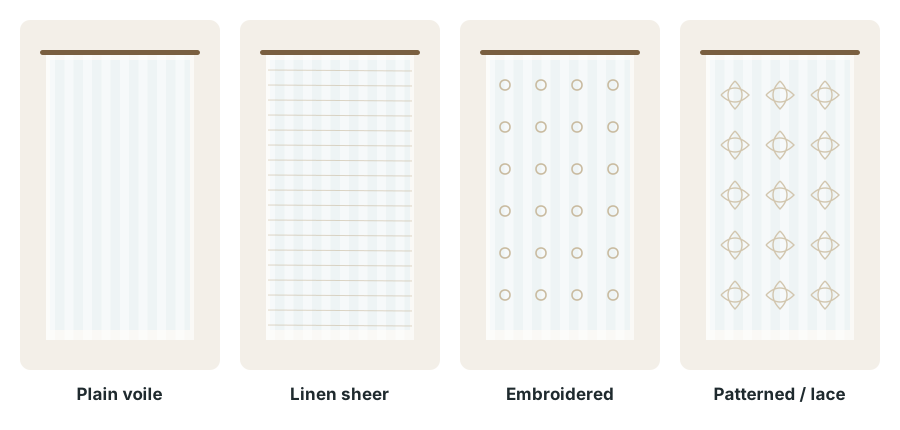
Voile
The most common sheer. Voile is a fine, soft, lightweight fabric, usually polyester or cotton, with a smooth, even weave. It drapes gracefully, washes easily and comes in every colour. Polyester voile is durable, fade-resistant and inexpensive.
Linen and linen-look sheers
Sheer linen, or polyester woven to look like it, has a visible, slightly irregular texture. It looks relaxed and natural, and glows beautifully in sunlight. Real linen sheers crease and may shrink; linen-look polyester is easier to care for. Our linen curtains guide explains the differences.
Batiste and lawn
Very fine, soft cotton fabrics, slightly more opaque than voile. They have a delicate, traditional feel.
Chiffon and organza
Chiffon is very light and floaty; organza is crisp, slightly stiff and often has a subtle sheen. Both are more decorative and formal.
Embroidered and patterned sheers
Sheers with embroidered motifs, woven patterns, printed designs or burnout patterns (where some fibres are dissolved to create a design) add decoration while keeping the light, airy feel.
Lace and net curtains
Traditional lace and net curtains have open, decorative patterns. They're less common in modern homes but still popular in classic and cottage styles.
Semi-sheers
Slightly heavier and more opaque than true sheers, semi-sheers give more privacy while still letting plenty of light through. They're a good compromise when you want sheers alone in a room.
How much privacy do sheers really give?
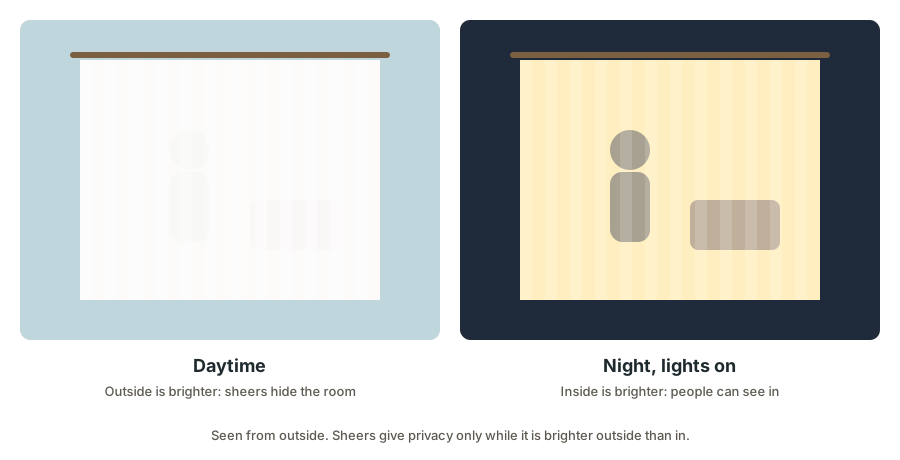
This is the most important thing to understand about sheers:
- During the day, when it's brighter outside than inside, sheers reflect light toward the street. People outside see the bright fabric rather than the room behind it. You get good daytime privacy, and you can still see out.
- At night, when the lights are on inside and it's dark outside, the situation reverses. People outside can see shapes, movement and sometimes detail inside.
So in bedrooms, bathrooms and street-facing living rooms, sheers alone are rarely enough. Pair them with heavier curtains, a blind or a shade for night-time privacy. Semi-sheers and patterned sheers give a little more privacy than plain voile, but the same principle applies.
Benefits of sheer curtains
- Soft, diffused light that makes rooms feel calm and bright.
- Less glare on screens, floors and tables.
- Daytime privacy without blocking the view or the light.
- Some protection from sun, which can help slow fading of furniture and floors.
- A finished look on windows that don't need heavy curtains.
- Softness and movement: sheers sway gently in a breeze and soften hard architecture.
- Affordable and easy to wash.
Choosing the right colour
White
Crisp, fresh and bright. Pure white sheers look clean and modern and maximise light. In some light they can look slightly cold or bluish.
Ivory and cream
Softer and warmer than white, and more forgiving. Ivory sheers often look best next to off-white walls, wood and warm neutrals.
Natural linen tones
Oatmeal, flax and sand sheers glow warmly and add texture. They suit relaxed, natural and Scandinavian interiors.
Grey and taupe
Modern and calm, and they reduce glare slightly more than white. Grey sheers can make a room look a little dimmer.
Coloured sheers
Coloured sheers tint the light that passes through them, so they change the colour of the whole room. Soft colours like blush or pale green can create a gentle glow; strong colours can make a room feel unusual. Test a sample at your window before committing.
For more on choosing colours, see our guide on how to choose curtain colours.
How much fabric do sheers need?
Sheers need more fullness than heavier curtains. Because the fabric is so light, it looks flat, thin and see-through without plenty of folds. Aim for:
- 2.5–3 times the rod width for a full, soft look.
- At least 2 times if budget is tight.
For example, a 200 cm rod needs 500–600 cm of sheer fabric in total. With 140 cm panels, that's four or five panels. Sheers are inexpensive, so generous fullness costs little but makes a big difference. Many sheers also come in extra-wide widths, which reduces the number of panels. Our guide to curtain fullness walks through the calculation.
How long should sheer curtains be?
- Floor length, floating about 1 cm above the floor, is the most popular and practical choice. Light sheers that drag on the floor pick up dust quickly and show it.
- A slight break looks romantic but needs more frequent washing.
- Sill length works for kitchens, bathrooms and windows above furniture.
- Café-style sheers cover only the lower half of the window for privacy at eye level.
When layering, the sheer should be the same length as the main curtain or slightly shorter, never longer, or it will peek out underneath. Our curtain length guide covers this in more detail.
Which heading suits sheers?
- Rod pocket: the most common and economical heading for sheers. Ideal for sheers that stay closed most of the day.
- Grommet: easy to slide; the fabric forms soft, even waves.
- Pencil pleat: gathers the fabric into fine folds that suit sheers well.
- Wave: sleek and modern, especially for sheers on tracks in contemporary rooms.
- Clip rings: a flexible option that lets sheers slide easily.
See our curtain headings guide for the pros and cons of each.
Layering sheers with curtains
Layering is where sheers really shine. A sheer layer plus a heavier curtain gives you four useful settings:
- Both open: full daylight and view.
- Sheer closed, curtain open: soft daylight, privacy and reduced glare.
- Both closed: privacy at night and more darkness.
- Curtain partly closed: extra shade on hot afternoons.
How to hang layered sheers
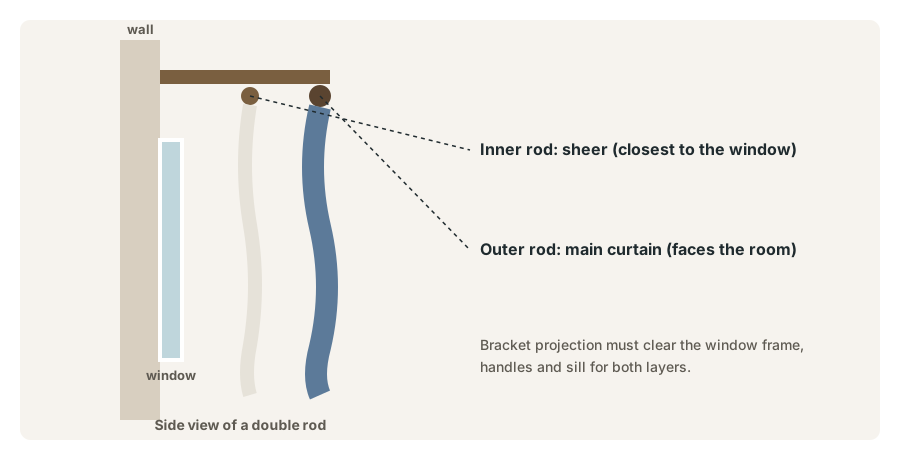
- Use a double rod or double brackets. The sheer goes on the inner rod, closest to the window; the main curtain goes on the outer rod.
- Check the projection: both layers need room to hang freely without touching the window frame, handles or sill.
- Choose the right widths: the inner rod is usually slightly shorter than the outer rod. Make sure the outer rod extends enough for the heavier curtains to stack clear of the glass.
- Measure each layer separately for length, because the two rods may sit at slightly different heights.
- Coordinate colours: white or ivory sheers suit almost any main curtain. Tone-on-tone combinations, such as an oatmeal sheer with a stone curtain, look especially elegant.
Our guide on how high and wide to hang curtain rods covers rod placement, and how to hang curtains covers installation.
Other layering options
- Sheers + blinds: sheers soften the hard lines of blinds, while the blind gives night-time privacy.
- Sheers + blackout shade: a blackout roller shade behind sheers gives darkness at night with a soft look during the day.
- Sheers + stationary side panels: heavier panels frame the window for decoration, while the sheer covers the glass.
Sheers, sun and heat
Sheers reduce glare and soften direct sunlight, which can make sunny rooms more comfortable. They do block some heat, but much less than lined or thermal curtains. For very hot rooms:
- Use sheers for daytime light and add a lined, thermal or blackout curtain for the hottest hours.
- Choose white or light-coloured sheers, which reflect more light.
- Consider solar shades or reflective blinds behind sheers on very sunny windows.
Polyester sheers resist sun damage better than cotton or linen, which can weaken and yellow over time in strong sun.
Sheer curtain sizes
Sheer curtains come in a wider range of sizes than many other curtains:
- Standard panels are often around 130–150 cm (about 50–60 inches) wide, in common lengths such as about 213 cm (84 in), 241 cm (95 in) and 274 cm (108 in).
- Extra-wide sheers, or sheer fabric sold by the metre, often come in widths of about 280–300 cm. Because the fabric is so wide, you can turn it sideways so the width becomes the drop, which avoids seams on very wide windows.
- Short sheers and café panels come in lengths for sill-length and half-window use.
Sizes vary by brand and country, so always check whether the listed width is for one panel or a pair.
How to spot good-quality sheers
- An even weave with no thin patches, pulls or snags.
- A weighted hem. Many good voiles have a fine weighted cord sewn into the hem, which helps them hang straight and stop billowing.
- Neat side hems that lie flat without puckering.
- A soft, matte finish, unless you specifically want sheen. Cheap sheers can look shiny or plasticky.
- Clear care instructions, ideally machine washable.
Hanging sheers inside a window recess
If your window sits in a recess, you can hang sheers inside it on a tension rod or a slim rod with small brackets, and hang main curtains on a rod outside the recess:
- Measure the inside width of the recess at the top.
- Choose a tension rod or slim rod that fits that width.
- Set the rod a few centimetres below the top of the recess, so the sheer's heading sits neatly.
- Choose sheers that reach the sill (about 1 cm above it) or the bottom of the recess.
- Hang your main curtains above and beyond the recess as usual.
This gives a neat, layered look without needing a double rod.
Sheers for special windows
Sliding glass doors
Floor-length sheers on a long rod or track, sliding easily on grommets, rings or wave carriers. Make sure they stack clear of the door opening and float above the door track.
French doors
Sheers mounted on the doors themselves with small rods at the top and bottom of the glass (sometimes called sash or hourglass curtains), or floor-length sheers on a rod above the doors that stack clear of them.
Bay windows
Sheers on a bendable track or bay rod, following the shape of the bay, often layered with heavier curtains at the outer ends.
Very wide windows
Extra-wide sheer fabric turned sideways gives one seamless sheet of sheer across a large window, which looks very elegant.
Sheers vs. blinds for daytime privacy
| Sheers | Blinds | |
|---|---|---|
| Look | Soft, airy, decorative | Neat, structured |
| Daytime privacy | Good | Good to excellent (adjustable) |
| Night privacy | Poor | Good when closed |
| Light quality | Soft, evenly diffused | Striped, adjustable |
| View when closed | Partial, soft | Limited |
| Cleaning | Machine wash | Dust or wipe |
Many people combine both: blinds for practical light and privacy control, sheers for softness.
Styling ideas with sheers
- Tone-on-tone layers: an ivory sheer behind an oatmeal linen curtain, or a pale grey sheer behind charcoal velvet.
- Ceiling-to-floor sheers on a hidden track for a light, gallery-like feel.
- Sheers with tiebacks for a soft, romantic frame on a window that doesn't need privacy.
- Café sheers on the lower half of a kitchen or bathroom window.
- Patterned sheers as the only decoration in a minimal room.
- Double sheers: two sheers in slightly different shades on a double rod, for a subtle layered glow.
Best sheers for each room
Living room
White, ivory or natural linen-look sheers layered behind main curtains give soft daylight and evening privacy. Floor length, on a double rod. See our living room curtain ideas.
Bedroom
Sheers behind blackout curtains give a soft look during the day and darkness at night. Never rely on sheers alone in a bedroom.
Kitchen
Short sheers or café-style sheers give privacy while letting light in. Choose polyester for easy washing and resistance to cooking humidity.
Bathroom
Polyester sheers handle humidity well. For privacy, combine with frosted glass or a blind.
Dining room
Elegant sheers, perhaps with subtle embroidery or texture, layered behind richer curtains.
Home office
Sheers cut screen glare while keeping the room bright and maintaining a view.
Sunrooms and enclosed porches
Light, airy sheers soften strong light. Choose fade-resistant polyester.
Sheers and café-style voiles are especially useful in kitchens; see kitchen curtain ideas. In children's rooms, sheers make a good daytime layer in front of blackout curtains, as explained in curtains for kids' rooms and nurseries.
Sheers in hot and humid climates
Sheers are especially useful in hot, sunny places, where they cut glare and let breezes through while giving daytime privacy. To get the most from them:
- Choose polyester voile, which resists humidity, mildew and sun damage better than cotton or linen sheers.
- Pick white or very light colours, which reflect sunlight and fade less visibly.
- Pair them with a lined or thermal curtain that you close during the hottest hours.
- Wash them more often in humid seasons to prevent musty smells and grey dust build-up.
- Let them move: sheers in front of an open window let air circulate while softening the light.
Sheers for renters
Sheers are one of the easiest window upgrades for renters. They're light enough for tension rods inside a window recess, so you don't need to drill. They're inexpensive, so you can leave them behind or take them with you. And neutral sheers soften almost any existing blind or curtain the landlord has provided.
Caring for sheer curtains
Sheers show dust and marks more than heavier curtains, but they're usually very easy to clean:
- Check the care label. Most polyester sheers are machine washable.
- Remove hooks and rings.
- Wash gently and cool, ideally in a laundry bag or a pillowcase to prevent snagging. Use a delicate cycle and mild detergent.
- Don't overload the machine, so the fabric rinses well and creases less.
- Skip the tumble dryer, or use the lowest setting. Polyester sheers can be rehung damp to dry and lose creases.
- Iron on a low setting if needed, or steam them as they hang.
Keeping white sheers white
- Wash them regularly, every one to three months, before dust and grime set in.
- Wash whites separately from colours.
- Use an oxygen-based whitener suitable for the fabric, following the product's instructions, rather than chlorine bleach, which can damage synthetic fibres and cause yellowing.
- Dry in the shade; strong direct sun can yellow some fabrics over time.
Common sheer curtain mistakes
- Too little fabric. Sheers need 2.5–3 times the rod width.
- Relying on sheers alone for night-time privacy in bedrooms and street-facing rooms.
- Sheers longer than the main curtains when layered, so they peek out underneath.
- Dragging hems that collect dust; float them slightly above the floor.
- Coloured sheers chosen without testing, which tint the whole room unexpectedly.
- Washing on a hot, heavy cycle, which can snag, crease and damage the fabric.
- Not enough bracket projection on a double rod, so the layers rub together.
Frequently asked questions
Can people see through sheer curtains at night?
Yes, often. When it's brighter inside than outside, people can see shapes and movement through sheers. Add heavier curtains, blinds or a shade for night-time privacy.
Do sheer curtains block heat?
They reduce glare and soften direct sun, but block much less heat than lined or thermal curtains.
How many sheer panels do I need?
Multiply the rod width by 2.5–3 and divide by the panel width, rounding up. A 200 cm rod usually needs four or five 140 cm panels.
Should sheers touch the floor?
Floating about 1 cm above the floor is most practical; sheers that drag collect dust quickly.
Should sheer curtains be white or ivory?
White looks crisp and modern; ivory looks warmer and softer. Choose the one that suits your wall colour and light. Ivory is more forgiving next to off-white walls.
Can I hang sheers without a double rod?
Yes. Sheers can hang alone on a single rod, or on a tension rod inside the window recess with main curtains on a rod outside.
Are sheer curtains out of style?
No. Simple, floor-length sheers in white, ivory or natural linen tones are widely used in modern, minimal and relaxed interiors. Heavily patterned net curtains are less common today, but plain and textured sheers remain very popular.
How often should I wash sheer curtains?
Every one to three months is a good rhythm for most homes, or more often in kitchens, near busy roads, or in humid weather.
Do sheer curtains need lining?
No. Sheers are designed to be unlined so light passes through. If you need more privacy or light control, add a separate layer behind or in front of them instead of lining them.
Why do my sheers look grey?
Sheers collect dust and pollution from outside air, which slowly dulls them. Regular gentle washing, and an oxygen-based whitener suitable for the fabric, usually restores them. Very old polyester sheers may have yellowed permanently and are best replaced.
The bottom line
Sheer curtains bring soft light, daytime privacy and an airy feel to almost any room. Choose the right fabric and colour for your style, buy generous fullness, float the hem just above the floor, and layer them with heavier curtains, blinds or shades wherever you need privacy or darkness at night. With these basics, sheers make every window look lighter, softer and more finished.
Keep reading
 Fabrics
Industrial blackout curtains: a complete guide to heavy-duty light blocking
Warehouses, studios, workshops, halls and loft homes all need serious darkness at times. Here's how to choose, size, hang and seal industrial blackout curtains that really block light.
 Fabrics
Velvet curtains: a complete guide to choosing, hanging and caring for them
Velvet curtains look luxurious, block light, keep rooms warm and quieten noise. Here's everything you need to know about velvet types, colours, hardware, hanging and care.
 Fabrics
Thermal curtains: do they really keep rooms warm or cool?
Thermal curtains promise cooler summers, warmer nights and lower energy bills. Here's how they actually work, what they can and can't do, and how to choose and hang them for the best results.