Room Ideas
Living room curtain ideas: styles, colours and layering

The living room is usually the room guests see first and the room you spend the most waking hours in. Curtains play a big part in how it looks and feels. They frame the windows, soften hard surfaces, add colour and texture, control glare on the TV, and give privacy in the evening. Done well, curtains make a living room feel complete, comfortable and pulled together.
Unlike bedrooms, living rooms rarely need complete darkness. Instead, they need flexibility: plenty of daylight most of the time, glare control when the sun is strong, and privacy and cosiness at night. This guide shares practical ideas for every style, window and budget, along with the details that make the difference between curtains that look ordinary and curtains that look designed.
What living room curtains need to do
- Frame the windows and make them look as large and balanced as possible.
- Let in daylight when open, without covering the glass.
- Soften glare on sunny afternoons, especially on TV and computer screens.
- Give privacy in the evening.
- Add warmth: colour, texture and softness that make the room inviting.
- Suit the style of the furniture and the rest of the home.
- Be easy to use, because living room curtains are opened and closed often.
The basics that make any living room look better
Before choosing a style or colour, get these three basics right. They make inexpensive curtains look expensive, and expensive curtains look even better.
- Hang the rod high and wide. Place the rod at least 10–15 cm above the window frame, or halfway to two-thirds of the way to the ceiling, and extend it 15–25 cm beyond each side. Our guide on how high and wide to hang curtain rods explains why this makes windows look bigger.
- Choose floor length. Curtains that float about 1 cm above the floor, or just touch it, make the room feel taller and more elegant. See our curtain length guide.
- Use generous fullness. Aim for about 2 times the rod width in total curtain fabric, so the curtains look full and soft. Our fullness guide shows how to calculate it.
Living room curtain ideas by style
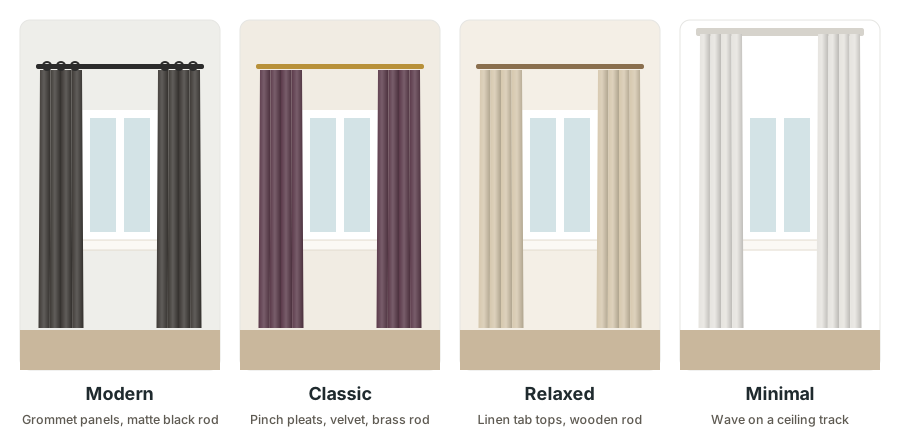
Modern
Clean lines, simple shapes and a restrained palette. Try:
- Grommet curtains in charcoal, stone, white or a deep solid colour.
- A slim matte black or brushed metal rod with simple finials.
- Plain fabrics with subtle texture, such as linen-look polyester or a fine weave.
- Sheers layered behind for daytime softness.
Classic and traditional
Elegant, tailored and rich. Try:
- Pinch pleat curtains in velvet, damask, jacquard or lined linen.
- A brass, bronze or dark wooden rod with decorative finials.
- Floor-length curtains with a slight break, and tiebacks or holdbacks.
- Warm, deep colours like burgundy, navy, emerald or gold, or soft traditional neutrals.
Relaxed and natural
Soft, casual and inviting. Try:
- Linen or cotton curtains in natural, oatmeal, sage or terracotta.
- Tab top, back tab or grommet headings.
- A wooden rod or a simple iron rod.
- Sheer linen layered behind, plants, rattan and woven textures nearby.
Our linen curtains guide covers the pros and cons of linen.
Minimal
Quiet, light and uncluttered. Try:
- Wave curtains on a ceiling-mounted track, running from ceiling to floor.
- White, warm white or pale grey sheers or semi-sheers.
- Curtains the same colour as the walls, so the room feels seamless.
- No visible rod, finials or tiebacks.
Bohemian and eclectic
Colourful, layered and personal. Try:
- Patterned curtains with prints, block prints or embroidered details.
- Earthy or jewel tones: rust, ochre, olive, teal and plum.
- Layered textures: sheers, linen, velvet and woven fabrics.
- Plants, baskets and mixed patterns elsewhere in the room.
Coastal
Light, breezy and fresh. Try white, sand or soft blue sheers or linen curtains on a whitewashed wooden rod, with plenty of fullness so they move in the breeze.
Choosing colours for the living room
Living rooms usually contain the most colours of any room: the sofa, rug, cushions, artwork, plants and wood tones all contribute. Curtains should tie these together rather than add another unrelated colour.
- Pick a colour from the rug or cushions for curtains that feel connected to the room.
- Choose tone-on-tone with the walls for a calm, sophisticated look.
- Go neutral if you like changing cushions and accessories with the seasons.
- Go bold with a deep colour like navy, forest green or rust, repeated in at least two other places.
- Match undertones: warm curtains with warm walls and wood; cool curtains with cool greys and whites.
Our guide on how to choose curtain colours explains these principles in detail.
Choosing fabrics for the living room
- Linen and linen-look: relaxed, textured and light-filtering. The most popular living room choice.
- Cotton: crisp, versatile and easy to care for.
- Velvet: rich and cosy, perfect for classic and dramatic rooms, and good for absorbing sound.
- Polyester blends: practical, fade-resistant and affordable, especially for sunny windows.
- Jacquard and textured weaves: add pattern and depth without busy prints.
- Sheers: for layering and soft daylight.
For most living rooms, light-filtering or lined curtains are the right choice. Room-darkening fabrics are useful in media rooms or rooms with strong afternoon sun. Our curtain fabrics guide compares them all.
Layering ideas for living rooms
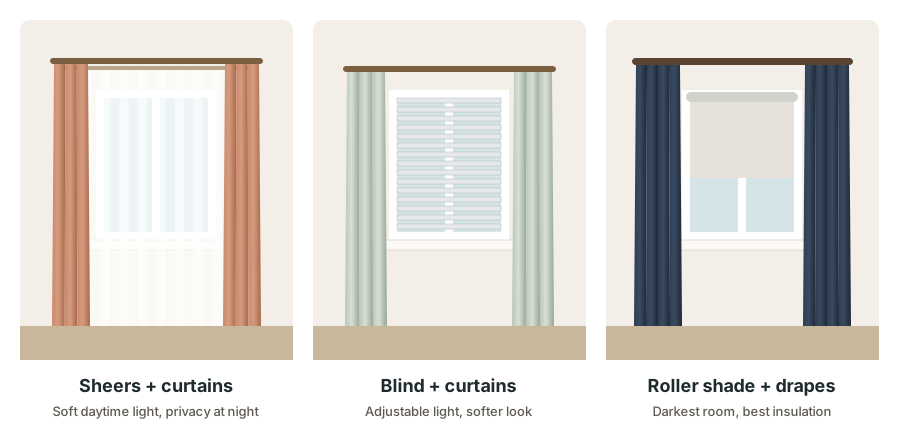
Sheers and curtains
The most popular living room combination. Sheers soften daylight and give daytime privacy; the main curtains add colour and close for evening privacy. Use a double rod. Our sheer curtains guide explains how to set it up.
Blinds and curtains
A wood or faux wood blind gives precise control over light and glare, while curtains add softness and colour. Mount the blind inside the window frame and the curtain rod above and beyond it. For a warm, natural look, see our guide to walnut venetian blinds.
Roman shade and side panels
A fabric roman shade does the practical work, while stationary curtain panels at each side frame the window. A smart choice for windows where full curtains wouldn't close easily, or where wall space is limited.
Solar shade and curtains
Solar shades cut glare and heat while keeping a view. Curtains in front add softness and night-time privacy. Ideal for very sunny living rooms.
Our guide to curtains, drapes, blinds and shades explains each product in detail.
Dealing with TV and screen glare
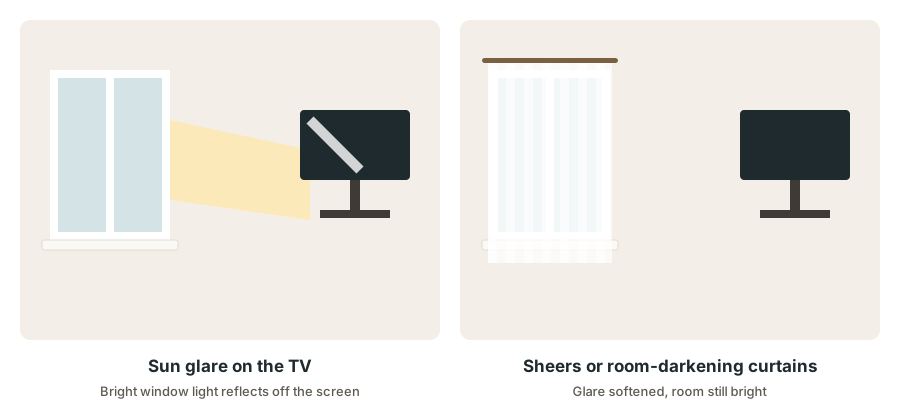
Glare on a TV screen is one of the most common living room complaints. A few fixes:
- Sheers diffuse direct sunlight enough to reduce reflections while keeping the room bright.
- Room-darkening curtains on the problem window give the strongest control for films and sport.
- Blinds let you tilt slats to bounce light away from the screen.
- Solar shades cut glare while keeping the view.
- Layering gives the most flexibility: sheers most of the time, heavier curtains when you watch.
If the TV faces a window, consider which window causes the reflection and treat that one first.
Ideas for different living room windows
A single standard window
Two floor-length panels on a rod mounted high and wide. Add sheers if the window faces the street or gets strong sun.
Several windows on one wall
Run one long rod across all the windows, with curtains at each end and between the windows. This makes the wall feel unified and the windows feel larger. Use enough centre brackets, and plan grommet panels around them.
Large picture windows
Use generous, floor-length curtains on a sturdy rod or track, with plenty of extension so the open curtains don't block the view. Consider wave curtains on a track for a sleek, modern look.
Sliding glass doors
Floor-length curtains on a long rod or track that extends well past the door on the opening side, so the curtains stack completely clear. Float the hem so it doesn't catch in the door track. Grommet and wave headings slide most easily.
Bay windows
A bendable track or jointed bay rod lets curtains follow the bay. Alternatively, use roman shades in each section with stationary side panels at the outer ends. Keep all curtains at the same length.
Corner windows
Two rods meeting at the corner, with a corner connector, or curtains on each window that stack at the outer ends, leaving the corner open.
Small or high windows
Hang curtains well above and beyond the window, in floor length, to make it look much bigger. If that's not practical, a roman shade gives a neat, tailored look.
Windows behind a sofa
Floor-length curtains can still work if there's a gap behind the sofa; otherwise choose sill-length curtains, a roman shade, or curtains that stack to the sides beyond the sofa.
Arched windows
Mount the rod above the arch so the curtains frame it without covering it, or use a flexible track that follows the curve for a custom look.
Small living room curtain ideas
- Choose light colours or curtains that match the walls so they don't close in the room.
- Hang the rod close to the ceiling with floor-length curtains to add height.
- Extend the rod so the open curtains sit on the wall, not the glass, letting in maximum daylight.
- Avoid heavy, bulky fabrics that stack wide and take up space.
- Use sheers for privacy without darkening the room.
- Choose simple headings like grommets or wave for a neat, slim stack.
For more ways to make a compact room feel bigger, read our full guide to curtains for small windows and small rooms.
Large living room curtain ideas
- Use richer, heavier fabrics like velvet or lined linen to add warmth and absorb sound in big, echoey rooms.
- Choose deeper colours to make the room feel cosier.
- Use bigger patterns, which suit large windows and walls.
- Add layers: sheers, curtains and perhaps a valance or pelmet for a finished look.
- Choose thicker rods, around 30 mm or more, which look in proportion in a large space.
Picture windows and patio doors need wide rods, plenty of panels and room for the curtains to stack. Our guide to curtains for large windows and sliding glass doors explains how to plan them.
Living rooms with a view
If your living room looks out onto a garden, the sea, a city skyline or greenery, curtains should frame the view rather than compete with it:
- Extend the rod generously so the open curtains sit fully on the wall, leaving all the glass clear.
- Choose colours that echo the view: greens near gardens, soft blues and sands near water, greys and blacks for city views.
- Use sheers rather than blinds for daytime privacy; they soften the view without breaking it into stripes.
- Keep patterns subtle, so the view stays the main feature.
Working around radiators, air conditioners and window seats
- Radiators and heaters under the window: floor-length curtains trap heat behind them. Use sill-length curtains, or floor-length curtains that stack to the sides and stay open while the heating is on.
- Wall-mounted air conditioners: keep curtains clear of the airflow. You may need a shorter rod extension on one side, or a ceiling track that runs below the unit.
- Window seats: use roman shades or sill-length curtains inside the recess, or floor-length curtains on the wall outside the seat area that frame the whole alcove.
- Built-in shelves beside the window: make sure the rod and stacked curtains won't cover them. Measure the stack-back carefully.
Finishing touches
Rods and finials
The rod is part of the look. Match its finish to other metals or woods in the room, such as lamp bases, picture frames or table legs. Thicker rods suit large windows and heavy curtains; slim rods suit small windows and light fabrics.
Tiebacks and holdbacks
Tiebacks hold curtains open in a graceful shape. Place them about one-third of the way up from the floor, or around sill height. Fabric, rope, tassel and metal holdbacks each create a different style.
Trims and borders
A contrasting band along the leading edge or the hem adds a tailored, custom touch, and can tie the curtains to other colours in the room.
Valances and pelmets
A fabric valance or a boxed pelmet across the top of the window hides the rod or track and adds a formal, finished look. They suit classic and traditional rooms especially well.
Curtains for open-plan living spaces
When the living room flows into the dining area and kitchen, curtains help define zones while keeping the space unified:
- Use the same fabric or colour family on all windows in the open space.
- Keep rod heights consistent across the whole wall or room.
- Change the treatment, not the colour, where function differs: full curtains in the living area, a roman shade or café curtain over the kitchen sink.
- Use curtains to soften large expanses of glass, which can make open-plan spaces feel echoey and exposed.
Curtains and sound in the living room
Living rooms with hard floors, large windows and minimal furniture can sound echoey. Curtains help absorb sound inside the room:
- Heavier fabrics such as velvet, lined linen and thick weaves absorb more sound than sheers.
- More fullness means more fabric and more absorption.
- Floor-length curtains cover more surface than short ones.
- Combined with rugs and soft furnishings, curtains can make a big difference to how comfortable a room sounds.
Curtains won't stop loud outside noise, but they make conversations and TV sound clearer and the room feel calmer.
Living rooms with children and pets
- Choose washable fabrics, such as polyester blends and washable cotton.
- Float the hem about 1 cm above the floor so curtains don't drag, collect hair or tempt pets to play.
- Avoid long trailing puddles and loose tiebacks within reach of young children.
- Choose cordless blinds and shades if you layer them behind curtains.
- Pick mid-tone colours or subtle textures, which hide marks and pet hair better than very light or very dark plain fabrics.
- Fix rods and brackets securely, since curtains are more likely to be pulled.
Motorised curtains for big living room windows
Large living room windows and sliding doors can carry a lot of heavy fabric. A motorised track opens and closes it smoothly at the press of a button, from a phone, or on a schedule. Closing curtains automatically during the hottest part of the afternoon keeps the room cooler and protects furniture from fading. Motorised tracks cost more than manual ones, but they can be worth it for windows you'd otherwise struggle to reach or open.
Seasonal living room styling
- Warmer months: keep sheers closed during strong sun, open the main curtains fully, and favour light linen and cotton.
- Cooler months: heavier lined or velvet curtains add warmth and cosiness; close them in the evening to keep heat in.
- Quick refresh: swap cushions and throws to match a new accent colour, keeping neutral curtains in place.
Living room curtain checklist
- Rod mounted high and wide, at the same height on every window.
- Floor-length curtains, floating about 1 cm or just touching the floor.
- Total width of about 2× the rod width.
- Colour that relates to the sofa, rug or cushions.
- A fabric that suits the style and the room's light.
- Sheers or blinds for glare and daytime privacy, if needed.
- A heading that slides easily.
- Rod finish that matches other metals or woods in the room.
Living room curtains on a budget
- Raise and widen the rod before buying anything; it often transforms the window for free.
- Buy more inexpensive panels rather than fewer expensive ones. Fullness matters more than price.
- Choose ready-made curtains in standard lengths, and adjust the rod height to fit.
- Layer inexpensive sheers behind existing curtains for an instant upgrade.
- Add a trim to plain curtains for a custom look.
- Steam and train curtains so they fall in neat folds. It costs nothing and looks professional.
Common living room curtain mistakes
- Rods hung right on the window frame, making windows look small.
- Curtains that stop above the floor by several centimetres.
- Skimpy panels that look flat and can't close properly.
- Curtains that block the glass when open, because the rod isn't wide enough.
- Colours that relate to nothing else in the room.
- Different curtain heights and styles on windows in the same room.
- Ignoring glare on the TV wall.
Frequently asked questions
What curtains are best for a living room?
Floor-length, light-filtering or lined curtains in linen, cotton, velvet or a quality polyester blend, hung high and wide with generous fullness. Add sheers for flexible light.
Should living room curtains touch the floor?
Yes, ideally. Floor-length curtains that float about 1 cm above the floor or just touch it look most elegant and make the room feel taller.
Should living room curtains match the sofa?
They don't need to match. They should relate to the sofa, rug or cushions through colour or tone.
Do I need blackout curtains in a living room?
Usually not. Light-filtering or room-darkening curtains are enough for most living rooms. Blackout can be useful for a media room or a window that causes strong TV glare.
Can I use different curtains on different windows in one living room?
It's best to use the same curtains, at the same height, on all windows in one room. The main exception is a feature window or a sliding door with a different treatment chosen to complement the others.
Are sheers enough for a living room?
They can be if privacy at night isn't important. For street-facing rooms, layer them with curtains or blinds.
How do I make cheap living room curtains look expensive?
Hang the rod high and wide, choose floor length, use generous fullness, steam out creases, train the folds for a few days, and choose a good-quality rod. These details matter more than the price of the fabric.
What length curtains for a living room with a low ceiling?
Floor-length curtains on a rod mounted just below the ceiling. This is the most effective way to make a low living room feel taller.
The bottom line
Great living room curtains start with the basics: a rod hung high and wide, floor-length curtains and generous fullness. Then choose a style, colour and fabric that suit your furniture and the mood you want, and add layers like sheers or blinds for flexible light, glare control and privacy. Finish with the right rod and a few tailored touches, and your living room will feel brighter, warmer and beautifully complete.
Keep reading
 Room Ideas
Bay window curtain ideas: how to measure, hang and style them
Bay windows are beautiful but tricky to dress. Here's how to choose between bent tracks, bay poles, separate rods and shades, how to measure every angle, and how to style a bay in any room.
 Room Ideas
Curtains for kids' rooms and nurseries: safety and style
Children's rooms need curtains that are safe, darken the room for sleep, wash easily and grow with your child. Here's how to choose curtains for nurseries and kids' bedrooms.
 Room Ideas
Curtains for large windows and sliding glass doors: a complete guide
Big windows and sliding doors need curtains that are wide enough, strong enough and easy to use. Here's how to measure, choose the hardware, fabric, fullness and style for large openings.