Styles
Grommet vs. pinch pleat vs. rod pocket: choosing a curtain heading

When people shop for curtains, they usually think about colour, pattern and fabric first. But there's another choice that affects how curtains look and work every single day: the heading. The heading is the top of the curtain, the part that attaches to the rod or track. It decides the shape of the folds, how easily the curtain slides, how much of the rod you see, how much light leaks over the top, and even how easy the curtain is to take down for washing.
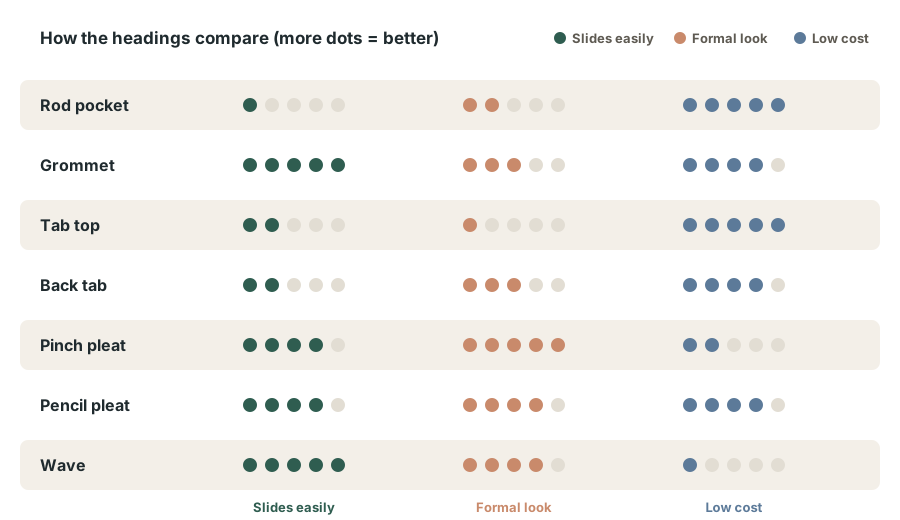
Three headings dominate ready-made curtains: grommet (also called eyelet), pinch pleat and rod pocket. Several others, including tab top, back tab, pencil pleat and wave, are also common. This guide compares them all in depth, so you can choose the right heading for each window in your home. If you're completely new to curtain terms, start with our beginner's guide to curtain types.
The quick verdict
- Choose grommet for a modern, easy-to-use curtain you'll open and close every day, on a standard rod, at a good price.
- Choose pinch pleat for a tailored, formal look with crisp, even folds, especially with heavier or lined fabrics.
- Choose rod pocket for curtains that mostly stay in place, sheers, café curtains and tight budgets.
- Choose wave for a sleek, hotel-style finish on a track, when budget allows.
- Choose tab top or back tab for relaxed, casual rooms where the curtains are opened only occasionally.
Grommet (eyelet) curtains in depth
How they're made
Large rings, usually metal or plastic, are fitted through holes punched along the top of the curtain. The rod passes through the rings, weaving in and out of the fabric. Because the fabric alternately goes in front of and behind the rod, it naturally forms deep, regular S-shaped folds.
How they look
Clean, modern and casual-to-smart. The folds are generous and even. When the curtains are closed, much of the rod is hidden behind the fabric; the top of the fabric sits slightly above the rod. The rings themselves become part of the design, so their finish (chrome, black, brass, bronze) matters.
How they work
Grommets slide very easily, because the smooth rings glide along the rod. This makes them one of the best choices for curtains opened and closed every day. They're also simple to hang: just thread the rod through.
Hardware
- A round rod that fits comfortably through the rings. Check the ring's inner diameter against the rod's diameter.
- Brackets at the ends only, or pass-through brackets. A standard centre bracket stops grommets sliding past it.
- Grommet curtains don't work on tracks.
Pros
- Very easy to open and close.
- Even, generous folds with little effort.
- Simple to hang and take down.
- Widely available and affordable.
- Modern look that suits most rooms.
Cons
- Need a compatible round rod; can't go on tracks.
- Centre brackets on long rods limit how the panels slide.
- Light can show through the grommet holes and above the rod on blackout curtains.
- Less formal than pleated headings.
- Washing machines can damage some grommets; check the care label.
Best for
Living rooms, bedrooms, family rooms, rentals and any room where curtains are opened every day.
Pinch pleat curtains in depth
How they're made
The top of the curtain is stiffened with buckram or heading tape, then folded into groups of two or three pleats at regular intervals and stitched at the base. Each pleat has a pocket on the back for a pin hook or a slot for a hook. The curtain hangs from rings on a rod, or from gliders on a track.
How they look
Tailored, structured and elegant. The pleats create neat columns of fabric that fall straight to the floor, giving a polished, custom-made appearance. Variations include double pleats (two folds), triple or French pleats (three folds), goblet pleats (rounded cups) and inverted box pleats (flat folds turned to the back).
How they work
Because they hang from rings or gliders, pinch pleat curtains slide smoothly and stack neatly to the sides when open. They hold their shape well over time.
Hardware
- A rod with rings (with eyelets at the bottom for hooks), or a curtain track with gliders.
- Pin hooks or slip-on hooks, depending on the curtain.
- Works on bay windows and long runs when used with a bendable track.
Pros
- Elegant, tailored look.
- Slides smoothly and stacks compactly.
- Works on rods or tracks, including curved bay tracks.
- Hook height can be adjusted to hide or show the rod.
- Ideal for heavy, lined and blackout fabrics.
Cons
- Usually more expensive than grommet or rod pocket curtains.
- More parts: rings, hooks and sometimes gliders.
- Taking down for washing means removing every hook.
- Can look too formal in very casual rooms.
Best for
Living and dining rooms with a classic or elegant style, bedrooms with heavy blackout curtains, made-to-measure curtains, and bay windows.
Rod pocket curtains in depth
How they're made
A channel, or pocket, is sewn across the top of the curtain. The rod slides through the pocket. Many rod pocket curtains also have a header: a few centimetres of fabric above the pocket that forms a frilled edge above the rod.
How they look
Soft and gathered. The fabric bunches along the rod into small, casual folds. The rod itself is completely hidden inside the pocket. With a header, the top looks ruffled and traditional; without one, it looks simple and neat.
How they work
This is the weak point. Fabric rubs directly on the rod, so rod pocket curtains are stiff to slide. Opening and closing them daily is tiring and can wear the fabric along the pocket. They're best for curtains that stay mostly in one position.
Hardware
- Any round rod that fits through the pocket, or a flat or slim tension rod.
- Often hung with tiebacks to hold them open.
Pros
- Usually the cheapest option.
- Simple construction with no extra hardware.
- Hides the rod completely.
- Blocks light well at the top, because there are no gaps above the rod.
- Great for sheers, café curtains and valances.
Cons
- Hard to open and close.
- Gathers can look untidy and need re-arranging.
- Bulky, uneven stack when open.
- Fabric along the pocket wears with frequent use.
Best for
Stationary side panels, sheers behind heavier curtains, café curtains in kitchens and bathrooms, valances and budget projects.
Other headings worth considering
Tab top
Fabric loops sit over the rod, with gaps between them where the rod shows. Relaxed and informal, ideal for cottage, farmhouse, coastal and children's rooms. Tabs drag on the rod, so they slide only moderately well, and the gaps let some light through at the top.
Back tab (hidden tab)
Loops on the back of the curtain hold it on the rod, hiding the rod behind a flat top edge. The folds are soft and tailored. Many back tab curtains also have a rod pocket, so they can be hung either way. Sliding is better than a rod pocket but not as smooth as grommets or rings.
Pencil pleat
A gathering tape on the back is pulled tight to create rows of narrow, pencil-like pleats. Popular in the UK, Europe and Australia. Flexible, because the tape can be gathered to suit different widths, and it works on tracks or rods with rings. The look is traditional and slightly busier than pinch pleats.
Wave (ripplefold)
The curtain is attached to evenly spaced carriers on a special track, forming smooth, continuous S-curves that look identical inside and out. It's the sleekest, most modern heading and glides effortlessly. It needs a dedicated track and tape, so it's usually the most expensive choice, often made to measure.
Clip rings on flat panels
Any flat-topped curtain can be hung with clip rings. The clips hold the top edge, and the rings slide on the rod. It's a flexible, affordable way to get a ring-top look, and it adds a few centimetres of length.
How each heading attaches to the rod
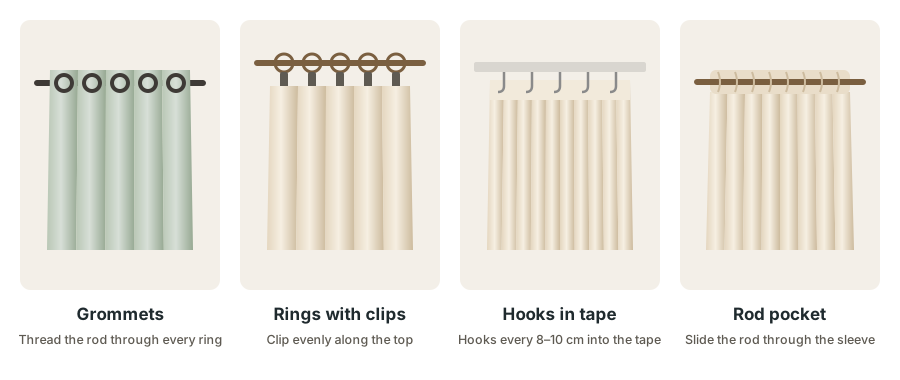
The way a heading attaches affects how quickly you can take curtains down for washing, which hardware you need, and how smoothly they move. Grommets and rod pockets attach directly to the rod. Pinch pleats, pencil pleats and clip-top curtains hang from rings or gliders, adding a moving part between the fabric and the rod, which is why they slide so freely. Our step-by-step guide on how to hang curtains shows how to put each type up.
Head-to-head: the details that matter
| Feature | Grommet | Pinch pleat | Rod pocket |
|---|---|---|---|
| Look | Modern, deep even folds | Tailored, structured columns | Soft, gathered, casual |
| Daily opening and closing | Excellent | Excellent | Poor |
| Hardware | Round rod only | Rod with rings, or track | Any rod that fits the pocket |
| Works on a track | No | Yes | No |
| Light at the top | Some above the rod and through rings | Depends on hook height | Very little |
| Stack when open | Neat | Compact and tidy | Bulky |
| Taking down to wash | Easy | Remove every hook | Easy |
| Typical fullness | 1.5–2× | 2–2.5× (fabric before pleating) | 2–2.5× |
| Typical cost | Low to medium | Medium to high | Low |
For more on how much fabric each heading needs, see our guide to curtain fullness.
How each heading stacks when open
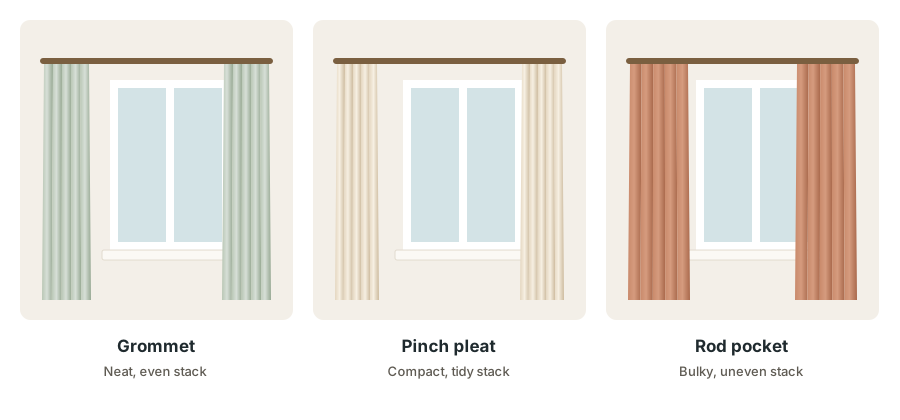
The stack-back is the bundle of fabric at each side when curtains are open. A compact stack leaves more of the window clear and needs less wall space. Pinch pleats and wave headings stack most neatly, grommets nearly as well, and rod pockets the least tidily. If space beside your window is tight, this can decide the heading for you. Our guide on how high and wide to hang curtain rods explains how to plan for stack-back.
Headings and blackout curtains
If darkness matters, the heading affects how much light sneaks in at the top:
- Rod pocket seals the top well, because the fabric wraps the rod with no gaps, but it's impractical for curtains opened daily.
- Grommet curtains let light shine above the rod and sometimes through the gaps around the rings. Mounting the rod close to the ceiling, or adding a valance, helps.
- Pinch pleat curtains with hooks set low in the pleat, so the heading stands above the rod or track, block light at the top well.
- Wave curtains on a ceiling track block light at the top very effectively.
Our blackout curtains guide covers all the ways to stop light gaps.
Matching the heading to the fabric
- Heavy fabrics (velvet, lined and blackout curtains): pinch pleat on rings or a track, or grommet. Both handle the weight well and slide easily. Rod pockets become very stiff with heavy fabric.
- Sheers and voiles: rod pocket (when stationary), wave, or pencil pleat. Sheers need plenty of fullness, and these headings gather it softly.
- Linen and relaxed cottons: grommet, back tab, tab top or soft pinch pleats, which suit linen's casual character.
- Large patterns: pinch pleats or grommets at moderate fullness show the pattern best. Tight gathers, like pencil pleats, hide much of the design.
- Stiff or crisp fabrics: pinch pleats, which use the fabric's structure to hold neat columns.
What you really pay for each heading
The price of the curtain is only part of the cost. Consider the whole setup:
- Rod pocket: the curtain and a simple rod. The cheapest setup overall.
- Grommet: the curtain and a compatible round rod with finials. Still affordable, with no extra parts.
- Pinch pleat: the curtain, a rod with rings or a track with gliders, and hooks. Ready-made pinch pleat curtains have become more affordable, but the extra hardware adds up.
- Wave: the curtain, a dedicated track and the wave tape and carriers. Usually the most expensive, and often made to measure.
If you already own a good rod, choosing a heading that works with it can save a lot of money.
Ready-made vs. made-to-measure headings
Most ready-made curtains come with grommet, rod pocket, back tab or tab top headings, because they're simple to manufacture. Ready-made pinch pleat and pencil pleat curtains are widely available too. Made-to-measure curtains offer every heading, including wave and hand-finished pleats, in the exact width and length you need. If your windows are an unusual size, or you want a specific heading in a specific fabric, made-to-measure may be worth the extra cost.
Choosing a heading for each room
Living room
Grommet for a relaxed, modern room; pinch pleat for a more formal or traditional room. Both open and close easily.
Bedroom
Grommet or pinch pleat blackout curtains. Pinch pleats on a track or ceiling-mounted rod give the best light seal at the top.
Dining room
Pinch pleat for elegance, often with lined fabric and a floor-length or break hem.
Kitchen and bathroom
Rod pocket café curtains, tier curtains or valances on simple rods. They stay in place and are easy to remove for washing.
Children's rooms
Grommet or tab top in washable fabrics. Avoid small hooks and loose parts within reach of young children.
Large windows and sliding doors
Wave or pinch pleat on a track, or grommet on a long rod with pass-through brackets, so the curtains can travel the full width.
Bay windows
Pinch pleat or pencil pleat on a bendable track, so one curtain can follow the curve of the bay.
Rentals
Grommet or clip-ring curtains. They're easy to take with you and work on most standard rods.
Changing the heading on curtains you already own
If you love your curtains but not their heading, you have options:
- Rod pocket to ring-top: add clip rings along the top edge. The curtain will now slide easily. This works best if the curtain is long enough to lose a little height, or if you remove the header.
- Flat panel to pleated: use pleater hooks, which slip into a pleating tape sewn or ironed onto the back, to create pinch pleats.
- Any curtain to pencil pleat: sew a pencil pleat tape across the back of the top edge.
- Grommet to something else: this is harder because of the holes. Folding the top over and adding a heading tape below the grommets is possible, but the curtain becomes shorter.
Small alterations like these are well within reach of a beginner sewer, or any local tailor or alteration shop.
Mixing headings in one home
It's perfectly fine to use different headings in different rooms. Practical rooms need practical headings, and formal rooms suit formal ones. Within one room, though, try to keep headings consistent so the windows look like a set. The main exception is layering: rod pocket sheers behind grommet or pinch pleat curtains on a double rod is a classic, effective combination.
A quick glossary of heading terms
- Buckram: a stiff fabric inside a pleated heading that keeps the pleats upright.
- Heading tape: a band sewn across the back of the curtain top, with pockets for hooks or cords for gathering.
- Pin hook: a sharp metal hook pushed into the back of a pinch pleat, used to hang it from a ring or glider.
- Glider (runner): a small part that slides inside a curtain track and holds a hook.
- Carrier: the evenly spaced glider used with wave curtains, linked to keep the folds regular.
- Header: the frill of fabric above the pocket on a rod pocket curtain.
- Return: the part of the curtain that turns back to the wall at the outer edge, covering the bracket and blocking side light.
- Overlap: extra fabric where the two panels meet in the middle, so they cross when closed.
- Pass-through bracket: a centre bracket shaped so rings or grommets can slide past it.
- Finial: the decorative end piece on a curtain rod, which also stops rings sliding off.
Common heading mistakes
- Choosing rod pocket for curtains you open daily. They'll frustrate you every morning.
- Buying grommet curtains for a track. They can't hang on one.
- Buying a rod too thick for the grommets. Check the ring's inner diameter.
- Placing a centre bracket where grommets need to slide. Plan panel positions around it, or use a pass-through bracket.
- Forgetting rings and hooks for pinch pleat curtains. Buy them together.
- Choosing a heading for looks without considering the hardware you already have. Changing rods and tracks adds cost.
Frequently asked questions
Which curtain heading is best?
For most people, grommet is the best all-round choice: it looks modern, slides easily and is affordable. Pinch pleat is best for a formal, tailored look. Rod pocket is best for curtains that stay in place.
Are pinch pleat curtains old-fashioned?
No. Pinch pleats are a timeless, tailored style used in modern homes and hotels. In clean, simple fabrics they look very current.
Do grommet curtains block light?
The fabric blocks light as well as any other heading, but some light can escape above the rod and through the ring gaps. Mounting the rod higher or adding a valance helps.
Can grommet curtains be used with a centre bracket?
Yes, but the panels can't slide past it. Hang one panel on each side, or use a pass-through bracket designed for grommets.
Which heading is easiest to wash?
Grommet and rod pocket curtains are easiest to take down, because there are no hooks to remove. Check whether grommet curtains are machine washable, since some rings can be damaged.
What's the difference between pinch pleat and pencil pleat?
Pinch pleats are separate groups of stitched folds with flat spaces between them. Pencil pleats are continuous narrow gathers created by pulling cords in a tape.
The bottom line
Choose the heading by how you'll use the curtains, then by style. For daily use, grommet and pinch pleat are the winners: grommet for modern simplicity and value, pinch pleat for tailored elegance. Save rod pocket for curtains that stay put, sheers and café curtains. Consider wave for a sleek, high-end finish, and tab tops for relaxed rooms. Match the heading to your rod or track, plan for stack-back, and your curtains will look good and be a pleasure to use.
Keep reading
 Styles
Oak wooden blinds: shades, slat sizes, real oak vs oak-effect, and care
Oak wooden blinds bring light, natural warmth to any room. Compare oak shades, real wood and oak-effect options, slat sizes and tapes, and learn how to style and care for them.
 Styles
Fitted horizontal blinds: a complete guide to made-to-measure blinds that fit perfectly
Fitted horizontal blinds are made to the exact size of your window, so they look neat and control light properly. Compare types, fitting methods, measuring and care.
 Styles
Blackout roman shades: how to choose, measure and fit them for a truly dark room
Blackout roman shades combine soft fabric folds with real darkness. Learn the styles, linings, mounts, measuring, cord safety and tricks that stop light leaking around the edges.