Measuring
Curtain fullness explained: how wide should curtains be?

Have you ever closed a pair of curtains and found them stretched flat across the window, with a gap at each side and no folds at all? Or noticed how hotel curtains always look thick and generous, while your own look thin even though the fabric seems similar? The difference is almost always fullness.
Fullness is simply how much curtain fabric you have compared with the width of the rod. It's the single most overlooked part of buying curtains, and it makes a bigger difference to the final look than the fabric, the colour or the price. Generous fullness makes inexpensive curtains look expensive. Too little fullness makes expensive curtains look cheap.
This guide explains what fullness is, how much you need for each type of curtain, and how to calculate exactly how many panels or how much fabric to buy, with step-by-step worked examples.
What is curtain fullness?
Fullness is the total width of your curtain fabric divided by the width of the rod or track it hangs on:
Fullness = total curtain width ÷ rod width
It's written as a ratio, such as 1.5×, 2× or 2.5×. If you have a 200 cm rod and two curtain panels that are each 200 cm wide, you have 400 cm of curtain on a 200 cm rod, which is 2× fullness.
At 1× fullness, the fabric is exactly as wide as the rod. When closed, it lies flat with no folds, like a sheet pinned to a wall. At 2× fullness, there's twice as much fabric as rod, so the curtain gathers into soft, even waves when closed. At 3×, the folds become deep and very full.
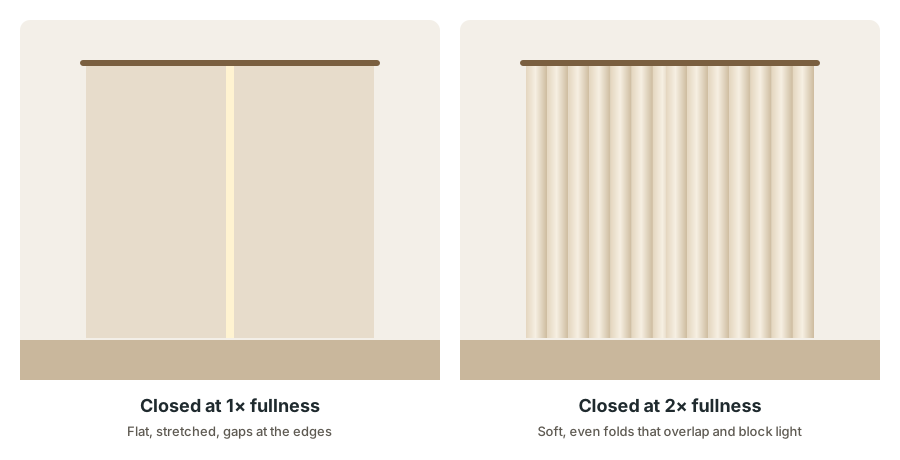
Why fullness matters so much
- Looks: folds create depth, shadow and texture. Flat curtains look thin, cheap and unfinished, even in beautiful fabric.
- Coverage: curtains with fullness can close completely and overlap in the middle and at the sides. Flat curtains often leave gaps.
- Light blocking: folds add layers of fabric and close gaps, so fuller curtains block more light. This is especially important for blackout curtains.
- Insulation: fuller curtains trap more air, which helps them keep rooms warmer or cooler.
- Sound: more fabric absorbs more sound, softening echoes in the room.
- Durability: curtains that are stretched tight to close strain their seams, grommets and hooks.
How much fullness do you need?
The right fullness depends mainly on the heading, because each heading uses fabric differently, and on the fabric weight.
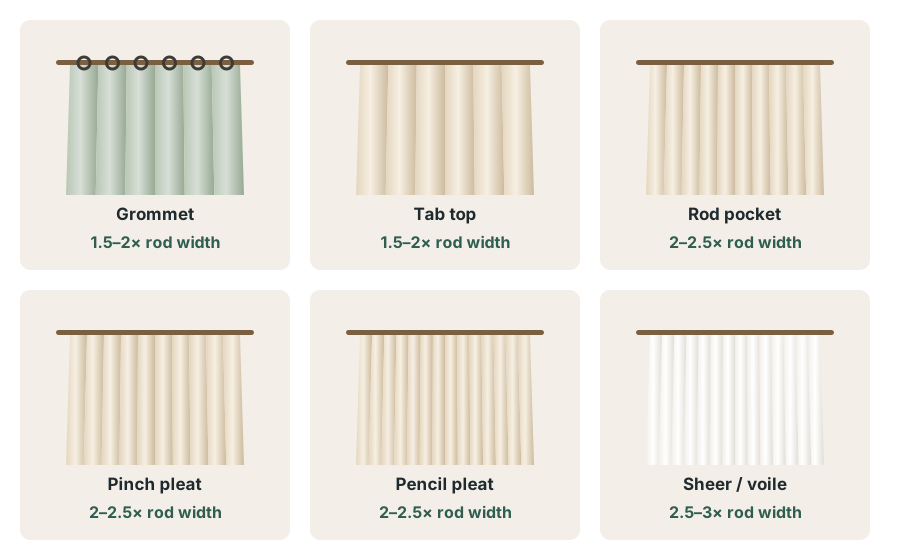
| Heading or fabric | Typical fullness | Why |
|---|---|---|
| Grommet / eyelet | 1.5–2× | Grommets create deep folds naturally; too much fabric makes them bunch and stack wide. |
| Tab top / back tab | 1.5–2× | Similar to grommets; folds form between the tabs. |
| Rod pocket | 2–2.5× | Fabric gathers along the rod, so it needs more width to look full. |
| Pinch pleat (fabric before pleating) | 2–2.5× | Pleats use up fabric; the finished curtain covers the rod with crisp folds. |
| Pencil pleat (fabric before gathering) | 2–2.5× | The tape gathers the fabric tightly. |
| Wave / ripplefold | About 2–2.5× | Set by the track carriers and tape; the supplier usually calculates it. |
| Sheers and voiles | 2.5–3× | Thin fabric looks flat unless it has plenty of folds. |
| Heavy fabrics (velvet, interlined) | Lower end of the range | Thick fabric is bulky; too much makes stacking difficult. |
Within each range, choose the lower number for a cleaner, more tailored look or when budget is tight, and the higher number for a lush, luxurious look or for very light fabrics.
Calculating fullness for ready-made curtains
Ready-made curtains are sold as panels of a fixed width. Here's how to work out how many you need.
Step 1: Measure the rod width
Measure the length of the rod between the finials, or the width you plan to cover. If you haven't installed the rod yet, it's the window frame width plus the extensions on each side. Our guide on how to measure windows for curtains explains this.
Step 2: Multiply by your chosen fullness
This gives the total width of curtain fabric you need.
Step 3: Divide by the panel width and round up
Divide the total width by the width of one panel. Always round up to the next whole panel, then split the panels evenly between the two sides of the window.
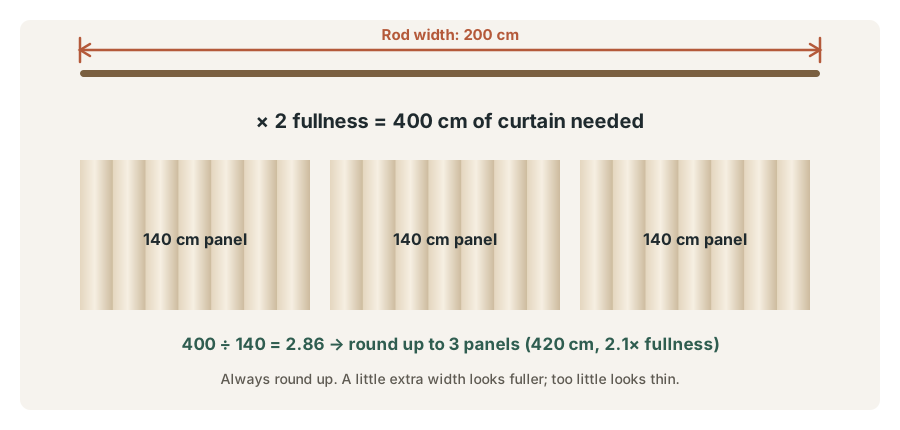
Worked example 1: a standard living room window
- Rod width: 180 cm
- Heading: grommet, target fullness 1.5× (a clean, tailored look)
- Total width needed: 180 × 1.5 = 270 cm
- Panel width: 140 cm
- Panels: 270 ÷ 140 = 1.93 → round up to 2 panels (280 cm, about 1.56× fullness)
Two panels, one on each side, give a neat result. For a fuller, more luxurious look at 2×, you'd need 360 cm: 360 ÷ 140 = 2.57 → 3 panels (420 cm, about 2.3×). With three panels, hang two on one side and one on the other, or look for wider panels so you can keep two.
Worked example 2: a wide window with sheers
- Rod width: 240 cm
- Fabric: voile sheers, target fullness 2.5×
- Total width needed: 240 × 2.5 = 600 cm
- Panel width: 140 cm
- Panels: 600 ÷ 140 = 4.3 → round up to 5 panels (700 cm, about 2.9×)
Sheers are inexpensive, so extra panels add a lot of richness for little cost. You could also use 4 panels (560 cm, about 2.3×) for a lighter look.
Worked example 3: blackout curtains in a bedroom
- Rod width: 160 cm
- Heading: grommet blackout, target fullness 1.5–2×
- Total width needed: 240–320 cm
- Panel width: 132 cm
- Two panels: 264 cm, about 1.65× fullness
Two panels work well, and leave enough fabric for the panels to overlap in the middle and wrap toward the wall at the sides, which helps block light. Our blackout curtains guide explains why overlap matters.
Quick reference: how many panels?
These figures assume 2 panels per window unless stated, and 2× fullness. Panel widths vary by brand, so always check the product:
| Rod width | Total curtain width at 2× | With ~140 cm panels |
|---|---|---|
| 100 cm | 200 cm | 2 panels (280 cm, 2.8×); narrower panels also work |
| 150 cm | 300 cm | 2 panels (280 cm, 1.9×) |
| 200 cm | 400 cm | 3 panels (420 cm, 2.1×) |
| 250 cm | 500 cm | 4 panels (560 cm, 2.2×) |
| 300 cm | 600 cm | 4–5 panels (560–700 cm) |
| 400 cm | 800 cm | 6 panels (840 cm, 2.1×) |
Fullness for made-to-measure curtains
Made-to-measure curtains are usually ordered by their finished width, the width of the curtain after it has been pleated or gathered. The maker adds the fullness for you.
To order, you normally provide:
- Rod or track width.
- Overlap: extra width so the two panels cross in the middle when closed, often around 5–10 cm per panel on tracks with overlapping arms.
- Returns: extra width at each outer edge so the curtain can wrap back to the wall around the bracket, roughly equal to the bracket's projection.
- Heading and fullness: for example, "double pinch pleat at 2.25× fullness".
Different makers use different conventions, so ask how they want the width given and whether overlaps and returns are included.
Fullness when sewing your own curtains
If you're making curtains, you'll work out the fabric in "widths", meaning the full width of fabric as it comes off the roll.
- Multiply the rod width by your fullness. Example: 200 cm × 2 = 400 cm.
- Add side hems: about 5–8 cm per side of each curtain, so roughly 20–30 cm for a pair.
- Add any overlap and returns if you're using them.
- Divide by the usable fabric width (the width minus the selvedges) and round up. Most curtain fabrics are around 137–150 cm wide; many sheers come in extra-wide widths of 280–300 cm.
- Multiply the number of widths by the cut length (finished length plus hem and heading allowances) to find how much fabric to buy.
- Add extra for pattern matching if the fabric has a pattern repeat: add one repeat per width of fabric.
For example, 430 cm of fabric needed (including hems), using 140 cm fabric with about 134 cm usable: 430 ÷ 134 = 3.2 → 4 widths. You'd split them as two widths per curtain. If your cut length is 260 cm, you'd buy 4 × 260 = 1,040 cm, about 10.5 metres, plus pattern repeats if needed.
For a full walk-through of measuring, cutting and sewing a pair of curtains, read how to sew simple unlined curtains.
Fullness and stack-back
More fullness means more fabric to gather at the sides when the curtains are open. That bundle is called the stack-back. Fuller curtains stack wider, so they need longer rod extensions beyond the window if you want the glass to stay clear when open.
If space beside the window is limited, for example near a corner, choose lower fullness or a lighter fabric so the stack is narrower. Our guide on how high and wide to hang curtain rods explains stack-back in detail.
Fullness for different fabrics
Light fabrics
Voiles, thin cottons and light linens need more fullness, 2.5–3×, because they have little body of their own. With too little fullness they look flat and see-through.
Medium fabrics
Most cottons, linen blends and polyester curtain fabrics look good at 1.75–2.5× depending on the heading.
Heavy fabrics
Velvet, heavy lined fabrics and blackout curtains look rich even at the lower end of the range, around 1.5–2×. Going much higher makes them bulky and hard to stack.
Patterned fabrics
Large patterns show best with moderate fullness, around 1.5–2×, because deep folds hide much of the design. Small patterns and plain fabrics can take more fullness.
When less fullness is better
- Stationary side panels that never close: they only frame the window, so one narrow panel per side is enough.
- Large-pattern fabrics you want to show off.
- Minimalist, modern rooms, where a flatter, cleaner look suits the style.
- Tight spaces beside the window, where a wide stack-back would block the glass.
- Roman shades and flat panels, which are designed to be flat.
Fullness and cost: a simple comparison
It's easy to assume that a more expensive fabric will make curtains look better. In practice, fullness usually makes the bigger difference. Imagine a 200 cm rod and two options:
- Option A: two premium panels, each 140 cm wide, at a high price per panel. Total width 280 cm, which is 1.4× fullness. When closed, the curtains look slightly stretched, and they barely meet in the middle.
- Option B: three mid-priced panels, each 140 cm wide. Total width 420 cm, which is 2.1× fullness. When closed, they fall in soft, even folds and overlap comfortably.
Even if Option B costs about the same or less, most people find it looks richer and more expensive on the window. The extra panel also blocks more light, insulates better and lasts longer, because no seam or grommet is under strain.
The lesson: decide your fullness first, then choose the best fabric your budget allows at that fullness.
Fullness and how you'll use the curtains
- Curtains you open and close daily: choose a heading that slides well (grommets, rings or a track) and stay in the middle of the fullness range, so they're full but not heavy to move.
- Curtains that stay closed most of the time, such as in a media room: you can go fuller for a luxurious look and better sound absorption.
- Curtains that stay open most of the time: fullness affects the size of the stack at the sides more than the closed look, so make sure the stack fits on the wall.
Budget tips: getting fullness for less
- Buy one more inexpensive panel rather than fewer expensive ones. Fullness matters more than fabric price.
- Choose wider panels where available. Fewer seams, and often better value per centimetre.
- Mix layers: inexpensive full sheers behind heavier curtains add richness without needing extra heavy panels.
- Use stationary side panels with a blind or shade doing the work, if the curtains don't need to close.
- Train the folds after hanging, so the fabric you have falls in neat, even pleats.
What each level of fullness looks like
If the numbers feel abstract, this description of each level may help you picture the result:
- 1× (no fullness): the curtain lies flat when closed, like a sheet of paper. It may not close fully, and gaps appear at the edges. Only suitable for flat panels and roman shades.
- 1.25×: very gentle waves. The curtain looks thin and slightly stretched when closed. Acceptable for stationary side panels, but rarely for curtains that close.
- 1.5×: soft, relaxed folds. A clean, modern look, and the minimum for most grommet and tab curtains.
- 2×: generous, even folds. The standard for most good-quality curtains, and a safe choice if you're unsure.
- 2.5×: rich, deep folds. A luxurious, tailored look, typical of pinch pleats and made-to-measure curtains.
- 3×: very full and soft. Ideal for sheers and voiles; usually too bulky for heavy fabrics.
How to check the fullness of curtains you already have
- Take one panel down and lay it flat, or open it fully on the rod and pull it straight.
- Measure its flat width from edge to edge. For pleated or gathered curtains, measure the width of the fabric as it hangs ungathered, if possible, or check the product details.
- Add up the widths of all panels on the rod.
- Divide by the rod width. If the result is below about 1.5×, adding fabric will make a visible difference.
How to add fullness to existing curtains
If your current curtains look thin, you don't necessarily need to replace them:
- Add another matching panel on each side, or one in the middle of a wide window.
- Add contrasting panels. A complementary colour or pattern at each outer edge can look deliberate and stylish, and gives you extra width.
- Layer sheers behind them on a double rod. The sheer adds depth and softness, so the room looks fuller even if the front curtains stay the same.
- Shorten the rod slightly, if your extensions are generous. Less rod width with the same fabric means more fullness, though the curtains will stack a little more on the glass.
- Change the heading. Switching from flat clip rings to a pleated look with pleater hooks or a gathering tape can make existing fabric look fuller.
- Train the folds so the fabric you have falls in even, deep pleats instead of random waves.
Fullness for special windows
Sliding glass doors
Wide doors need a lot of fabric. Use the same fullness as a normal window, but remember that the curtains must stack completely clear of the door opening, so allow plenty of rod extension on the opening side. Grommets and wave headings stack most neatly.
Bay windows
Calculate fullness for the total length of the bay track or rod, following its shape. If you use separate curtains for each section, calculate each section separately and make sure each has enough fullness on its own.
French doors
Curtains on French doors need to open fully clear of the doors. Calculate fullness on the full rod width, and make sure the stack-back fits on the wall beside the doors so they can still open.
Very narrow windows
A single panel pulled to one side often looks better than two thin panels. Aim for a panel that's at least 1.5–2 times the window width so it looks generous when closed.
Very wide windows
Wide windows may need four, six or more panels. Using several standard panels side by side is fine; when closed, the joins disappear into the folds. Make sure the rod has enough centre brackets, and if you use grommet curtains, plan which panels go on each side of each bracket.
Very wide windows and sliding doors often need four to eight panels. Our guide to curtains for large windows and sliding glass doors includes a worked example of how many to buy.
Common fullness mistakes
- Buying panels that add up to the rod width. That's 1× fullness: flat and thin.
- Forgetting that panel widths are per panel. A "pair" may already include two panels; a single panel listing is for one.
- Ignoring the heading. Rod pockets and sheers need more fabric than grommets.
- Too much fullness with heavy fabric. It bunches, stacks wide and is hard to open.
- Not rounding up. When the calculation lands between panel numbers, round up.
- Forgetting stack-back. Fuller curtains need more wall space beside the window.
Frequently asked questions
How wide should curtains be compared to the window?
The total width of all panels should be about 1.5–2× the rod width for grommet and tab curtains, 2–2.5× for pleated and rod pocket curtains, and 2.5–3× for sheers. The rod itself is usually wider than the window.
Is 2× fullness enough?
Yes. 2× is a good, generous fullness for most curtains. Sheers look better at 2.5–3×, and grommet curtains can look good from 1.5×.
How many curtain panels do I need for a 200 cm rod?
At 2× fullness you need about 400 cm of curtain. With 140 cm panels, that's three panels. With wider panels, two may be enough.
Can curtains be too full?
Yes. Too much fabric, especially heavy fabric, bunches awkwardly, is hard to open and stacks very wide. Stay within the recommended range for your heading.
Does fullness matter for curtains that don't close?
Much less. Decorative side panels that never close only need to look full at the sides, so one standard panel per side is usually enough.
Do blackout curtains need more fullness?
They need enough to overlap in the middle and at the sides when closed, so around 1.5–2×. Because blackout fabric is heavy, you rarely need more.
The bottom line
Fullness is the ratio of curtain fabric to rod width, and it's the secret to curtains that look generous and finished. Aim for 1.5–2× for grommet and tab curtains, 2–2.5× for pleated and rod pocket curtains, and 2.5–3× for sheers. Multiply your rod width by the fullness, divide by the panel width, and always round up. If you have to choose between more fabric and a fancier fabric, choose more fabric: your curtains will look better for it.
Keep reading
 Measuring
Curtain rods and tracks: a complete guide to choosing the right hardware
Rods or tracks? Which diameter, length and brackets? This guide explains every type of curtain rod and track, how to size them, and how to choose hardware that fits your curtains and windows.
 Measuring
Curtain length guide: sill, apron, floor or puddle?
Curtain length changes how tall a room feels, how big a window looks and how well curtains block light. Here's how to choose the right length for every room, and how to get it exactly right.
 Measuring
How high and wide to hang curtain rods (with simple rules)
Where you hang the rod changes how big your windows look, how much light gets in, and how well curtains block it. Here are simple rules for every ceiling and window.