Measuring
Curtain length guide: sill, apron, floor or puddle?

Of all the decisions you make when buying curtains, length has the biggest effect on how the finished window looks. The same fabric in the same colour can make a room feel taller and more elegant, or shorter and slightly awkward, depending only on where the hem ends.
Length also affects how practical your curtains are. Curtains that drag on the floor collect dust and get caught in doors and vacuum cleaners. Curtains that stop in mid-air look like they shrank. Curtains that cover a radiator block its heat. And curtains that are too short let light leak in underneath.
This guide explains every standard curtain length, gives the exact measurements for each, and shows you how to choose the right one for each room, each ceiling height and each type of window. It also covers what to do when curtains turn out too long or too short.
The five curtain lengths at a glance
| Length | Where the hem sits | Best for |
|---|---|---|
| Sill | About 1 cm (½ in) above the window sill | Kitchens, bathrooms, windows over radiators, sinks, counters or beds |
| Apron | About 10–15 cm (4–6 in) below the sill | Bedrooms, children's rooms, cottages, windows above furniture |
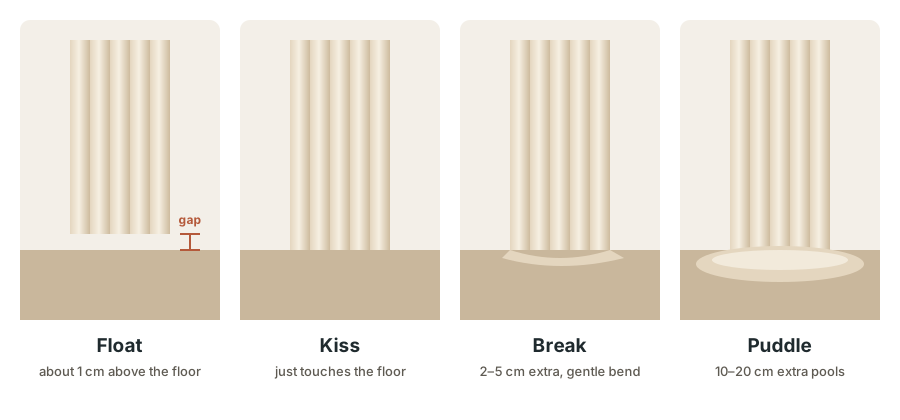
| Floor (float or kiss) | About 1 cm above the floor, or just touching it | Living rooms, bedrooms, dining rooms; the most popular choice |
| Break | 2–5 cm (1–2 in) longer than the floor, so the hem bends slightly | Relaxed, tailored look; better light blocking at the bottom |
| Puddle | 10–20 cm (4–8 in) longer than the floor, pooling on it | Formal, romantic rooms; curtains that are rarely opened |
If you're not sure, choose floor length. It suits almost every room, makes ceilings feel higher and windows look bigger, and is the easiest length to get right with ready-made curtains.
Sill length
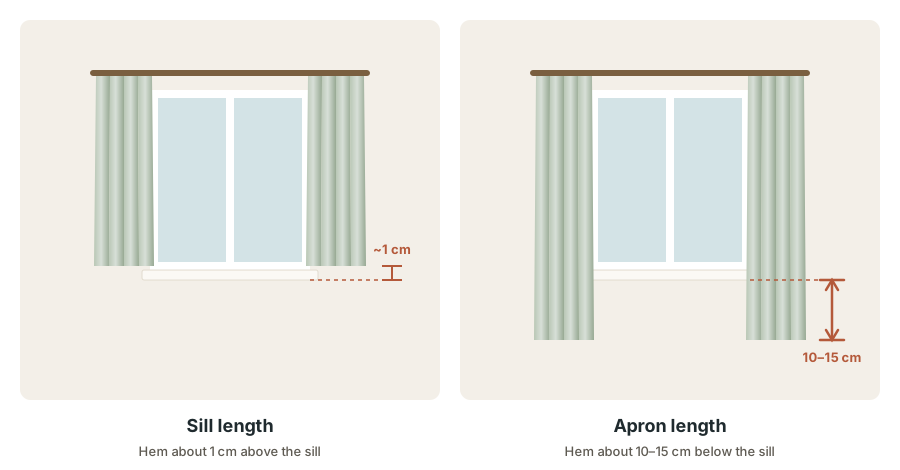
Sill-length curtains end about 1 cm (½ inch) above the window sill. Leaving that small gap stops the hem from resting on the sill, where it would bunch, pick up dust and wear more quickly.
When to choose sill length
- Kitchens: curtains stay clear of the sink, counter and cooking area.
- Bathrooms: less fabric near water and humidity.
- Windows above radiators or heaters: floor-length curtains would trap heat behind them and send it out the window instead of into the room.
- Windows above beds, desks, sofas or window seats: the curtain doesn't hang over the furniture.
- Deep window recesses: sill-length curtains can hang inside the recess for a neat, built-in look.
Tips for sill-length curtains
- Measure to the top of the sill, not to the bottom of the window frame.
- If the sill sticks out from the wall, mount the rod on brackets with enough projection so the curtain clears the sill.
- Keep the gap consistent. A curtain that touches the sill on one side but not the other looks untidy, so measure on both sides.
Apron length
Apron-length curtains extend about 10–15 cm (4–6 inches) below the sill. They cover the lower part of the window frame and give a slightly fuller, more finished look than sill length, without going all the way to the floor.
When to choose apron length
- Bedrooms and children's rooms where furniture sits below the window.
- Cottage, farmhouse and casual styles.
- Windows that sit high on the wall, where floor-length curtains would look out of proportion.
- Rooms where you want a little more coverage than sill length but floor length isn't practical.
When to avoid it
Apron length can look like a mistake if it ends at an awkward point, such as halfway between the sill and the floor. If the hem would end much lower than 15 cm below the sill, it usually looks better to go all the way to the floor instead.
Floor length
Floor-length curtains reach the floor, either just touching it or floating slightly above it. They're the most popular length in living rooms, bedrooms and dining rooms because they create long, unbroken vertical lines that draw the eye upward, make ceilings feel higher and windows look larger.
Float
A floating hem ends about 1 cm (½ inch) above the floor. It looks crisp and tailored, and it's the most practical floor length: the curtains don't collect dust, don't drag when you open them, and don't get caught by robot vacuums, pets or doors.
Keep the gap small. A gap of more than about 2 cm starts to look like the curtains are too short.
Kiss
A kissing hem just touches the floor. It looks precise and polished, but it's the hardest length to get exactly right, because floors are rarely perfectly level and fabrics can shrink or stretch slightly. A curtain that kisses at one end may float or drag at the other.
Which is better?
For most homes, float. It gives the same tall, elegant look with fewer practical problems. Choose kiss if you love the precise look and your floor is level.
Break
A break is 2–5 cm (1–2 inches) longer than floor length, so the hem rests on the floor and bends slightly, like a trouser leg resting on a shoe. It's a relaxed, slightly luxurious look that also helps blackout curtains block light at the bottom.
A break is forgiving: if the floor isn't level or the fabric changes length slightly, the hem still rests on the floor everywhere. It suits linen and other relaxed fabrics especially well.
The trade-offs are small. Breaks collect a little more dust than floating curtains, and the bend can shift when you open and close the curtains, so you may need to straighten the hem occasionally.
Puddle
A puddle is 10–20 cm (4–8 inches) or more longer than the floor, so the fabric pools generously. It's a romantic, formal, traditional look, often seen with silk and velvet drapes in grand rooms.
When puddles work
- Formal living or dining rooms.
- Curtains that are mostly decorative and rarely opened.
- Rooms where you want a soft, luxurious, slightly dramatic effect.
When to avoid puddles
- Curtains you open and close every day: the puddle needs re-arranging each time.
- Homes with pets, young children or robot vacuums.
- Busy areas, doorways and sliding doors.
- Dusty or humid rooms, where the fabric on the floor gets dirty or damp.
Puddles take more fabric, so they also cost more. Arrange the pooled fabric by hand after hanging: fan it out evenly and tuck the edges under for a neat finish.
How curtain length changes a room
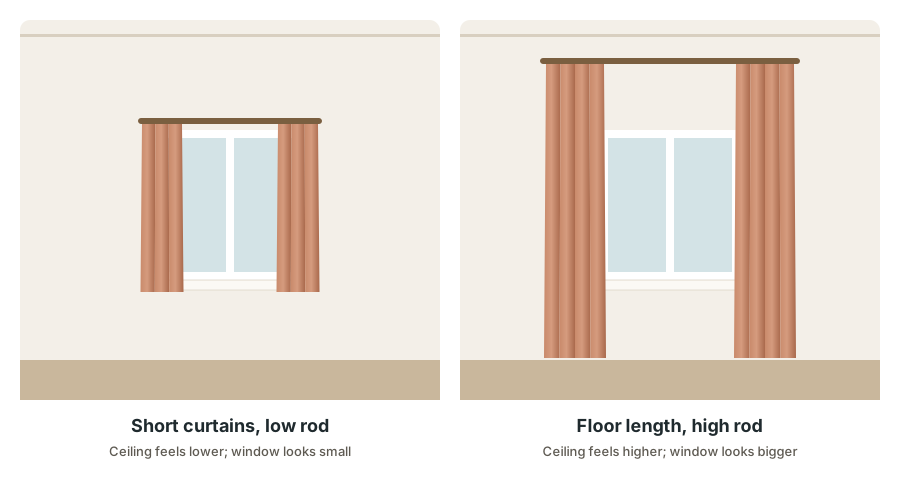
Curtains create strong vertical lines. When they run from high on the wall all the way to the floor, they lead the eye up and down the full height of the room, which makes the ceiling feel higher. Short curtains interrupt the wall halfway down, which makes the room feel lower and the window feel smaller.
This is why interior designers often combine two things: a rod mounted higher than the frame and floor-length curtains. One without the other doesn't work as well. A high rod with short curtains looks odd, and floor-length curtains on a low rod don't add height. Our guide on how high and wide to hang curtain rods explains how to set the rod height.
Choosing the right length for each room
Living room
Floor length (float, kiss or break). It looks finished and elegant and makes the room feel taller. Use a break if you like a relaxed look or if your floor is uneven.
Bedroom
Floor length or break, especially for blackout curtains, so light can't leak underneath. If a bed or dresser sits under the window, consider apron or sill length, or a blackout shade with side panels. See our blackout curtains guide for more.
Dining room
Floor length, break or puddle for a formal look. Dining room curtains are often opened less, so a puddle is more practical here than elsewhere.
Kitchen
Sill length, café curtains or a valance. Keep fabric away from the sink and stove.
Bathroom
Sill length or café curtains, ideally in a fabric that handles humidity.
Children's rooms and nurseries
Floor length (float) or sill length. Avoid puddles and long trailing fabric that small children can pull on or trip over.
Home office
Floor length if the window is clear; sill length if a desk sits beneath it.
Sliding glass doors
Floor length with a float, so the hem stays clear of the door track and doesn't drag as the door moves.
Choosing length by ceiling height and window position
Low ceilings
Mount the rod close to the ceiling and use floor-length curtains. This is the most effective way to make a low room feel taller.
Standard ceilings
Floor-length curtains on a rod mounted halfway to two-thirds of the way between the frame and the ceiling work in most rooms.
High ceilings
Floor-length curtains still work best, but you don't need to start them at the ceiling. Choose a rod height that balances the window and the wall, and buy curtains long enough to reach the floor from there.
Small windows high on the wall
Floor-length curtains hung well above and beyond a small window make it look much bigger. If that's not practical, sill length looks tidier than apron length on a high window.
Windows of different heights in one room
Hang all the rods at the same height and use floor-length curtains on every window. The different window heights become far less noticeable.
Standard curtain lengths
Ready-made curtains come in standard lengths. Sizes vary by country and brand, but these are common:
| Length | Approximately | Typical use |
|---|---|---|
| 63 in | 160 cm | Sill or apron length on many windows; floor length on very low rods |
| 84 in | 213 cm | Floor length on rods about 215 cm from the floor |
| 95–96 in | 241–244 cm | Floor length on rods mounted higher, about 240–245 cm |
| 108 in | 274 cm | High ceilings and tall windows |
| 120 in | 305 cm | Very high ceilings, double-height rooms |
In the UK, Europe and Australia, you'll often see lengths described as the "drop", such as 137 cm, 183 cm, 229 cm or 250 cm, depending on the brand. Always check how the shop measures length: from the top of the curtain, from the top of the grommet, or from the bottom of the hook or ring.
When your ideal length falls between standard sizes, you have three easy choices: adjust the rod height a few centimetres, buy the next size up and hem it, or buy made-to-measure. Our guide on how to measure windows for curtains includes worked examples.
How to measure for the right length
- Install the rod first, or mark its exact height on the wall.
- Find the hanging point. For rings and hooks, it's the bottom of the ring or hook. For grommet and rod pocket curtains, start at the top of the rod.
- Measure down to the target point: the sill, the floor, or the floor plus your chosen break or puddle.
- Measure in three places: left, centre and right. Floors and rods are rarely perfectly level.
- Use the shortest measurement for float and kiss lengths, so the curtain never drags at the lowest point. For a break or puddle, the difference matters less.
- Adjust for the heading. Grommet curtains usually sit a few centimetres above the rod; check the product details.
Things that change curtain length after you hang them
- Shrinkage: natural fabrics such as cotton and linen can shrink when washed, especially in warm water. Pre-washed fabrics shrink less.
- Dropping: heavy curtains, and loosely woven fabrics like linen, can stretch slightly under their own weight in the first weeks after hanging.
- Humidity: some natural fabrics lengthen slightly in humid weather and shorten again when it's dry. A small float or a break hides this.
- Hardware: changing from clip rings to grommets, or from a rod to a track, changes the hanging point and therefore the length.
For linen and other natural fabrics, consider hanging the curtains for a week or two before hemming, so they settle first.
Length allowances if you're sewing your own
If you're making curtains, the fabric you cut is longer than the finished curtain, because you need fabric for the heading at the top and the hem at the bottom:
- Bottom hem: a deep double-fold hem of around 8–15 cm finished depth is common on full-length curtains. Deeper hems add weight, help the curtain hang straight, and leave fabric you can let down later. So you'll need roughly twice the finished hem depth in extra fabric.
- Heading: depends on the style. A rod pocket needs enough fabric to wrap around the rod with a little ease, plus any header above it. Heading tapes and pleats usually need a few centimetres folded over at the top.
- Pattern repeat: for patterned fabrics, add one pattern repeat per width of fabric so the pattern lines up across panels and sits at the same height on every curtain.
Always check your pattern or heading tape instructions for exact allowances, and pre-wash natural fabrics before cutting if you plan to wash the finished curtains.
If you are making curtains from scratch, our step-by-step guide on how to sew simple unlined curtains shows exactly how much to add for the heading and hem.
Curtain length for special windows
Bay windows
All the curtains in a bay should end at the same length. Floor length usually looks best and helps the bay feel like one unified space. If there's a window seat in the bay, sill length or a blind is more practical.
See our guide to bay window curtain ideas for lengths that work with window seats and radiators.
French doors
Floor-length curtains hung above and beyond the doors, with a float rather than a break, so they don't catch as the doors open.
Windows next to a door or wall corner
Match the length to other curtains in the room for a consistent look, even if the window itself is smaller.
Small windows and sliding doors have a few extra rules of their own. See curtains for small windows and small rooms and curtains for large windows and sliding glass doors for the details.
What to do if your curtains are the wrong length
If your curtains are too long
- Raise the rod a few centimetres. This is often the easiest fix and makes the room look taller too.
- Turn the extra into a break or puddle if the difference is small and the look suits the room.
- Hem them. Sew a new hem, or use iron-on hemming tape for a no-sew fix.
- Fold the top over for rod pocket or tab curtains, creating a deeper header above the rod.
If your curtains are too short
- Lower the rod slightly, if there's room above the window frame.
- Use clip rings. Hanging curtains from rings adds a few centimetres of length.
- Add a band of fabric to the hem. A contrasting band can look intentional and stylish.
- Let down the hem. Many curtains have a deep hem with extra fabric folded inside.
- Switch to a shorter style, such as sill or apron length, if the window suits it.
Layered curtains: getting both layers right
When you hang sheers behind heavier curtains on a double rod, both layers should usually end at the same point, for example both floating 1 cm above the floor. Because the inner and outer rods may sit at slightly different heights, measure the drop for each layer separately.
A popular alternative is to let the sheer float while the heavier curtain has a slight break. This keeps the sheer clean and looks deliberate. Avoid having the sheer longer than the main curtain, as it peeks out underneath and looks untidy.
Hem weights and finishing touches
Many good-quality curtains have small weights sewn into the corners of the hem, or a weighted tape along the bottom. Weights help curtains hang straight, keep the hem level and stop light fabrics from blowing around. If your curtains flare out or twist at the bottom, adding small curtain weights to the corners can help.
After hanging, "train" your curtains by gently folding them into even pleats and tying them loosely for a couple of days. The folds will then fall neatly, which also makes the hem look more even.
Common curtain length mistakes
- "High-water" curtains that stop 5–10 cm above the floor. Either float about 1 cm above the floor or choose sill or apron length.
- Apron length that ends at an awkward point halfway down the wall.
- Floor-length curtains over a radiator, which block heat from reaching the room.
- Puddles in busy rooms, where they're constantly kicked and dirty.
- Measuring from the wrong point, such as the top of the rod for ring-top curtains.
- Measuring only once, then discovering the floor isn't level.
- Hemming natural fabrics immediately, before they've settled or been washed.
Frequently asked questions
How long should curtains be?
In most living rooms and bedrooms, curtains should reach the floor, ideally floating about 1 cm above it or just touching it. In kitchens and bathrooms, sill length is usually more practical.
Should curtains touch the floor?
They can, but they don't have to. A floating hem about 1 cm above the floor looks almost the same and is more practical. A slight break on the floor looks relaxed and blocks more light.
Is it OK for curtains to be above the floor?
Yes, if it's a deliberate length: about 1 cm above the floor (float), or clearly at sill or apron length. Curtains that hover several centimetres above the floor look too short.
What length curtains make a room look bigger?
Floor-length curtains on a rod mounted high and wide make both the ceiling and the window look bigger.
Are 84-inch or 96-inch curtains better?
It depends on your rod height. With the rod about 215 cm from the floor, 84-inch (213 cm) curtains reach the floor. With the rod raised to about 245 cm, you'll need 95–96-inch (241–244 cm) curtains. Measure from your rod to the floor and choose the size that matches.
Can curtains be too long?
Yes, if the extra fabric isn't intentional. A small break or a deliberate puddle looks good; fabric that bunches randomly on the floor looks messy and gets dirty.
The bottom line
Choose sill length where curtains need to stay clear of furniture, heat or water. Choose apron length for a neat, casual look below the sill. Choose floor length, floating about 1 cm above the floor, for almost every living room and bedroom. Add a break for a relaxed look or better light blocking, and save puddles for formal rooms where the curtains rarely move. Measure from the right point, measure three times, and allow for natural fabrics to settle, and your curtains will look made for your windows.
Keep reading
 Measuring
Curtain rods and tracks: a complete guide to choosing the right hardware
Rods or tracks? Which diameter, length and brackets? This guide explains every type of curtain rod and track, how to size them, and how to choose hardware that fits your curtains and windows.
 Measuring
Curtain fullness explained: how wide should curtains be?
Thin, flat curtains are the most common curtain mistake, and fullness is the fix. Here's how wide your curtains should be, with simple formulas, worked examples and fullness by heading.
 Measuring
How high and wide to hang curtain rods (with simple rules)
Where you hang the rod changes how big your windows look, how much light gets in, and how well curtains block it. Here are simple rules for every ceiling and window.