Fabrics
Curtain fabrics compared: linen, cotton, velvet, polyester, silk and sheers

Two curtains in exactly the same colour can look completely different on a window. One falls in soft, relaxed waves; the other hangs in deep, heavy folds. One glows when the sun hits it; the other blocks the light entirely. One still looks fresh after five years; the other has faded and wrinkled. The difference is the fabric.
Fabric decides how curtains look, how they move, how much light they block, how well they insulate, how easy they are to clean, and how long they last. Yet most product listings only tell you the colour and size. This guide compares every common curtain fabric in plain language, with honest pros and cons, so you can choose with confidence.
Five things to think about before choosing a fabric
- Light: do you want to soften light, filter it, or block it? Fabric weight, weave and lining all affect this.
- Drape: how the fabric hangs and folds. Heavy fabrics fall in deep, structured folds; light fabrics are soft and airy.
- Sun exposure: strong sunlight fades colours and weakens fibres over time. Some fabrics cope better than others.
- Humidity and cleaning: kitchens, bathrooms and humid climates need fabrics that resist mould and wash easily.
- Budget and upkeep: some fabrics are cheap and easy; others look wonderful but need gentle care.
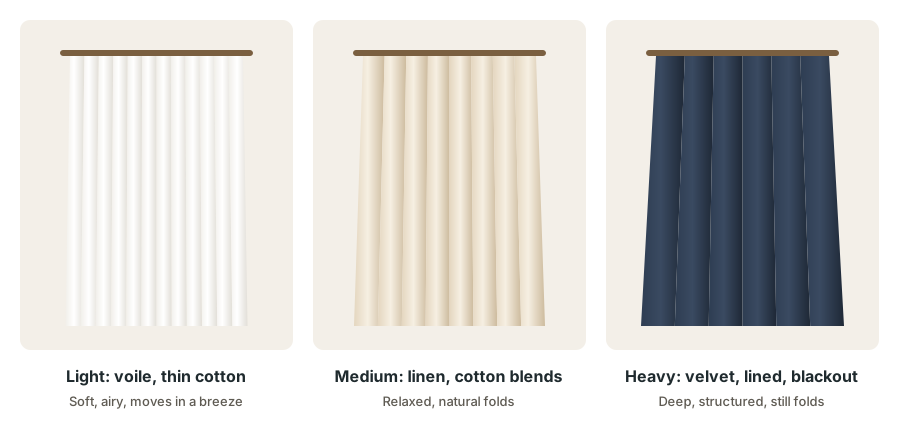
Natural fabrics vs. synthetic fabrics
Curtain fabrics fall into two broad groups:
- Natural fibres such as linen, cotton, silk and wool come from plants or animals. They tend to look and feel beautiful, breathe well and drape naturally, but they can wrinkle, shrink, fade or need more careful cleaning.
- Synthetic fibres such as polyester, acrylic and nylon are man-made. They're usually cheaper, stronger, more resistant to wrinkles, fading and shrinking, and easier to wash. Modern synthetics can imitate natural textures very convincingly.
Many curtains are blends, combining a natural fibre for looks with a synthetic fibre for durability and easy care. A linen-polyester blend, for example, gives a linen look with fewer wrinkles and less shrinkage.
Linen

Linen is made from flax plant fibres. It has a distinctive slightly uneven, textured weave and a relaxed, natural look that's very popular in modern, Scandinavian, coastal and rustic interiors. Unlined linen lets light glow softly through, creating a warm, airy feel.
Pros
- Beautiful natural texture that looks relaxed and expensive.
- Breathable and airy; lovely in warm climates.
- Filters light softly when unlined.
- Strong fibre that gets softer with washing.
Cons
- Wrinkles easily. Many people embrace the relaxed look; if you don't, choose a blend.
- Can shrink when washed unless pre-washed. Check the label.
- Fades in strong sun, especially in darker colours. A lining helps.
- Pure linen is more expensive than cotton or polyester.
Best for: living rooms, bedrooms with a separate blackout layer, and relaxed, natural styles. Look for: "pre-washed" or "stonewashed" linen to reduce shrinkage, or a linen blend for fewer wrinkles.
Cotton
Cotton is the all-rounder of curtain fabrics. It comes in every weight, from fine voile to heavy canvas and twill, in solids, prints and woven patterns. It takes dye well, so colours look crisp and clear.
Pros
- Versatile: suits almost any style and room.
- Soft, natural feel with a clean, crisp look.
- Widely available and affordable.
- Often machine washable.
Cons
- Can shrink when washed, especially in hot water.
- Fades in strong sun over time.
- Wrinkles, though less than linen.
- Unlined cotton doesn't block much light.
Best for: almost anywhere: bedrooms, living rooms, kitchens and children's rooms. Heavier cotton (canvas, duck, twill) with a lining makes excellent everyday curtains.
Velvet
Velvet has a short, dense pile that gives it a soft, rich surface. It catches light beautifully, giving colours depth and a subtle sheen. Traditional velvet was made from silk or cotton; today most curtain velvet is polyester, which is durable and more affordable.
Pros
- Luxurious, dramatic look with deep, heavy folds.
- Naturally blocks a lot of light, especially in dark colours.
- Good insulation and sound absorption because of its thickness.
- Polyester velvet resists fading and wrinkles well.
Cons
- Heavy, so it needs a sturdy rod and strong brackets.
- Attracts dust, lint and pet hair.
- Pile can crush or mark; it may need steaming rather than ironing.
- Can feel too heavy in small rooms or very hot, humid climates.
Best for: bedrooms, living rooms, home theatres and formal dining rooms. Velvet is a great choice when you want warmth, darkness and drama in one fabric.
Polyester
Polyester is the most common curtain fabric in ready-made curtains. It can be woven to look like linen, silk, velvet or cotton, and it's the base of most blackout and thermal curtains.
Pros
- Affordable and widely available in every style.
- Durable, with good resistance to fading, wrinkling and shrinking.
- Usually machine washable and quick-drying.
- Handles humidity better than most natural fibres, so it suits kitchens and bathrooms.
Cons
- Can look shiny or flat in cheaper versions.
- Less breathable than natural fibres.
- Can melt or go shiny under a hot iron; use a low to medium setting.
- Can hold static and attract dust.
Best for: budget-friendly curtains, blackout and thermal curtains, kitchens, bathrooms, rentals and homes with children or pets. A good-quality "linen-look" polyester is a smart, practical alternative to real linen.
Silk and faux silk
Silk is a natural protein fibre with a luminous sheen and a luxurious, elegant drape. Dupioni silk, with its slightly crisp texture and irregular slubs, is the most common type for curtains. Because real silk is expensive and delicate, many "silk" curtains are actually faux silk, usually polyester.
Pros
- Beautiful sheen and rich colour.
- Elegant, formal look.
- Faux silk gives a similar look for much less money and is more durable.
Cons
- Real silk is easily damaged by sunlight and can fade and weaken quickly. It should be lined, and ideally kept away from strong direct sun.
- Usually dry clean only.
- Can water-mark and is sensitive to humidity.
- Expensive.
Best for: formal living and dining rooms, and bedrooms without harsh direct sun. Choose faux silk for sunny rooms, humid climates or lower budgets.
Sheer fabrics: voile, batiste and chiffon
Sheers are lightweight, translucent fabrics. Voile, the most common, is usually made from polyester or cotton. Sheers soften light, reduce glare, and give daytime privacy while keeping a room bright.
Pros
- Make rooms feel bright, airy and soft.
- Reduce glare and protect furniture from some sun.
- Inexpensive and usually machine washable.
- Perfect for layering behind heavier curtains.
Cons
- Little privacy at night when lights are on inside.
- Don't block heat or light much.
- Need plenty of fullness to look good; skimpy sheers look flat.
Best for: layering in living rooms and bedrooms, and on their own in rooms where privacy isn't a concern. Plan for 2.5–3 times the rod width in fabric, as explained in our guide on measuring for curtains.
Other fabrics you'll see
Jacquard and damask
Jacquard is a weaving method that creates a pattern directly in the fabric, rather than printing it on top. Damask is a type of jacquard with a reversible pattern, often traditional or floral. Both have a rich, textured look and work well in formal rooms.
Brocade
Brocade is a heavy, decorative fabric with raised patterns, often including metallic threads. It's very formal and traditional.
Chenille
Chenille has a soft, fuzzy, tufted texture. It drapes heavily and feels cosy, similar to velvet but more casual.
Rayon and viscose
Rayon and viscose are made from wood pulp. They drape softly and take colour well, but they can shrink significantly and become weaker when wet. Follow care labels carefully; many need dry cleaning or gentle hand washing.
Acrylic
Acrylic is a synthetic fibre often used in outdoor fabrics because it resists fading and mildew. It's a good choice for porches and very sunny windows.
Wool
Wool is warm, insulating and naturally flame-resistant, but it's expensive, heavy and can attract moths. It's mostly used in cold climates and high-end made-to-measure curtains.
Blackout and thermal fabrics
These aren't single fibres but constructions: a fabric with a light-blocking coating, a triple weave with a dark yarn core, or a separate blackout or thermal lining. Most are polyester-based. Our blackout curtains guide explains how each type works.
Curtain fabrics at a glance
| Fabric | Look | Light (unlined) | Fade resistance | Wrinkles | Easy care | Price |
|---|---|---|---|---|---|---|
| Linen | Relaxed, textured | Filters softly | Fair | High | Medium | Medium–high |
| Cotton | Crisp, versatile | Filters | Fair | Medium | Good | Low–medium |
| Velvet (poly) | Rich, dramatic | Blocks a lot | Good | Low | Medium | Medium |
| Polyester | Any look | Varies | Good | Low | Very good | Low |
| Silk | Lustrous, formal | Filters | Poor | Medium | Poor | High |
| Faux silk | Lustrous | Filters | Good | Low | Good | Low–medium |
| Voile / sheer | Light, airy | Lets most through | Good (poly) | Low | Very good | Low |
| Jacquard | Patterned, rich | Filters–blocks | Varies | Low–medium | Medium | Medium–high |
These ratings are general guides. Fabric weight, weave, colour and finish all make a difference, and a lining improves light blocking and fade resistance for almost any fabric.
Why linings matter
A lining is a second layer sewn to the back of a curtain. It may be the single biggest upgrade you can make to any fabric:
- Protects from sun: the lining takes the sunlight, so the main fabric fades much more slowly.
- Improves the drape: lined curtains hang with fuller, more even folds.
- Blocks more light and adds privacy.
- Adds insulation, especially thermal and interlined options.
- Gives a neat, uniform look from outside, since every window shows the same lining colour.
The trade-off is weight, cost and cleaning: lined curtains are heavier, a little more expensive, and the two layers can shrink at different rates if washed incorrectly.
How colour affects your fabric choice
- Dark colours block more light and hide marks, but show fading and dust more quickly in sunny windows.
- Light colours keep rooms bright and fade less visibly, but show stains more.
- Patterns and textures hide wrinkles and small marks well.
- In very sunny windows, choose fade-resistant fabrics (polyester, acrylic, solution-dyed fabrics) or add a lining.
Caring for curtain fabrics
Always check the care label before washing. These symbols tell you exactly what each fabric can handle:
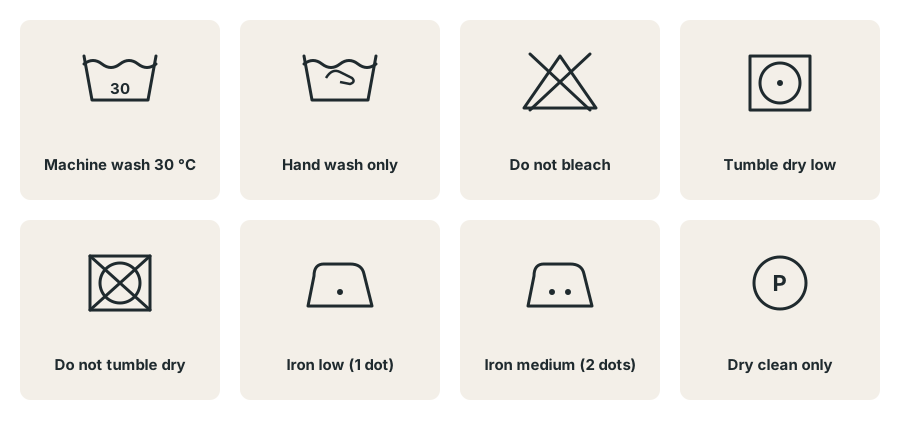
- Vacuum regularly with a soft brush attachment to remove dust. This is the easiest way to keep any curtain fresh.
- Wash cool and gentle unless the label says otherwise. Hot water is the main cause of shrinkage.
- Avoid high-heat tumble drying. Hang curtains to dry, or tumble on low and remove while slightly damp.
- Iron on the right setting: one dot (low) for delicate synthetics like acrylic and nylon, two dots (medium) for polyester, silk and wool, three dots (high) for cotton and linen. Never iron blackout coatings directly.
- Dry clean silk, many velvets, interlined curtains and anything labelled dry clean only.
- Rehang while slightly damp so creases fall out under the curtain's own weight.
How to read a curtain product description
Product listings use a lot of shorthand. These terms tell you far more than the photo does:
- Fabric composition (for example "55% linen, 45% cotton" or "100% polyester"): the actual fibres. "Linen-look" or "faux linen" usually means polyester made to look like linen.
- Fabric weight, often shown in grams per square metre (gsm or g/m²): a higher number means a heavier, more opaque fabric. As a rough guide, sheers are very light, everyday curtain fabrics are medium weight, and velvets and blackout fabrics are the heaviest. Comparing gsm between products is more useful than comparing photos.
- Lined / unlined / blackout lined / thermal lined: what's sewn to the back.
- Pre-washed or pre-shrunk: the fabric has been washed before sewing, so it should shrink less in your wash.
- Solution-dyed: the colour is added to the fibre before it's spun, which makes it highly fade-resistant. Common in outdoor fabrics.
- Certifications: labels such as OEKO-TEX Standard 100 mean the fabric has been tested for certain harmful substances. They don't tell you about quality or durability, but they're reassuring for bedrooms and nurseries.
- Flame retardant (FR): required for curtains in many public buildings, hotels and offices, and sometimes preferred at home.
- Care instructions: machine wash, hand wash or dry clean only. Check before you buy if easy cleaning matters.
Fabrics for hot and humid climates
In hot, humid places, curtains face strong sun, high humidity and sometimes salty sea air. A few simple choices make a big difference:
- Choose fade-resistant fabrics such as polyester, acrylic or solution-dyed fabrics for windows that get direct afternoon sun, or add a lining to natural fabrics.
- Prefer synthetics or blends in bathrooms, kitchens and rooms that stay damp. They resist mildew better than pure cotton, linen or silk.
- Use light-coloured or reflective backings on windows facing the sun. They bounce heat back out and keep rooms cooler.
- Keep air moving. Leave a small gap between curtains and damp walls, open curtains during the day when you can, and wash or air curtains regularly to prevent musty smells.
- Avoid unlined silk and dark unlined linen in strong sun; they fade and weaken quickly.
- Think about weight: heavy velvet can feel stuffy in a hot room. A lined linen-look polyester or a thermal curtain blocks heat without the heaviness.
Eco-friendly curtain fabric choices
If sustainability matters to you, these options are worth considering:
- Linen and hemp: flax and hemp plants generally need less water and fewer pesticides than conventional cotton, and the fibres are strong and long-lasting.
- Organic cotton: grown without synthetic pesticides and fertilisers. Look for recognised certifications such as GOTS (Global Organic Textile Standard).
- Recycled polyester: made from recycled plastic, often bottles. It keeps polyester's durability and easy care while reusing existing material.
- Durable, timeless choices: the most sustainable curtain is often the one you keep longest. A well-made, lined curtain in a neutral colour can last many years and move with you from home to home.
Whatever the fabric, washing less often, washing cool, line drying and repairing hems rather than replacing curtains all reduce their environmental impact, and help them look better for longer.
Quick picks: which fabric should you choose?
- "I want a relaxed, natural look": linen or a linen blend.
- "I want it easy to wash and long-lasting": polyester or a cotton-polyester blend.
- "I want a dark, cosy bedroom": velvet or any fabric with a blackout lining.
- "I want soft daylight and privacy": sheers layered with a heavier curtain.
- "I want an elegant, formal room": faux silk, jacquard or lined velvet.
- "My window gets strong afternoon sun": polyester, acrylic or a lined fabric in a lighter colour.
How to choose using swatches
Colours and textures look very different on a screen than in your own room. Many shops offer free or low-cost swatches, and they're worth ordering:
- Order two or three options so you can compare them side by side.
- Pin them to the window or hold them against the glass, not just against a wall.
- Look at them in morning, afternoon and evening light, and with the lights on at night.
- Hold them up to the sun to see how much light passes through, and how the colour changes when backlit.
- Scrunch and release them to see how much they wrinkle.
- Compare them with your wall colour, floor and furniture, not just with each other.
Best fabrics for each room
Living room
Linen, linen-look polyester, cotton or velvet, depending on your style. Add sheers for daytime softness.
Bedroom
Velvet, heavy cotton or polyester with blackout lining. Linen works too if paired with a blackout shade or lining.
Kitchen
Polyester, cotton-polyester blends or washable cotton. Avoid silk and delicate fabrics near cooking.
Bathroom
Polyester or other synthetics that handle humidity and resist mildew.
Dining room
Velvet, jacquard, faux silk or lined linen for a more formal look.
Children's room and nursery
Washable cotton or polyester, ideally with blackout lining for naps.
Very sunny or humid rooms
Polyester, acrylic or lined fabrics. Avoid unlined silk and dark unlined natural fibres in strong sun.
For room-specific advice, see kitchen curtain ideas, which covers washable fabrics near cooking areas, and our velvet curtains guide. If you would like to work with fabric yourself, start with how to sew simple unlined curtains.
Common fabric mistakes
- Choosing unlined silk for a sunny window. It can fade and weaken quickly.
- Washing linen or cotton in hot water. Shrinkage can leave curtains too short.
- Expecting sheers to give night-time privacy. Add an opaque layer.
- Hanging heavy velvet on a thin rod. It sags. Use a sturdy rod with a centre bracket.
- Judging fabric from a screen. Order swatches when possible and look at them in your own window light at different times of day.
Frequently asked questions
What is the best fabric for curtains?
There's no single best fabric. Polyester is the most practical all-rounder, linen is the most popular for a natural look, velvet is the best for drama and darkness, and cotton is the most versatile natural fabric.
Which curtain fabric lasts longest?
Good-quality polyester and polyester blends usually last longest because they resist fading, shrinking and wrinkling. Lining any fabric extends its life.
Are linen curtains worth it?
If you love a relaxed, natural texture and don't mind some wrinkles, yes. For a similar look with less upkeep, choose a linen blend or linen-look polyester.
Which fabric blocks the most light?
Fabrics with a blackout coating, triple weave or blackout lining. Among ordinary fabrics, thick, dark velvet blocks the most.
Which fabric is best for humid climates?
Synthetics such as polyester and acrylic handle humidity best and resist mildew. Keep curtains clean and let air circulate around them.
Can I wash velvet curtains?
Some polyester velvets are machine washable on a gentle, cool cycle; others need dry cleaning. Always follow the care label.
The bottom line
Choose fabric based on the job the curtain needs to do. For softness and texture, choose linen or cotton. For darkness and drama, choose velvet or a blackout-lined fabric. For easy care and durability, choose polyester or a blend. For elegance, choose silk or faux silk, and line it. Add a lining wherever sun is strong, check the care label before buying, and order swatches when you can. The right fabric will make your curtains look better and last much longer.
Keep reading
 Fabrics
Industrial blackout curtains: a complete guide to heavy-duty light blocking
Warehouses, studios, workshops, halls and loft homes all need serious darkness at times. Here's how to choose, size, hang and seal industrial blackout curtains that really block light.
 Fabrics
Velvet curtains: a complete guide to choosing, hanging and caring for them
Velvet curtains look luxurious, block light, keep rooms warm and quieten noise. Here's everything you need to know about velvet types, colours, hardware, hanging and care.
 Fabrics
Thermal curtains: do they really keep rooms warm or cool?
Thermal curtains promise cooler summers, warmer nights and lower energy bills. Here's how they actually work, what they can and can't do, and how to choose and hang them for the best results.