Fabrics
Industrial blackout curtains: a complete guide to heavy-duty light blocking

Industrial blackout curtains are heavy-duty, light-blocking curtains built for big, hard-working spaces: warehouses, factories, photography and film studios, laboratories, sports halls, event venues, workshops, garages and grow rooms. They do the same basic job as the blackout curtains in a bedroom, which is stopping light, but they are made from tougher materials, hung on stronger hardware and sized for openings that can be many metres wide and high.
The same name is also used for something quite different: blackout curtains in an industrial style for loft apartments and modern homes, with dark colours, raw textures and black metal hardware. This guide covers both. You'll learn what makes a blackout curtain "industrial", which materials to choose, how fire safety rules apply, which tracks and cables to use, how to size and seal the curtains so no light leaks through, and how to bring the look into a home.
If you're new to blackout fabrics in general, our blackout curtains guide explains the basics, including the difference between blackout and room-darkening.
What makes a blackout curtain "industrial"?
There's no single official definition, but industrial blackout curtains usually share these features:
- Heavy, opaque material: vinyl-coated polyester, tightly woven multi-layer polyester or laminated fabrics that block close to 100% of light.
- Large sizes: panels are often 3–10 m high and joined to cover whole walls, windows or openings.
- Commercial hardware: ceiling tracks with roller trolleys, tensioned steel cables or heavy pipes, rather than domestic curtain poles.
- Reinforced construction: welded or double-stitched seams, reinforced headers, metal grommets and weighted hems.
- Fire performance: fabrics tested to recognised flame-resistance standards, which is often a legal requirement in workplaces and public buildings.
- Durability and easy cleaning: surfaces that resist tears, abrasion, dust and grease and can be wiped down.
- Extra functions: many also insulate, cut noise, or divide a large space into zones.
Where industrial blackout curtains are used
Photography, film and video studios
Studios need total control of light. Blackout curtains on ceiling tracks let a crew shut out daylight from windows or skylights, create a dark set within a larger room, or separate one shoot area from another. Black is the usual colour because it absorbs stray light instead of bouncing it back onto the subject.
Warehouses and storage
Some products fade, spoil or react when exposed to light, including certain foods, plants, chemicals, printed materials and textiles. Blackout curtains can wall off part of a warehouse or cover high windows without the cost of building solid walls, and they can be drawn back when the space needs to be open.
Laboratories, darkrooms and testing areas
Optical testing, imaging and some lab work need very dark conditions. Curtains can create a dark area quickly, and because they slide, they can be opened for ventilation or access.
Sports halls, gyms and event venues
Large halls use blackout curtains to darken the room for projection, stage lighting, presentations or exams, and to divide the hall so that two activities can happen at once. In these spaces the curtains often double as dividers, with mesh at the top for airflow and solid fabric below.
Schools, auditoriums and conference rooms
Projectors and screens are much easier to see in a dark room. Motorised blackout curtains in auditoriums can be closed with a switch before a talk or performance.
Grow rooms and greenhouses
Some plants flower only when they get a set number of hours of darkness each day. Growers use blackout curtains (sometimes called light-deprivation or "light dep" curtains) to give plants long nights on a strict schedule. These are often white or reflective on one side to bounce heat and light away.
Workshops and garages
A garage workshop may need privacy, darkness for projector work or photography, or a way to keep heat in. Heavy-duty blackout curtains on a track across a roller door or window do all three.
Night-shift workers and hotels
Industrial-grade blackout is not only for buildings full of machinery. Hotels and people who work night shifts often choose the heaviest blackout fabrics available, because even a thin line of daylight can disturb sleep. Our guide to the best curtains for bedrooms covers sleep-friendly choices for homes.
Blackout curtains vs. welding curtains and strip curtains
A few types of industrial curtain are easy to confuse:
- Blackout curtains are opaque and block visible light completely.
- Welding curtains and screens are usually tinted, see-through PVC designed to filter harmful light and contain sparks around a welding area. They are a safety product with their own standards and are not meant to make a space dark.
- Strip curtains are overlapping strips, usually clear PVC, hung in doorways so forklifts and people can pass while heat, dust or cold is kept in. Opaque versions exist, but most strip curtains are not blackout.
If you need to protect people from welding glare, buy a product made for that job rather than a blackout curtain.
Materials
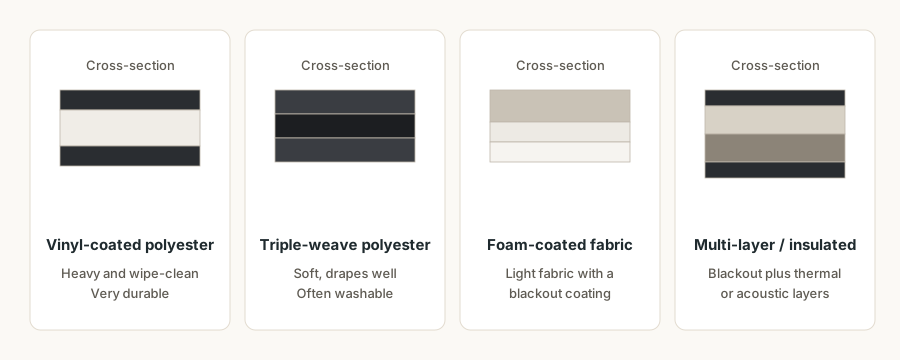
Vinyl-coated polyester (PVC-coated)
The workhorse of industrial curtains. A strong polyester base fabric is coated on both sides with vinyl, often with a dark layer inside to stop light shining through. It is tough, waterproof, tear-resistant, easy to wipe clean and available in fire-rated grades. It's heavy and stiff, and it doesn't drape softly, which doesn't matter in a warehouse but does in a home. Weight is often given in ounces per square yard or grams per square metre; heavier grades are more durable and block sound better.
Triple-weave polyester
Three layers woven together, with a black yarn in the middle. It feels like ordinary curtain fabric, drapes in soft folds and is often machine washable. It's popular for studios, hotels, theatres and homes. Some triple-weave fabrics are rated "blackout" but let a faint glow through in bright sun, so check the specification and test a sample.
Foam-coated or acrylic-coated fabric
A normal face fabric with one or more layers of opaque coating on the back. It's lighter and cheaper, and comes in many colours. The coating can crack or peel over time with heavy use, washing or folding, so it suits lighter-duty jobs.
Multi-layer, insulated and acoustic curtains
These combine a blackout layer with insulation (such as quilted wadding) or a dense sound-absorbing layer. They are useful when a curtain needs to divide a building into temperature zones, or keep noise down in a hall or studio. They are heavy, so the hardware must be chosen carefully. For more on insulation, see our thermal curtains guide.
Material comparison
| Material | Light block | Durability | Drape | Cleaning | Best for |
|---|---|---|---|---|---|
| Vinyl-coated polyester | Total | Excellent | Stiff | Wipe clean | Warehouses, garages, grow rooms |
| Triple-weave polyester | Very high | Good | Soft | Often washable | Studios, hotels, homes |
| Foam/acrylic-coated | High to total | Fair | Medium | Gentle only | Lighter commercial and home use |
| Multi-layer insulated | Total | Very good | Heavy | Spot clean | Dividers, cold rooms, halls |
Our curtain fabrics compared guide explains the everyday fabrics used for home curtains.
Fire safety and standards
In workplaces, schools, venues and other public buildings, curtains and drapes usually have to meet fire safety rules. The exact rules depend on your country, the type of building and your local fire authority, so always check before you buy. Common test standards include:
- NFPA 701 in the United States, a test of how flame spreads on curtains and other hanging textiles.
- BS 5867 in the United Kingdom, used for curtains and drapes.
- EN 13773 and national classifications in Europe.
- California Title 19 for many public spaces in California.
Some good habits apply everywhere:
- Ask the supplier for the test certificate for the exact fabric you are buying.
- Know whether the fabric is inherently flame-retardant (it stays that way for life) or treated (the treatment can wash out and may need to be renewed).
- Never let curtains block fire exits, exit signs, alarms, extinguishers or sprinkler heads, and keep the required clearance below sprinklers.
- Keep curtains away from heaters, hot lights and machinery.
- If in doubt, talk to your fire safety officer or local fire department before installing.
Tracks, cables and other hardware
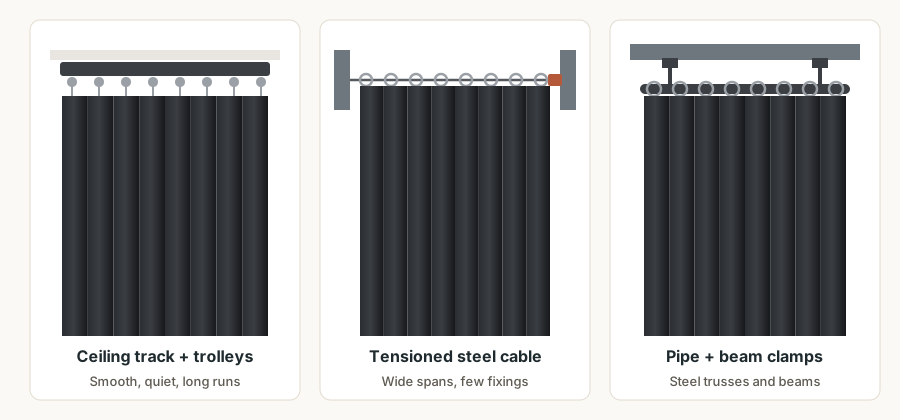
Ceiling tracks with roller trolleys
The most common and most professional option. A heavy aluminium or steel track is fixed to the ceiling or to brackets, and the curtain hangs from roller trolleys or ball-bearing carriers that run inside it. Tracks can be very long, can curve around corners, and can carry heavy curtains smoothly and quietly. They can also be motorised. Ceiling mounting also helps seal the top edge against light.
Tensioned steel cable
A steel cable is stretched between two strong anchor points and tightened with a turnbuckle or tensioner. The curtain hangs from rings or snap hooks. Cable systems are quick and cheap for wide spans with few places to fix brackets, such as across a warehouse bay. Their weakness is sag: the wider the span and the heavier the curtain, the more tension the cable needs, and the anchors must be strong enough to take that load.
Pipe with beam clamps
In buildings with steel beams or trusses, a heavy pipe can be hung from clamps on the beams, with the curtain on large rings or grommets. It's sturdy and simple, and it suits the industrial look too. Our curtain rods and tracks guide explains rods and tracks in more detail.
Hardware tips
- Check the load rating of the track, cable, brackets and fixings, and allow a good safety margin above the curtain's weight.
- Fix into structure: concrete, steel, or timber joists and studs, never just plasterboard or suspended ceiling tiles.
- Use enough carriers, roughly one every 15–30 cm, so the curtain hangs evenly and the weight is shared.
- Choose metal grommets or reinforced headers so the top of the curtain doesn't tear.
- For very large or high installations, use a professional installer and safe access equipment.
Sizing industrial blackout curtains
Width
For total darkness, a curtain must cover the opening and extend well past it. As a guide:
- Add at least 15–30 cm on each side of a window or opening, more if the light is very bright.
- Where two panels meet, let them overlap by 15–30 cm, or fix the join with hook-and-loop tape or magnets.
- For room dividers, run the curtain wall to wall, and seal the ends to the walls.
Fullness
Home curtains are usually made with 2 to 2.5 times the width of the window in fabric, so they fall in deep folds; see curtain fullness explained. Industrial curtains are often flatter: vinyl curtains are commonly made with little or no extra fullness, while fabric studio curtains might use 1.25–1.5 times. Flatter curtains use less material, weigh less and stack smaller, but deeper folds absorb more sound and look softer.
Height
Measure from the underside of the track (or cable) to the floor. For blackout, the curtain should touch the floor or drag slightly on it, or reach a sealed sill. In tall spaces, measure at several points, because floors and ceilings are rarely perfectly level.
Weight
Industrial curtains get heavy quickly. To estimate, multiply the curtain's area by the fabric weight. For example, a curtain 4 m wide and 6 m high is 24 m². In a vinyl fabric weighing 600 g per square metre, that's about 14.4 kg before adding hems, grommets and chains. Use this figure when choosing the track and fixings.
Our guide on how to measure windows for curtains explains the basics, and curtains for large windows and sliding doors covers large openings in homes.
Stopping light leaks
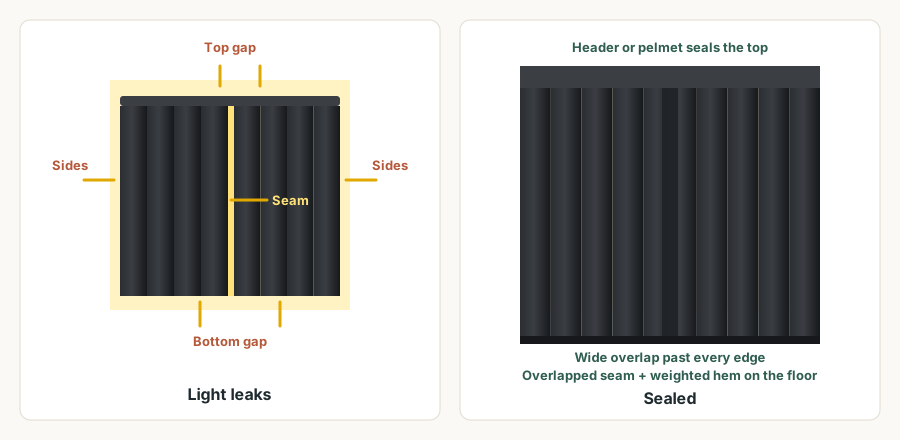
A blackout fabric can block 100% of light, yet a room can still be far from dark. That's because light sneaks in around the edges. To reach true darkness, deal with each of these weak points:
The top
- Mount the track on the ceiling, or as close to it as possible.
- If there's a gap above the track, add a pelmet, valance or header board that meets the ceiling.
- Choose a header style that sits close to the track, without big gaps between the carriers.
The sides
- Make the curtain wider than the opening so it overlaps the wall.
- Add "returns" that wrap the curtain back to the wall at the ends, or fix the outer edge with hook-and-loop tape, magnets or side channels.
The middle seam
- Overlap the meeting panels, or use an overlap arm on the track so one panel passes in front of the other.
- Fasten the join with hook-and-loop tape or magnets for full blackout.
The bottom
- Let the curtain touch or drag slightly on the floor.
- Add a weighted hem, a chain in the hem pocket, or a floor brush seal.
The fabric itself
- Check for pinholes, especially at seams, grommets and folds. Welded seams in vinyl are more light-tight than stitched ones.
- Test it: in daylight, close the curtains, turn off the room lights, let your eyes adjust for a few minutes, and look for any glow. Fix the leaks you find, one at a time.
Choosing a colour
- Black: the standard for studios, theatres and labs because it absorbs stray light. It's also the most forgiving for dust and marks.
- Grey and charcoal: neutral and less heavy-looking, common in venues and offices.
- White or reflective outer face: reflects sunlight and heat on the window side, keeping spaces cooler, especially useful in greenhouses and sunny warehouses.
- Two-tone: a light colour facing the window and black facing the room, combining heat reflection with a dark interior.
- Brand or décor colours: for public spaces and venues, many fabrics come in a range of colours.
Manual or motorised?
Small and medium curtains can be pulled by hand, with a pull handle or a wand. Very long, tall or heavy curtains are much easier to operate with a cord-draw system or a motor. Motors can be wired to wall switches, timers, remotes or building controls, so a hall can be darkened at the press of a button or a grow room's curtains can close on schedule. Motorised systems cost more and need proper electrical installation, but they reduce wear on the fabric because nobody drags it by the edge.
How to install industrial blackout curtains
- Plan the layout: decide the track route, where the curtain stacks when open, where panels meet, and where exits, signs and sprinklers are.
- Check the structure: confirm what the track or cable will be fixed to and whether it can carry the load.
- Mark and fix the track: use a laser level or chalk line so it runs straight, and fix brackets at the spacing the maker recommends.
- Fit end stops and carriers: slide in enough trolleys, then fit the end stops so they can't run off.
- Hang the curtain: attach it to the carriers from one end to the other. For tall curtains, use two people and safe access equipment.
- Seal the edges: fit pelmets, returns, side fixings and hem weights.
- Test: open and close the curtain several times, then do a light test and fix any leaks.
For smaller jobs at home, our guide on how to hang curtains explains fixings and levelling step by step.
Industrial-style blackout curtains for the home
Industrial interiors take their look from old factories and warehouses: exposed brick, concrete, steel windows, metal beams, wooden floors and simple furniture. Blackout curtains fit this style naturally, and they're practical too, because loft apartments often have huge windows that let in too much light and heat for sleeping.
Fabrics
- Linen-look blackout: a textured face fabric with a blackout lining gives a relaxed, natural look. See our linen curtains guide.
- Heavy cotton canvas or denim-look fabrics: workwear textures that suit industrial spaces.
- Velvet: deep charcoal or rust velvet adds softness against hard surfaces; see our velvet curtains guide.
- Triple-weave blackout: soft, practical and easy to find in neutral colours.
Colours
Charcoal, graphite, slate grey, black, olive, rust, tan and deep navy all work well with brick and metal. A warm colour like rust or tan softens the space, while charcoal and black look sleek and dramatic. For help choosing, see how to choose curtain colours.
Hardware
- Black iron pipe rods made from plumbing-style pipe and flanges are an industrial classic.
- Large metal grommets in black, gunmetal or antique brass suit the look and slide easily.
- Ceiling-mounted tracks make tall loft windows look even taller and seal the top edge for better blackout.
Hanging tips for lofts
- Hang the curtains as high as possible, ideally from the ceiling, and let them reach the floor.
- Extend the rod or track well beyond the window so the curtains stack on the wall, not over the glass.
- In open-plan lofts, a ceiling-track blackout curtain can also screen off a sleeping area at night.
- Pair blackout curtains with sheers on a double track for daytime privacy; see our sheer curtains guide.
Our guide on how high to hang curtain rods explains why hanging high works so well in tall rooms.
Cleaning and maintenance
- Vinyl curtains: wipe with warm water and mild detergent, rinse and let dry before folding. Avoid solvents that can damage the coating.
- Fabric curtains: vacuum regularly with a brush attachment. Wash only if the label allows it, and check whether washing affects the fire treatment.
- Coated fabrics: spot clean gently and avoid hot washes, tumble drying and hard folding, which can crack the coating.
- Hardware: check tracks, trolleys, cables and fixings regularly, keep tracks clean, and retension cables if they sag.
- Inspection: look for tears, worn grommets and new pinholes, and repair them before they grow.
For home curtains, see our guide on how to wash curtains.
Common mistakes
- Buying blackout fabric but ignoring the edges, so light leaks around the top, sides and bottom.
- Underestimating weight and fixing a heavy curtain to a light-duty track or into plasterboard.
- Forgetting fire rules in a workplace or public building.
- Blocking exits, signs or sprinklers with the curtain or its stack.
- Letting cables sag because the span was too long or the anchors too weak.
- Choosing the wrong colour, for example white facing into a studio, which reflects stray light.
- Using welding screens or strip curtains when you actually need blackout, or the other way round.
- Skipping the light test after installation.
Frequently asked questions
What are industrial blackout curtains made of?
Most are made from vinyl-coated polyester, triple-weave polyester, coated fabrics or multi-layer insulated materials. Vinyl is the toughest; triple-weave is the softest.
Do industrial blackout curtains block 100% of light?
The best fabrics block all light passing through them, but the room will only be completely dark if the top, sides, seams and bottom are sealed too.
Are industrial blackout curtains fire-rated?
Many are, but not all. In commercial and public buildings, choose a fabric certified to the standard your local rules require, and ask for the certificate.
Can I use industrial blackout curtains at home?
Yes. Heavy-duty blackout works well in bedrooms, home cinemas, garages and loft apartments. Choose a softer triple-weave or lined fabric for living spaces, and make sure your walls and ceilings can carry the weight.
Do they help with heat and noise?
Thick blackout curtains reduce heat gain from sunny windows and help keep warmth in during winter. Heavy or acoustic versions also reduce echo and noise, though no curtain is fully soundproof.
How do I hang blackout curtains in a warehouse with no ceiling to fix to?
Use a tensioned cable between strong wall or column anchors, or hang a pipe or track from the steel beams with beam clamps. Ask a professional to check the loads for big installations.
The bottom line
Industrial blackout curtains bring fast, flexible darkness to big spaces. Choose vinyl-coated polyester for toughness, triple-weave for softness, and insulated or acoustic layers when you also need warmth or quiet. Check fire ratings for any workplace or public building, hang the curtains on hardware rated for their weight, size them generously, and seal every edge, because most light gets in around a curtain rather than through it. At home, the same ideas, in charcoal linen, canvas or velvet on black metal hardware, give a loft-style room a bold industrial look and a properly dark night.
Keep reading
 Fabrics
Velvet curtains: a complete guide to choosing, hanging and caring for them
Velvet curtains look luxurious, block light, keep rooms warm and quieten noise. Here's everything you need to know about velvet types, colours, hardware, hanging and care.
 Fabrics
Thermal curtains: do they really keep rooms warm or cool?
Thermal curtains promise cooler summers, warmer nights and lower energy bills. Here's how they actually work, what they can and can't do, and how to choose and hang them for the best results.
 Fabrics
Sheer curtains: how to choose, hang and layer them
Sheer curtains soften light, add privacy by day and make rooms feel airy. Here's how to choose the right sheers, how much fabric you need, how to layer them and how to care for them.